
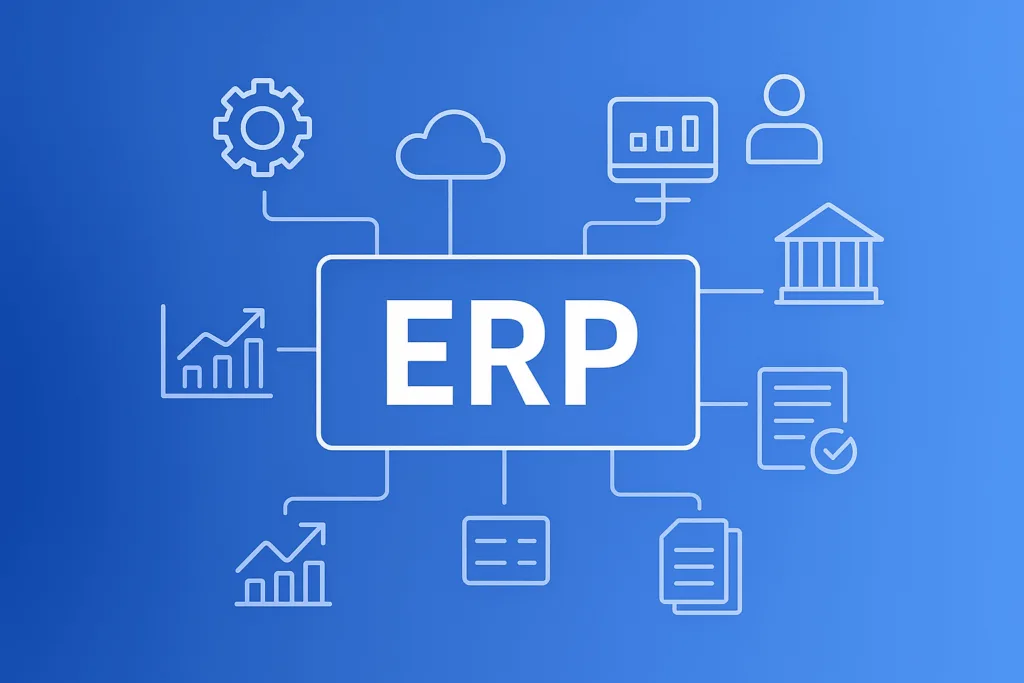
Enterprise Resource Planning (ERP) is central to modern business operations. The right ERP system or ERP platform ties together finance, human resourcing, project management, supply chain, CRM and reporting to deliver real-time visibility, better financial reports, and data-driven decisions. Choosing among ERP software vendors is as important as selecting the software itself as the vendors determine support, localisation, pricing models and the partner ecosystem that will implement your ERP solutions.
What is ERP?
ERP (Enterprise Resource Planning) software is an integrated suite that consolidates core business processes such as finance, procurement, inventory, manufacturing, HR, project management and customer relationship management (CRM) into a single system and common database. A modern ERP reduces silos, improves data integrity, supports regulatory compliance, and enables organisations (from small businesses to large enterprises) to achieve streamlined operations and real-time insights.
Best ERP Software Vendors
Below is a concise vendor list:
-
Juntrax
-
Oracle NetSuite
-
SAP S/4HANA
-
Microsoft Dynamics 365
-
Oracle Fusion Cloud ERP
-
Infor (CloudSuite Industrial / SyteLine)
-
Acumatica
-
Epicor Kinetic
-
IFS Cloud
-
Odoo
-
Sage (Intacct / X3)
-
ERPNext
Note: Each vendor offers different ERP solutions, deployment models (including cloud-based ERP system options), licensing and partner ecosystems.
How to Choose an ERP Vendor
Follow this concise, practical checklist when evaluating ERP software vendors and enterprise resource planning softwares:
-
Define core business objectives and required modules: finance, HR, CRM, manufacturing, project management, etc.
-
Prioritise what you need now vs later to avoid overbuying modules.
-
Confirm deployment options: cloud, on-premise or hybrid (cloud based ERP solution vs on-premise).
-
Check vendor stability and roadmaps: product updates, security practices and innovation.
-
Verify localisation and compliance: tax, languages and regulatory support for your operating countries.
-
Evaluate partner ecosystem: experienced implementation partners and support presence in your region (important for India/Bengaluru).
-
Assess integration capabilities: APIs and prebuilt connectors to your CRM, BI and payroll systems.
-
Calculate full Total Cost of Ownership (TCO): licences, implementation, customisation, training and ongoing support.
-
Run focused demos or proofs of concept using your real processes and data.
-
Plan for change management: dedicated project manager, governance, training, and phased rollout.
-
Measure success post-go-live: faster month-end close, improved cycle times, employee productivity and customer satisfaction.
These steps help you pick the best ERP system and the appropriate ERP software vendor for your organisation.
Conclusion
Selecting an ERP vendor is a strategic decision that affects operations, finance, HR, customer service and compliance. Use the vendor shortlist above to research functionality, industry fit, deployment model and partner presence. A disciplined evaluation—focused demos, TCO analysis, and strong change management—will help you select the best ERP software and vendor to deliver streamlined operations, real-time visibility, and data-driven decisions.
FAQs
Q1 What’s the difference between an ERP vendor and ERP software?
An ERP vendor is the company that develops, sells and supports the ERP software. The software is the product; the vendor supplies licensing, updates, partnerships and implementation services.
Q2 Should I choose a cloud-based ERP system or on-premise?
Cloud ERP generally offers faster deployment, lower upfront IT cost and easier scaling. On-premise may be chosen for specialised customisation or strict data sovereignty. Match the model to your compliance and operational needs.
Q3 How long does ERP selection and implementation take?
Selection (shortlisting, demos, procurement) commonly takes 2–4 months. Implementation timelines vary: small cloud deployments 3–6 months, mid-market 6–12 months, large/complex 12–24 months or more.
Q4 How do I avoid vendor lock-in?
Prioritise vendors that support standard APIs, exportable data, clear contracts and modular deployments. Negotiate exit clauses and data-portability terms up front.
Q5 What KPIs should I track after ERP go-live?
Track month-end close time, days sales outstanding (DSO), inventory accuracy, order cycle time, on-time delivery, employee productivity, and customer satisfaction to measure ERP impact.