

If you run a marketing agency, you have probably tried at least three project management tools in the last five years. Maybe you started with Trello, moved to Asana because the team wanted more structure, added Harvest for time tracking, then stitched in QuickBooks for invoicing and Float for resource planning. Now you pay for four tools, your team copies data between them, and you still cannot answer a basic question on demand: which clients are actually profitable this quarter?
This is the agency operating problem, and it has very little to do with tasks. The hard part is keeping money, people, and time moving through the business in a connected way, so that what gets delivered actually matches what was sold.
We reviewed 35 platforms across project management, agency operating systems, and professional services automation, then narrowed the list to 15 tools that hold up for marketing agencies in 2026. Each entry covers what it actually does, what it costs, where it falls short, and the kind of agency that gets the most value from it.
Juntrax is the first tool on this list because it was built for the operating problem above, not the task problem. If you want to skip ahead, the comparison table is in section 6. If you want to understand what to look for before you compare anything, start with section 3.
Table of Contents
- Why marketing agencies need different software than product teams
- Task tracker vs. agency operating system: the choice that shapes everything
- What to look for in agency project management software
- The 15 best project management tools for marketing agencies in 2026
- Side-by-side comparison table
- What does a typical agency stack actually cost?
- How to pick the right tool for your agency stage
- Implementation realities no vendor will mention
- AI features that actually matter for agency operations
- Common mistakes when choosing agency software
- Why Juntrax fits SME and mid-market service agencies
- Frequently asked questions
Why Marketing Agencies Need Different Software Than Internal Product Teams
Most popular project management tools were built for internal teams shipping software, launching products, or organizing operations work. The unit of value is the task. Time spent on a task does not directly affect revenue, and the team rarely thinks in terms of clients.
Marketing agencies operate on a fundamentally different model. Every project is tied to a client. Every hour has a cost and (hopefully) a billing rate attached. Every scope change moves a margin number up or down. The agency is not just executing tasks. It is selling time, expertise, and creative output, then defending the margin between the price quoted and the cost of delivery.
When an agency picks a tool that was built for internal teams, the surface fit looks fine. Boards work. Timelines work. People can comment. After three to six months, the cracks show up:
- Account managers cannot tell you how many billable hours a client used last week without exporting CSVs.
- Project managers cannot see who is overbooked across all clients without a separate resource tool.
- Finance cannot reconcile timesheets to invoices without manual cleanup at month-end.
- Leadership has no view of project profitability until the books close, by which time it is too late to act.
A marketing agency tool needs to solve five things that internal-team tools usually ignore:
- Billable vs non-billable time captured at the task level
- Per-person utilization across multiple clients in real time
- Project-to-invoice flow so billing runs from the same data as delivery
- Resource planning across the client portfolio, not just within a project
- Profitability by project, client, and service line
If a tool cannot do at least three of these five well, it is a task tracker, not an agency operating system.
Task Tracker Vs. Agency Operating System: The Choice That Shapes Everything
The market splits roughly into two categories. Most listicles mix them together and leave the reader to figure out the difference. We are going to separate them up front.
Task Trackers and Work Management Platforms
These tools focus on what is being done, by whom, by when. They are usually visually polished, easy to onboard, and priced affordably. They handle tasks, boards, lists, calendars, files, and basic time tracking. They generally do not handle billing rates, project margins, utilization reporting, or resource forecasting at the portfolio level.
Examples: Trello, Asana, Basecamp, monday.com (Work Management), ClickUp.
These work well for in-house marketing teams, small agencies under 10 people, and agencies that already run financials in a separate tool and accept the data fragmentation cost.
Agency Operating Systems and PSA Platforms
These tools focus on running the agency, not just the projects. Project management is one module among several: time and billing, resource planning, invoicing, retainer tracking, sales pipeline, sometimes HR, and reporting on margins and utilization. They take longer to set up. They cost more per seat. They consolidate three or four tools into one and pay back the difference in clean data and reporting.
Examples: Juntrax, Productive.io, Scoro, Teamwork.com, Workamajig, Ravetree, Kantata, Adobe Workfront.
These work well for agencies of 10 or more people who bill clients by the hour, by retainer, or by milestone, and need to defend margins.
Which category you need depends on the answer to one question: when a client asks “are we under budget on this project,” can you answer in 10 seconds, or do you need to open three tabs and a spreadsheet? If the latter, you have outgrown your task tracker.
What To Look For In Agency Project Management Software
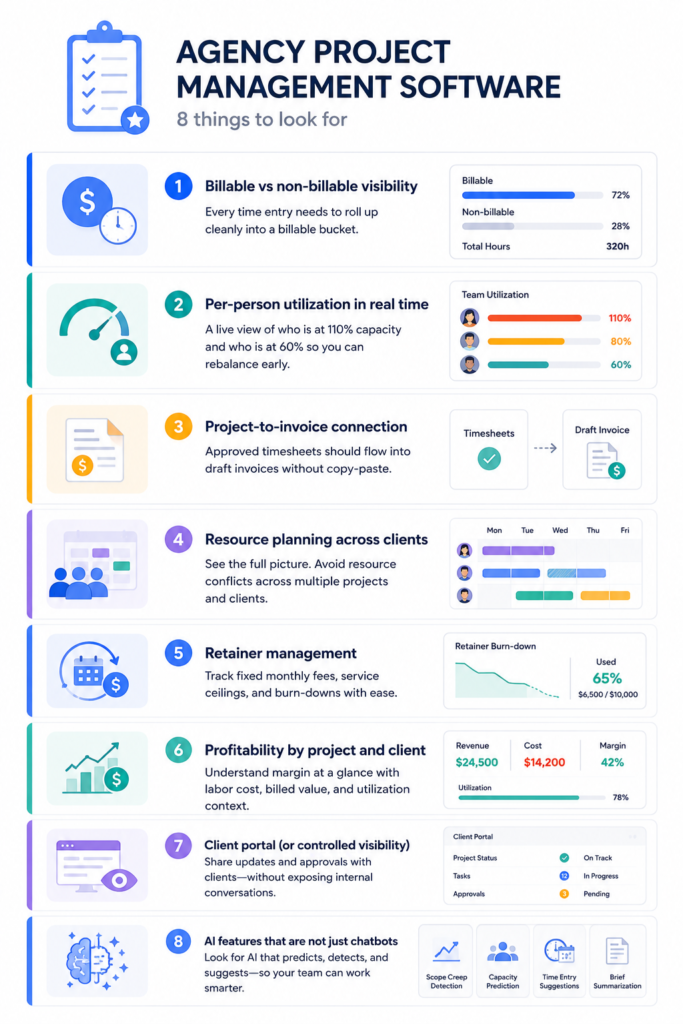
Beyond surface features, agency operators should evaluate tools against eight criteria. We use these in the reviews below.
1. Billable vs non-billable visibility
Every time entry needs to roll up cleanly into a billable bucket. If your team has to remember to flag every hour, adoption will drift.
2. Per-person utilization in real time
Not month-end reports. A live view of who is at 110% capacity and who is at 60% so you can rebalance before clients feel the consequence.
3. Project-to-invoice connection
Approved timesheets should flow into draft invoices without copy-paste. Hours billed should match hours delivered, automatically.
4. Resource planning across clients
Most projects look fine in isolation. They fall apart when three of them collide on one designer’s calendar in the same week. The tool needs a portfolio view.
5. Retainer management
A surprising number of PM tools cannot handle a basic retainer model: a fixed monthly fee with a service ceiling and burn-down. Marketing agencies live on retainers.
6. Profitability by project and client
Direct cost (labor) versus revenue (billed value) at a glance, ideally with utilization and write-off context.
7. Client portal (or controlled visibility)
Clients want updates. Most agencies do not want to give clients a direct line into internal chaos. A clean portal that shows status and approvals without exposing internal threads is a differentiator.
8. AI features that are not just chatbots
Useful AI in 2026 means scope-creep detection, capacity prediction, time-entry suggestions from calendar data, and brief summarization. Avoid tools where AI is only present as a status-update generator.
A tool does not need to win on all eight to be worth considering. It needs to win on the three or four that matter most to how your agency is run.
The 15 Best Project Management Tools For Marketing Agencies In 2026
1. Juntrax: Best For Service-Business Operations At Growing SME Agencies
Juntrax is an integrated business operations platform that brings HRMS, professional services automation (PSA), and financials into one system. It was built for small and mid-sized service businesses, including marketing agencies, design studios, and digital consultancies, that have outgrown task-only tools and want to run people, projects, and money from the same source of truth.
What makes it relevant for marketing agencies is the operational layer. Time entered against a client project flows into utilization views, project profitability, and invoices without manual reconciliation. Resource managers can see who is overbooked across the portfolio. Account managers can see the burn-down on a retainer in the same screen they use to review tasks.
Best for: Marketing, digital, and creative agencies between 10 and 250 employees that bill clients for time, retainers, or fixed-fee projects and need to track utilization and margin alongside delivery.
Key features for agencies:
- Project management with task assignment, milestones, and timesheets that feed billing automatically
- Per-person utilization view across all client projects
- Configurable billable rates by role, project, or client
- Retainer tracking with monthly burn-down
- Integrated HRMS so leave, headcount, and capacity all align with project plans
- Invoicing module with multi-currency support for global agencies
- Expense management tied to projects and clients
- Mobile app (JuntraxGO) for on-the-go timesheet entry
Pricing: Starts at $5 to $6 per user per month, with module-based plans and a free trial. This is among the lowest entry points in the agency-PSA category. Custom plans available for larger teams.
Who this is not for: Solo freelancers, very small teams (under five people) who only need a task tracker, or large enterprise marketing departments needing portfolio management at the 1,000-user scale.
Implementation reality: Most agencies are operational within two to six weeks. The system is no-code to configure, but agencies should plan for two weeks of active change management around timesheet adoption.
2. Productive.io: Best For Agencies Wanting Deep Financial Visibility
Productive is purpose-built for agencies and consultancies. Its core strength is how tightly the financial layer is woven into the project layer: billable hours, overheads, margins, and forecasted revenue all sit alongside tasks and resources. Agencies running on hourly billing or blended rate cards tend to like the depth here.
Best for: Agencies of 15 to 200 people that want unified project and financial management without enterprise complexity.
Pricing: Essential at $9 per user per month (annual), Professional at $24, Ultimate at $39, Enterprise custom. Three-seat minimum.
Strengths: Strong reporting on profitability, real-time margin tracking, sales pipeline that converts deals into projects.
Weaknesses: No built-in content scheduling or social publishing. Some users report the learning curve takes two to three weeks for full adoption.
Who this is not for: Teams that need a simple visual board or in-house marketing departments without billing complexity.
3. Scoro: Best For End-To-End Agency Operations At Mid-Market
Scoro is a full PSA platform covering quoting, project management, time tracking, billing, and financial reporting. The end-to-end coverage is genuinely useful for agencies that want one system from sales pipeline through invoice. The trade-off is the price floor and the five-seat minimum.
Best for: Established agencies of 10 or more people that want quote-to-cash visibility in one platform.
Pricing: Essential at $26 per user per month (5-seat minimum, so ~$130/month entry), Standard at $37, Pro at $63, Ultimate custom. Resource planning sits behind the Pro tier.
Strengths: Quoting integrated with delivery and billing, strong dashboarding, mature reporting.
Weaknesses: No native proposals with e-signatures, no contracts module, learning curve on the heavier side.
Who this is not for: Very small agencies or freelancers (entry cost is too high), or teams that want a simple visual layout.
4. Teamwork.com: Best For Client-Work Project Management
Teamwork is one of the few mainstream PM platforms that explicitly positions for client work. It includes Gantt charts, milestones, retainer time tracking, and a client portal as part of the base product. Invoicing is light, so most agencies pair it with a separate billing tool.
Best for: Mid-size agencies that want client-facing PM with time tracking and a workable client portal, and are comfortable using a separate accounting tool.
Pricing: Free plan up to 5 users. Deliver at $13.99 per user per month, Grow at $25.99, Scale at $69.99, Enterprise custom. Five-user minimum on paid plans.
Strengths: Built for agencies (rare among general-purpose PM tools), free client user access, retainer time tracking, intuitive interface.
Weaknesses: No native invoicing, reporting depth is mid-tier compared to dedicated PSA platforms, mobile app gets mixed reviews.
Who this is not for: Agencies that want one platform for delivery and billing combined. You will still need QuickBooks, Xero, or similar.
5. monday.com: Best For Flexible Visual Workflows
monday.com (Work Management) is a flexible “work OS” with a strong visual interface. Marketing teams use it for campaign trackers, content calendars, client dashboards, and creative approvals. It is not a PSA platform, so margin and utilization work has to live elsewhere.
Best for: In-house marketing teams and agencies that want a customizable visual platform and have separate tools for billing.
Pricing: Free for 2 users. Basic at $9 per seat per month (annual), Standard at $12, Pro at $19, Enterprise custom. Note: monday.com uses “bucket pricing” in multiples of 5, with a 3-seat minimum, so a 7-person team pays for 10 seats.
Strengths: Highly customizable, strong automation, polished UX, large template library, growing AI assistant tooling.
Weaknesses: No native financials, bucket pricing inflates real cost for odd team sizes, advanced features push you to Pro tier.
Who this is not for: Agencies that need integrated billing, utilization, or margin reporting.
6. Asana: Best For Clean Task Management And Creative Approvals
Asana sits in the same broad category as monday.com. It is polished, intuitive, and adopted quickly by creative and marketing teams. Its strengths are task structure, project views, workload management, and proofing workflows on higher tiers. It does not handle billing or invoicing.
Best for: Internal marketing teams and small to mid-size agencies that prioritize ease of adoption and creative review workflows.
Pricing: Personal plan free for up to 10 users. Starter at $10.99 per user per month (annual), Advanced at $24.99, Enterprise custom.
Strengths: Generous free tier, clean interface, strong portfolio and goal alignment views, established AI assistant features.
Weaknesses: No native time tracking, no invoicing, no resource management on lower plans, pricing scales fast per user.
Who this is not for: Agencies that want utilization or margin reporting baked in.
7. ClickUp: Best For Maximum Features On A Tight Budget
ClickUp consolidates project management, docs, chat, goals, and time tracking into one platform with an exceptionally generous free tier. For small and growing agencies that need a lot of feature surface area on a small budget, it is hard to beat the price-to-feature ratio. The trade-off is configuration overhead and a feature density that overwhelms some teams.
Best for: Small and growing agencies that want broad functionality without per-tool sprawl, and have the appetite to configure the platform thoughtfully.
Pricing: Free Forever for unlimited users with basic features. Unlimited at $7 per user per month, Business at $12, Business Plus at $19, Enterprise custom.
Strengths: Best-in-class free plan, deep customization, native time tracking included from the Unlimited plan up, strong AI assistant on paid tiers.
Weaknesses: Steep configuration curve, occasional performance complaints, automation caps on lower tiers, no native invoicing.
Who this is not for: Teams that want a simple, opinionated tool out of the box, or agencies that need PSA-grade financials.
8. Wrike: Best For Enterprise Marketing Teams And Complex Creative Workflows
Wrike is a long-standing work management platform with a dedicated “Wrike for Marketers” edition. It is more structured than monday.com or Asana, with cross-tagging (one task in multiple projects), request forms, approval workflows, and proofing for creative review. The trade-off is a steeper learning curve and an interface that feels denser.
Best for: Mid-market and enterprise marketing teams and larger agencies with complex creative approval workflows.
Pricing: Free plan available. Team at $10 per user per month, Business at $24.80, Enterprise custom, Pinnacle custom. Wrike for Marketers is an add-on.
Strengths: Mature proofing and approval workflows, strong reporting, configurable to complex agency workflows.
Weaknesses: Time tracking only on Business tier, no native invoicing, 1-2 week learning curve for new users.
Who this is not for: Very small agencies or teams that want quick adoption.
9. Ravetree: Best For Boutique Agencies Wanting Agency-Specific PM And Billing
Ravetree positions itself directly at digital and creative agencies. It bundles project management, time tracking, resource planning, billing, and a basic CRM into one platform with a single price point. Agencies that want one tool for delivery and basic billing without going to enterprise PSA pricing tend to evaluate it.
Best for: Boutique agencies of 5 to 50 people that want an all-in-one with native billing and want to avoid configuring a separate accounting tool for project invoices.
Pricing: Starts around $29 per user per month with all features included. No tiered upsells, which is unusual.
Strengths: Agency-specific features (estimating, invoicing, retainer management, CRM) in one plan, free onboarding included.
Weaknesses: Interface feels less modern than monday or Asana, smaller community and integration ecosystem, mobile app limited.
Who this is not for: Agencies needing the polish of monday/Asana, or large agencies needing accounting depth on the level of Workamajig.
10. Trello: Best For Very Small Teams Needing Visual Kanban
Trello is the classic Kanban board, built around cards and columns that team members drag through stages. It is fast to learn, generous on the free plan, and sufficient for very small teams running simple workflows. It is not built for client billing, resource planning, or margin tracking, so most agencies outgrow it by year two.
Best for: Solo marketers, freelancers, and agencies under five people running basic campaign workflows.
Pricing: Free plan with up to 10 boards per workspace. Standard at $5 per user per month (annual), Premium at $10, Enterprise from $17.50.
Strengths: Simplest possible PM tool, large free plan, low learning curve, strong Power-Ups library.
Weaknesses: No native time tracking, no billing, weak reporting, no resource view.
11. Basecamp: Best For Teams That Want Simplicity Over Depth
Basecamp is opinionated software. It refuses to add features that most competitors include (no Gantt, no subtasks, no time tracking in the base product, no priority field). What you get is one consistent experience for every project: to-dos, message boards, schedule, docs, chat. For agencies that find modern PM tools overwhelming and want communication to scale, Basecamp is genuinely refreshing.
Best for: Small agencies and creative shops that want lightweight coordination without configuration burden.
Pricing: Free Starter (1 project, 20 users). Plus at $15 per user per month. Pro Unlimited at $299 per month flat (or $349 monthly billing) for unlimited users.
Strengths: Genuine simplicity, fast adoption, opinionated structure that prevents tool fatigue, flat-fee Pro plan favors larger teams.
Weaknesses: Time tracking is a paid add-on, no native Gantt or dependencies, weak reporting, no billing.
Who this is not for: Agencies that need depth around time, billing, or resources.
12. ProofHub: Best For Fixed-Fee Flat-Rate Billing Simplicity
ProofHub is one of the few PM tools that charges a flat monthly fee regardless of team size. For mid-size agencies with growing headcount, this can be significantly cheaper than per-user pricing. It includes built-in proofing for creative review, Gantt charts, time tracking, and basic reporting.
Best for: Agencies of 15 or more people that want predictable flat-rate pricing and have heavy creative review workflows.
Pricing: Essential at $45 per month flat (annual). Ultimate Control at $89 per month flat (annual). Unlimited users on both.
Strengths: Flat pricing, native online proofing for creative work, custom workflows, time tracking included.
Weaknesses: No native invoicing, smaller integration library than monday or Asana, fewer power-user features.
Who this is not for: Small teams (flat pricing is not cost-effective under 10 users) or agencies needing deep financials.
13. Workamajig: Best For Established Creative Agencies Wanting Integrated Accounting
Workamajig has been in the market since 1986 and is the most accounting-deep platform built specifically for creative agencies and in-house creative teams. It includes full project management, resource scheduling, time and billing, and a true general ledger accounting module. Few competitors bundle accounting at this depth.
Best for: Established creative, advertising, and PR agencies of 25 to 250 people that want to replace QuickBooks or NetSuite alongside their PM tool.
Pricing: Custom only. Typical reported spend lands in the $50 to $60 per user per month range for the base platform, more with add-ons. Five-user minimum.
Strengths: Real accounting included (not just invoicing), purpose-built for creative workflow, mature implementation process.
Weaknesses: Interface feels dated, configuration is heavier, implementation can take 8-12 weeks.
Who this is not for: Small agencies, or agencies that already have an accounting system they intend to keep.
14. Adobe Workfront: Best For Enterprise Marketing Departments
Workfront is enterprise marketing work management. It is widely adopted by Fortune 500 in-house marketing departments and global agencies that need to coordinate creative work across many teams and stakeholders. Strong on workflow automation, request intake, proofing, and portfolio reporting. Pricing and complexity make it overkill for most independent agencies.
Best for: Enterprise in-house marketing teams and global agencies with 200+ users.
Pricing: Custom only. Reported deal sizes start in the high five figures annually.
Strengths: Mature enterprise capability, deep proofing and approval, strong Adobe Creative Cloud integration.
Weaknesses: Pricing is enterprise-only, implementation typically 3-6 months, learning curve is significant.
Who this is not for: Any agency under 100 people.
15. Paymo: Best For Freelancers And Very Small Agencies
Paymo is a lightweight project, time tracking, and invoicing tool aimed at freelancers, solo consultants, and tiny agencies. It is one of the few sub-$10 tools that includes native invoicing, which makes it a popular starter for new agencies that want to bill from the same place they track time.
Best for: Freelancers and agencies under 10 people that want project management plus invoicing in one tool at a low price.
Pricing: Free plan for up to 10 users with basic features. Starter at $5.95 per user per month, Small Office at $11.95, Business at $24.95.
Strengths: Native invoicing in low tiers, time tracking built in, simple UX, mobile app works well.
Weaknesses: Light on resource management, limited reporting, fewer integrations than market leaders.
Who this is not for: Agencies over 15 people, or agencies that need portfolio-level resource and margin views.
Side-By-Side Comparison Table
| Tool | Best for | Starting price | Free plan | Time tracking | Invoicing | Resource mgmt | AI features |
|---|---|---|---|---|---|---|---|
| Juntrax | SME agencies wanting full ops platform | $5-6/user/mo | Free trial | Yes | Yes | Yes | Roadmap |
| Productive.io | Agencies needing margin visibility | $9/user/mo | 14-day trial | Yes | Yes | Yes | Yes |
| Scoro | Mid-market agency end-to-end | ~$26/user/mo | 14-day trial | Yes | Yes | Yes (Pro+) | Yes |
| Teamwork.com | Client-work PM | $13.99/user/mo | Up to 5 users | Yes | No | Yes | Yes |
| monday.com | Flexible visual workflows | $9/seat/mo | 2 users | Add-on | No | Yes (Standard+) | Yes |
| Asana | Task management + approvals | $10.99/user/mo | Up to 10 users | No | No | Advanced+ | Yes |
| ClickUp | Max features, tight budget | $7/user/mo | Unlimited users | Yes | No | Yes | Yes (paid) |
| Wrike | Enterprise marketing teams | $10/user/mo | Limited | Business+ | No | Business+ | Yes |
| Ravetree | Boutique agencies, all-in-one | $29/user/mo | Demo only | Yes | Yes | Yes | Limited |
| Trello | Very small teams, kanban | $5/user/mo | 10 boards | Power-Up | No | No | Limited |
| Basecamp | Simplicity-first teams | $15/user/mo | Starter plan | Add-on | No | No | Limited |
| ProofHub | Flat-fee agencies, 15+ people | $45/mo flat | 14-day trial | Yes | No | Yes | Limited |
| Workamajig | Creative agencies w/ accounting | Custom | Demo only | Yes | Yes | Yes | Limited |
| Adobe Workfront | Enterprise marketing | Custom | Demo only | Yes | No | Yes | Yes |
| Paymo | Freelancers, small agencies | $5.95/user/mo | Up to 10 users | Yes | Yes | Limited | Limited |
Prices verified May 2026 from vendor websites and Capterra. Confirm before purchase.
What Does A Typical Agency Stack Actually Cost?
This is the section most competitor articles skip. The sticker price of any single tool is misleading because most agencies run three to five tools at once.
Here is what a typical 15-person marketing agency stack tends to cost in 2026, before consolidating:
| Stack option | Tools | Approx. monthly cost (15 users) |
|---|---|---|
| Task tracker + separate everything | monday.com Standard ($180) + Harvest ($120) + QuickBooks ($90) + Float ($89) | $479/mo |
| Asana mid-tier stack | Asana Advanced ($375) + Harvest ($120) + QuickBooks ($90) + Float ($89) | $674/mo |
| ClickUp consolidated | ClickUp Business ($180) + QuickBooks ($90) + Float ($89) | $359/mo |
| Teamwork agency stack | Teamwork Grow ($390) + QuickBooks ($90) | $480/mo |
| Productive.io PSA | Productive Professional ($360) | $360/mo |
| Scoro PSA | Scoro Standard ($555) | $555/mo |
| Juntrax integrated | Juntrax base plan (~$90) | ~$90/mo |
This is a directional comparison, not a quote. Discounts, add-ons, and module choices change the math. The point is that consolidation matters. An agency paying $500 per month on a four-tool stack is also paying for the time it takes their team to maintain that stack: two to four hours per week of admin work, reconciliation, and “where is that file” coordination.
When you evaluate, run the math on the full stack you would replace, not the single tool you would add.
How To Pick The Right Tool For Your Agency Stage
There is no universally correct answer. The right tool depends on the stage of the agency.
Stage 1: Solo or 2 to 5 people, founder-led. You probably do not have billable rate complexity yet. A free Trello board or ClickUp free plan is enough. If you bill clients, Paymo bridges PM and invoicing cheaply.
Stage 2: 6 to 15 people, first project manager hired, retainers starting. You need real time tracking and basic resource visibility. This is where Asana, ClickUp Business, monday.com Standard, or Teamwork’s Deliver plan tend to work. If you already feel the spreadsheet pain on utilization, jump straight to Productive Essential or Juntrax instead.
Stage 3: 15 to 50 people, multiple service lines, retainers plus project work. This is the inflection point. Task trackers start to break. You need PSA capability: utilization, margin, resource forecast. Juntrax, Productive.io, Scoro, Teamwork Grow, or Ravetree are the contenders.
Stage 4: 50 to 250 people, mature agency, often multi-office or multi-country. Workamajig if accounting depth matters, Juntrax if global integrated HR + PSA + financials matters, Productive Ultimate, Scoro Pro, or Adobe Workfront if you are an enterprise marketing department.
Stage 5: 250+ people, agency network or enterprise marketing function. Adobe Workfront, Workday PSA, NetSuite, or custom-configured Kantata. You are buying portfolio governance more than project management.
Implementation Realities No Vendor Will Mention
Three things tend to surprise agency operators after they sign a contract.
Time entry is a culture problem, not a software problem. No tool can force consistent timesheet submission. The platform makes it easy. Leadership has to expect it and follow up when it does not happen. Plan for two to three weeks of active reinforcement after rollout.
Migrating data takes longer than the sales rep estimates. A typical migration from a patchwork (PM tool + time tracker + accounting) to a consolidated platform takes four to eight weeks of part-time work for an operations lead. Expect to run two systems in parallel for at least a month.
The resource manager is the linchpin. If your resource manager keeps a parallel spreadsheet six weeks after go-live, the rollout is in trouble. Make sure they are trained, supported, and bought in before you switch. Their adoption signals everyone else’s.
AI Features For Agency Operations In 2026
Every PM vendor put “AI” on the homepage in 2025. Most of it is window dressing. The AI features that materially help agency operations sit in five areas:
Time-entry suggestion from calendar and email
Asana, ClickUp, monday.com, and Productive.io have versions of this. Time recovery is real if it actually works.
Scope-creep detection on retainers and projects
Productive.io and Wrike have started shipping this. The tool flags when the burn rate is outpacing the original scope. This is especially valuable for agencies that live on retainers, which is why it’s on Juntrax’s near-term roadmap.
Capacity forecasting
Workfront and Scoro have it for portfolio-level planning. Useful for agencies running multiple concurrent retainers. Juntrax bakes this into the core utilization reporting, so forecasting lives in the same screen where you’re already looking at headcount and project demand.
Meeting and brief summarization
monday.com and Wrike have integrated this with notable polish. Useful for account managers running multiple client calls per week.
Project-status auto-generation
Saves account managers two to four hours per week if the underlying data is clean.
Skip vendors whose only AI feature is “ask the assistant” with no grounding in your project data.
Common Mistakes When Choosing Agency Project Management Software
A few patterns derail agency tool rollouts more than any others.
Buying for the agency you imagine being in three years. Enterprise PSA pricing and complexity will crush a 20-person agency budget and overwhelm a lean ops team. Pick the platform that fits this year and the next two, with a credible upgrade path.
Skipping the trial with real data. Demos look polished because vendors use prepared data. Run a 14-day trial with your actual rate card, three to five real projects, and your real team. The signal lives in week two of the trial, not day one of the demo.
Underestimating integration depth. “Supports QuickBooks” on a marketing page can mean anything from real-time sync to a nightly CSV export. Validate the depth of every critical integration during the trial.
Picking based on features, not workflows. A feature spec sheet says yes to everything. A workflow walkthrough exposes the actual friction. Always test in your real workflow.
Letting one team make the call. PM tools are cross-functional. Pick a tool that finance, delivery, and account management can all live with. If finance is left out, billing will be a mess. If delivery is left out, no one will use it.
Why Juntrax Fits SME And Mid-Market Service Agencies
Most PSA platforms in the market were built for enterprises and adapted downward. Their pricing, implementation timelines, and complexity often feel disproportionate for a 30- or 100-person marketing agency. Juntrax was built the other way around: for small and mid-sized service businesses first, with operational essentials in one platform.
The system brings together PSA, HRMS, and financial management so that people data, project data, and money data live in one place instead of three. For a marketing agency, this means:
- Timesheets flow from project tasks into utilization reports and invoices automatically.
- Resource managers see availability across the entire client portfolio, with leave and holiday data already pulled in from HRMS.
- Account managers can see retainer burn-down on the same screen as the task list.
- Finance can close the month without chasing project managers for hours.
Implementation typically lands in the four-to-eight-week range for an SME agency, the platform is no-code to configure, and pricing starts at around $5 per user per month, which is among the lowest entry points in the agency-PSA category.
If your agency sits in the 10-to-250-person band and at least three of these sound familiar:
- You run more than one tool for tasks, time, and billing.
- You cannot answer “is this client profitable” without exporting CSVs.
- Resource conflicts surface after the damage is done.
- Month-end takes more than two days to close.
- You have grown past the point where spreadsheets are reliable.
The next step is concrete: book a 30-minute demo with a real agency project loaded in. Most evaluators can tell whether Juntrax fits within the first 20 minutes.
Closing Thought
The right project management software for a marketing agency in 2026 is the one that connects work to revenue, not the one with the prettiest boards. If your current stack tells you how busy the team is but not whether each client is profitable, you are managing visibility, not the business.
Most agencies discover this the same way: they outgrow a task tracker, layer in a time tool, add accounting, add resource planning, and end up with a stack that costs more than a consolidated platform and tells them less. The fix is structural, not cosmetic.
If your agency is in the 10-to-250-person range and that sounds familiar, book a Juntrax demo with your actual workflow in mind. You can also explore the PSA module for a feature-level look, or read our companion guide on PSA software in 2026 for the broader category context.
Frequently Asked Questions
What is the best project management software for a marketing agency in 2026?
There is no single best tool for every agency. For SME and mid-market service agencies (10 to 250 people) that need integrated project, people, and financial management, Juntrax is purpose-built for that profile. For agencies that already have strong accounting elsewhere and want a financial-first PM layer, Productive.io and Scoro are strong. For task-first teams that handle billing separately, monday.com, Asana, and ClickUp are common choices.
What is the best free project management software for marketing agencies?
ClickUp’s Free Forever plan is the most generous for unlimited users, though storage is capped at 100 MB. Asana’s Personal plan is free for up to 10 users. Trello’s free plan works for up to 10 boards per workspace. Basecamp’s Starter plan supports up to 20 users on a single project. Juntrax offers a free trial rather than a free tier.
What is the difference between project management and PSA software?
Project management software focuses on tasks, timelines, and team coordination. Professional services automation (PSA) software extends that scope to include time tracking, billable rate management, resource planning, project profitability, and invoicing. For marketing agencies that bill clients for time, PSA capability is usually the difference between knowing a project’s budget status in real time versus discovering issues at month-end.
How much does project management software cost for a marketing agency?
For a 15-person agency, expect to pay $400 to $700 per month on a multi-tool stack (PM + time tracking + invoicing + resource planning) or $90 to $600 per month on a consolidated PSA platform. Per-user pricing on PSA platforms typically lands between $6 and $40 per user per month depending on tier and vendor.
Is monday.com or Asana better for marketing agencies?
For agencies that prioritize visual flexibility and template-driven workflows, monday.com tends to win. For agencies that prioritize clean task structure and creative approval workflows, Asana tends to win. Neither handles billing or utilization natively, so both require a separate financial tool. If margin visibility is critical, consider stepping up to a PSA platform like Juntrax or Productive.io instead.
What software do marketing agencies use most?
Industry surveys consistently show monday.com and Asana as the most widely adopted general-purpose tools in agencies, followed by Teamwork, ClickUp, and Trello. Among PSA platforms, Productive.io, Scoro, Juntrax, and Workamajig appear most often in agency software comparisons.
What is agency operating system software?
Agency operating system (AOS) is a category description for software that runs the agency, not just the projects. It typically consolidates project management, time tracking, billing, resource planning, and sometimes CRM and HR into one platform. Examples include Juntrax, Productive.io, Scoro, Workamajig, and Teamwork.
Can a marketing agency run on free project management software?
Solo operators and very small teams (under five people) can run successfully on free plans from ClickUp, Asana, Trello, or Basecamp Starter. As soon as billable hours, retainers, and multiple clients enter the picture, free tools start to leave significant operational gaps. Most agencies hit the limit between year one and year two.
How long does it take to implement agency project management software?
For task-tracker tools (Trello, Asana, monday.com, ClickUp), most teams are operational within one to two weeks. For PSA platforms (Juntrax, Productive.io, Scoro, Teamwork), four to eight weeks is typical. For enterprise platforms (Workamajig, Adobe Workfront), 8 to 16 weeks is typical. The variable is not the software. It is the data migration and the change management around timesheets and process.
What should an agency look for in 2026 specifically?
Three things to weight more heavily this year than in previous evaluations. First, the depth and grounding of AI features (not generic chatbots, but agents that act on your project data). Second, retainer support, as more agencies move to recurring revenue models. Third, integrated reporting on utilization and margin, since margin compression is the dominant agency concern entering 2026.