

You close the books every month, and every month the same question hangs in the air: did that project make money? By the time the answer reaches your inbox, the project is finished, the client is invoiced, and there is nothing left to fix.
Finance leaders in professional services live with a peculiar kind of blindness. The revenue is real. The costs are real. The connection between them shows up weeks late, stitched together from timesheets in one system, invoices in another, and a spreadsheet someone updates on Fridays.
Professional Services Automation (PSA) software closes that gap. For a finance leader, the value is specific and measurable. PSA ties the hours your team works to the money your firm earns, in real time, so margin, utilization, and cash flow stop arriving as month-end surprises. The category has grown into a serious market for a reason. Grand View Research values the global PSA software market at USD 12.4 billion in 2024, on track to reach USD 40.3 billion by 2033 at a 14.7% CAGR.
This guide walks through the advantages of PSA for finance leaders, the numbers behind each one, and where a unified platform like Juntrax fits into the picture.
What PSA Does for a Finance Function
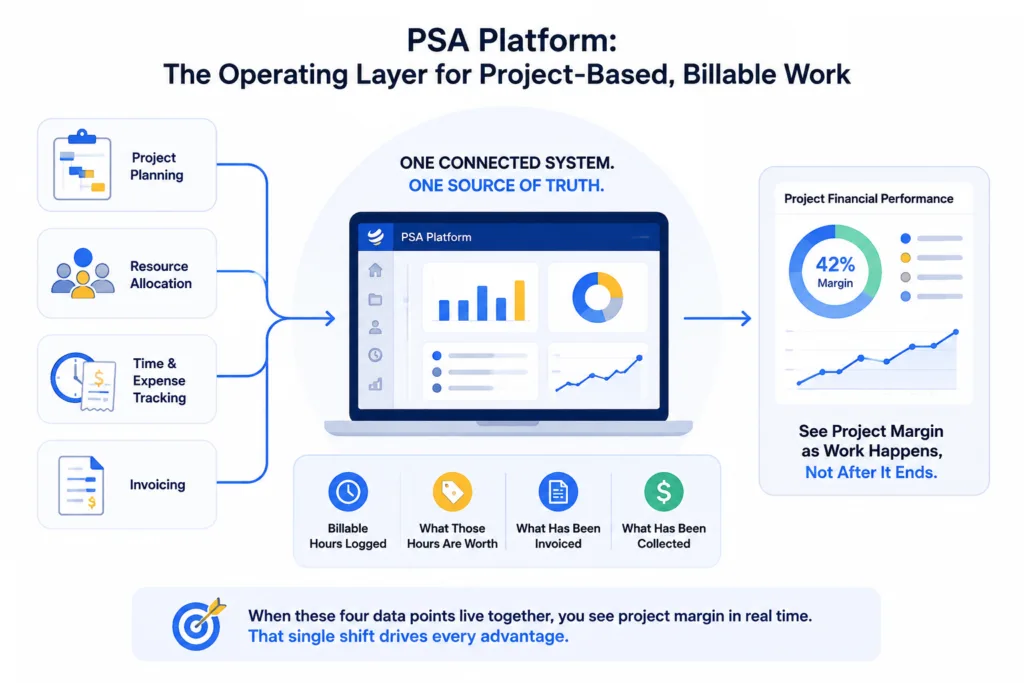
A PSA platform is the operating layer for project-based, billable work. It brings project planning, resource allocation, time and expense tracking, and invoicing into one connected system, then reports on the financial performance of every engagement.
For your team specifically, that means four things move into a single source of truth: how many billable hours your people log, what those hours are worth, what has been invoiced against them, and what has been collected. When those four data points sit together instead of in separate tools, you can see project margin as work happens rather than after it ends. That single shift is the root of almost every advantage below. You can read a fuller breakdown in this guide to the benefits of professional services automation software.
Advantage 1: Real-Time Project Profitability Instead of Month-End Surprises
The hardest number to trust in a services business is project margin. It depends on hours logged, the rate each person carries, discounts applied, and expenses booked, and each of those lives in a different place. Reconcile them by hand, and the picture is always a few weeks old.
A PSA platform calculates margin continuously. Every timesheet, expense, and invoice feeds the same engagement record, so you see cost against revenue while there is still room to act. A project drifting toward a write-off surfaces at week three, not at close.
The payoff is documented. Firms that implemented PSA lifted project margins from 32.4% to 38.5%, a 6.1-point gain. That improvement comes from catching problems early, which you can only do when the data is live.
Advantage 2: Higher Billable Utilization, and the Revenue That Follows
Utilization is the quiet lever behind services profitability. It measures how much of your team’s available time turns into billable work, and small movements carry large sums.
The industry needs the help. Industry-wide billable utilization fell to 66.4% in 2025, a record low that sits below the 70% mark SPI treats as the healthy floor. Every point under that line is capacity you are paying for and not billing.
PSA moves the number in the other direction. The same SPI End-User research found that firms implementing PSA raised billable utilization from 66.0% to 74.2%, an 8.2-point gain that worked out to roughly USD 32,500 in additional revenue per consultant per year. Multiply that across a team of forty, and the case builds itself. The mechanism is straightforward: when resourcing, timesheets, and project demand share one system, fewer people sit idle between engagements and fewer billable hours slip through unrecorded. Accurate timesheets are where this starts, and they matter far beyond payroll, as this piece on the role of timesheets in project management explains.
Advantage 3: Less Revenue Leakage From Work You Already Delivered
Revenue leakage is the gap between the work your firm performs and the work it manages to bill. Hours logged late, logged to the wrong project, or never logged at all. Expenses that miss the invoice. Discounts nobody signed off on. It rarely shows up as a single dramatic loss, which is exactly why it survives for years.
For a finance leader, leakage is margin walking out the door with no paper trail. A PSA platform narrows the gap by capturing billable time and expenses at the source and carrying them straight into invoicing, so what was delivered is what gets billed.
The scale of the recovery is real. SPI’s End-User research recorded revenue leakage dropping from 6.8% to 3.72% after PSA implementation, close to halving the loss. On a firm billing several million a year, that recovered percentage is often larger than any cost-cutting program you could run instead.
Advantage 4: Cleaner Billing and Healthier Cash Flow
Cash flow in a services firm is a timing problem. You pay salaries every month, but client money arrives on its own schedule, and slow or inaccurate invoicing pushes that schedule further out. When billing depends on chasing timesheets and rekeying them into an invoice, cycles stretch and disputes multiply.
PSA compresses the distance between finished work and a sent invoice. Approved billable time flows into the invoice without copy-paste, so bills go out sooner and match the contract, which means fewer queries and faster payment. Faster, more accurate invoicing feeds directly into the working capital you manage. If cash flow is where your attention sits, this guide to project cash flow covers the mechanics in depth, and Juntrax handles the receivables side through its Cash Flow module.
SPI’s research reinforces the delivery side of this: on-time project completion rose from 75.3% to 82.1% for firms that adopted PSA, a 6.8 point improvement. Projects that finish on schedule get billed on schedule.
Advantage 5: Forecasting You Can Trust
Finance leaders are asked to predict three things that used to require guesswork: how much revenue is coming, whether the firm has the people to deliver it, and what cash will look like in ninety days. A PSA platform grounds all three in current data rather than last quarter’s assumptions.
Because the pipeline, resource availability, and project financials sit in one place, you can model revenue against real capacity and flag a resourcing shortfall before it becomes a delivery failure. Forecasts stop being a hopeful spreadsheet and start being a rolling view built from what your team is doing right now. That is the difference between reacting to a cash crunch and steering around it.
Advantage 6: One Source of Truth That Works Alongside Your Accounting System
Here is a distinction worth getting right, because a lot of PSA content blurs it. A PSA platform is not your accounting software, and it is not trying to be. Your ledger, your statutory reporting, and your final books stay where they are, whether that is Tally, QuickBooks, Xero, or SAP.
What PSA owns is the project-to-cash operations layer that sits in front of accounting: quotes, project budgets, timesheets, billable hours, invoices, expenses, and receivables. It answers the operational questions your ledger was never designed to handle, such as which engagement is profitable this week and which consultant is underbooked next month. The clean, structured output it produces then feeds your accounting system, so finance works from one agreed set of numbers instead of reconciling three.
This is exactly how Juntrax is built. It unifies HRMS, PSA, and Cash Flow for professional services SMEs, and it runs alongside your accounting stack rather than replacing it. Your team keeps the tools it trusts for the books and gains the project-level visibility those tools cannot provide.
Advantage 7: Audit-Ready Records Across Regions
If your firm operates across India, the GCC, or the US, compliance is a standing cost of doing business, and finance carries it. E-invoicing mandates, tax rules that differ by jurisdiction, and audits that ask you to prove what was billed and why all demand a clean trail.
A PSA platform produces that trail as a byproduct of normal work. Every quote, timesheet, invoice, and payment is timestamped and linked, so when an auditor or a tax authority asks how a number was reached, the answer is a few clicks away rather than a week of archaeology. For multi-entity firms, that consistency across regions is worth as much as any single feature, because it turns compliance from a fire drill into a report.
PSA, Accounting Software, and ERP: Where Finance Fits
Because these categories overlap in conversation, they get confused in budgets. Keeping them straight helps you buy the right thing.
Accounting software records financial transactions and produces your statutory books. It is built for the ledger, not for tracking whether a specific project is on margin.
An ERP is a broad platform that runs many core functions across a whole organization, from finance to supply chain to procurement. It is powerful and heavy, and for a services SME it is often more system than the problem requires.
A PSA platform is purpose-built for firms where time is the product. It tracks project-level profitability, billable utilization, and delivery outcomes, then hands clean financial data to whatever system keeps your books. For most professional services SMEs, PSA is the layer that has been missing, and it delivers project visibility without the cost and complexity of a full ERP rollout. If you are weighing tools, this rundown of the top PSA software options is a useful starting point.
How to Evaluate PSA as a Finance Leader
When the demos start, keep your evaluation anchored to the numbers you are accountable for. A few questions cut through the feature lists:
- Does it show live project margin, or only report it after the fact? Live is the whole point.
- Does billable time flow into invoicing automatically, or does someone rekey it? Rekeying reintroduces the leakage you are trying to remove.
- Does it work alongside your existing accounting system without forcing a rip-and-replace? For an SME, migration risk is real money.
- Can it handle your regions, your tax rules, and your entity structure out of the box? Compliance gaps surface at the worst possible time.
- Will it deploy in weeks rather than quarters? A tool that takes a year to implement costs you a year of the visibility you bought it for.
Score vendors against those five questions and the finance case usually resolves itself. Juntrax was designed around exactly this profile: professional services SMEs that need project-to-cash visibility, want to keep their accounting stack, and cannot afford a heavyweight rollout. You can see the PSA module in detail, and firms like multi-region engineering teams run their timesheets, projects, and billing on it every day.
The Finance Leader’s Takeaway
The advantages of PSA for finance leaders come down to one shift: the work your firm does and the money it earns finally live in the same place, in real time. From there, margin becomes visible, utilization climbs, leakage shrinks, cash flow steadies, and forecasts hold up. The SPI research puts numbers on all of it, and the numbers point the same direction.
If any of this sounds like the month-end scramble you know too well, seeing it work on your own data is the fastest way to judge the fit.
Frequently Asked Questions
What Is PSA Software in Simple Terms?
PSA, or Professional Services Automation, is software that runs the business side of billable, project-based work. It combines project planning, resource allocation, time and expense tracking, and invoicing in one system, then reports on how profitable each engagement is. For finance teams, it connects the hours worked to the money earned so margin and cash flow are visible in real time.
Does PSA Replace Accounting Software Like QuickBooks or Xero?
No. A PSA platform handles the project-to-cash operations layer that sits in front of accounting, including quotes, timesheets, billable hours, invoices, and receivables. Your accounting software keeps the ledger and produces your statutory books. PSA works alongside it and feeds it clean, structured financial data, so the two systems complement each other rather than compete.
How Does PSA Improve Profitability for a Professional Services Firm?
PSA improves profitability by raising billable utilization, protecting margin, and reducing revenue leakage. In SPI Research’s 2022 End-User Survey, firms that implemented PSA lifted utilization from 66.0% to 74.2% and project margins from 32.4% to 38.5%, while revenue leakage fell from 6.8% to 3.72%. The common thread is real-time visibility, which lets leaders correct course before losses lock in.
What Is Revenue Leakage, and How Does PSA Reduce It?
Revenue leakage is the difference between the billable work a firm delivers and the work it manages to invoice, caused by unlogged hours, missed expenses, and unapproved discounts. PSA reduces it by capturing time and expenses at the source and carrying them straight into invoicing. SPI’s research recorded leakage dropping from 6.8% to 3.72% after PSA implementation, close to halving the loss.
Is PSA the Same as an ERP?
No. An ERP is a broad platform that runs core functions across an entire organization, such as finance, supply chain, and procurement. A PSA platform is purpose-built for professional services, focusing on project profitability, billable utilization, and delivery. Many firms integrate the two, but a services SME often gets the visibility it needs from PSA without the cost of a full ERP.
What Return Can a Finance Leader Expect From PSA?
Returns vary by firm, but the SPI benchmark data offers a grounded starting point: an 8.2 point utilization gain worth roughly USD 32,500 per consultant per year, a 6.1 point margin improvement, and a halving of revenue leakage. The strongest returns come from firms that integrate PSA with their financial systems, because that is where real-time margin visibility is built.