
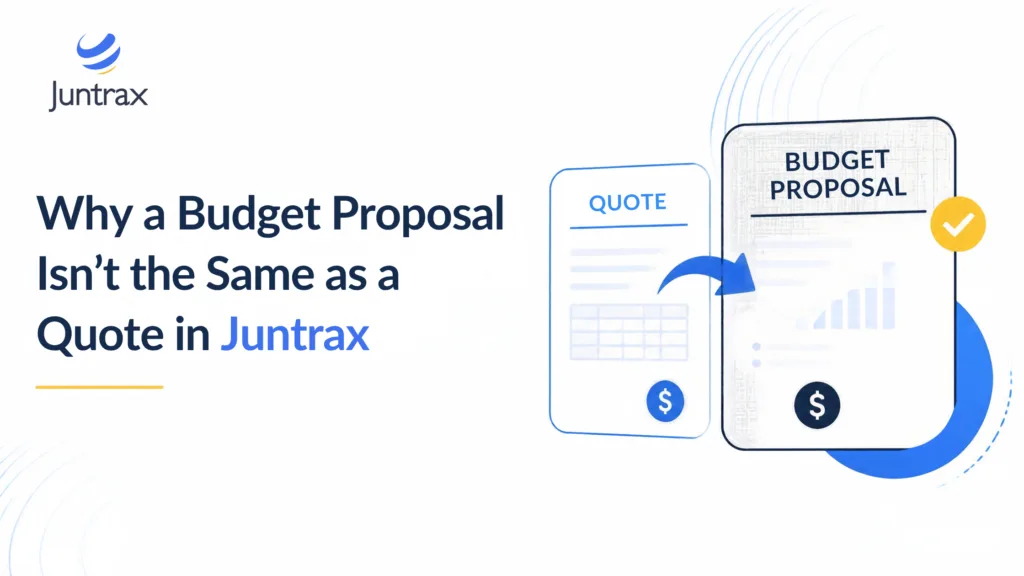
Your delivery lead has costed a new engagement, your finance head has signed off on the number, and the client is waiting to hear back. The quickest move is to send that approved figure straight over. Before you do, settle the budget proposal vs quote question. A budget proposal is an internal document that asks someone in your firm to approve what a piece of work should cost and earn. A quote is the external, priced offer your client can accept. In Juntrax, the two live on separate screens by design, and approving one does not create the other.
Key Takeaways
- A budget proposal is an internal sign-off on cost, price, and margin. Your client never sees it.
- A quote, also called a quotation, is the external offer, with line items, rates, taxes, terms, and an expiration date.
- The budget proposal answers “should we take this on at this number?” The quote answers “what will the client pay, and for what?”
- Under Indian contract law, a definite quote sent to a client can amount to an offer, which is why its terms and validity date deserve care.
- In Juntrax, Proposals handle approval, and Quotations handle the commercial document. Approving a proposal notifies the person who raised it, and someone then builds the quote from the approved numbers.
Budget Proposal vs Quote at a Glance
The difference between a budget proposal and a quote comes down to audience and purpose. A budget proposal is an internal request to approve a project’s budget, delivery costs, and expected profit. A quote is a formal, priced offer sent to a client that sets out what they will pay and on what terms.
| Aspect | Budget Proposal | Quote |
| Who sees it | An internal approver, such as a manager, partner, or finance head | The client |
| Question it answers | Should we commit to this work at this number? | What will the client pay, and for what? |
| What is inside | Budget amount, cost options, expected profit, approver comments | Services and items, rates, discounts, taxes, totals, terms, expiration date |
| Who says yes | Someone inside your firm | The client, usually by sending a purchase order |
| Legal weight | An internal record | Can amount to a formal offer once sent |
| What comes next | A quote built from the approved numbers | A received purchase order, then invoices |
| Status labels in Juntrax | Open, Sent for Approval, Approved, Rejected | New, Email Sent, PO Received, Expired, Cancelled |
What Is a Budget Proposal?
A budget proposal is the document you use to get internal approval before you commit money, people, or a price. It maps what the work is expected to bring in against what it will cost to deliver, so a decision-maker can approve it, reject it, or send it back with changes.
In a professional services firm, the budget proposal tends to show up at one specific moment: after discovery and before pricing goes to the client. The account lead knows roughly what the client wants and roughly what they are prepared to spend. What nobody has agreed yet is whether the firm can deliver the work at that number and still make money on it.
What a Budget Proposal Usually Contains
Most budget proposals carry the same core pieces: the client and engagement name, the budget amount, the delivery options on the table (an in-house team versus bringing in a subcontractor, for example), the cost of each option, the profit each one leaves, and a named approver. Good ones also include a short description of scope, so the approver knows what the number is buying.
Why Services Firms Rely on Them
For a 40-person consultancy, a single fixed-fee engagement can decide whether the quarter lands well or badly. The budget proposal is where a partner or finance head checks the project margin before the firm is committed. It also leaves a record of who approved what and why, which becomes very useful when a project later runs over and someone asks how the number was set in the first place.
The same logic shows up on the buying side. A purchase requisition is the internal request, and the purchase order is the document that goes to the supplier. If that split is familiar, our guide to the purchase requisition vs purchase order difference covers the procurement version of this idea.
What Is a Quote?
A quote, or quotation, is a formal, priced document you send a client. It lists the services or goods you will provide, the hours or quantities, the rates, any discounts, the taxes, and the total. It also carries your terms and a date after which the price no longer holds.
The quote is the first document in a sale that faces outward. Everything downstream, from the client’s purchase order to your invoices, traces back to it. That makes it the document where your numbers need to be ones your firm has already agreed it can live with.
Quote, Estimate, and Sales Proposal: Clearing Up the Terms
These words get used interchangeably, which is where a lot of the confusion starts. An estimate is an approximate figure, often a range, shared early so a client can check whether you are in the right ballpark. A quote is a firm price for a defined scope. A sales proposal is a persuasive, client-facing document that explains your approach and value, and it often includes pricing. A budget proposal is the odd one out among the four, since it is the only one written for your own team. For more on the different kinds of quotes, see our explainer on what a price quote means.
5 Key Differences Between a Budget Proposal and a Quote
1. Audience: Your Approver vs Your Client
A budget proposal travels upward or sideways inside your firm, to whoever holds the authority to commit. A quote travels outward to the client. Keeping that line clear decides what information can safely go into each document.
2. Purpose: Approving a Number vs Offering a Price
The budget proposal exists to get a decision from your own side. The quote exists to get a decision from the client. One protects your margin before you commit, and the other starts the commercial relationship.
3. Contents: Costs and Margin vs Line Items and Tax
A budget proposal is full of information your client should never see, such as delivery costs, supplier quotes, and the profit you expect to make. A quote shows the client the price, broken into services and items with rates, discounts, and tax, and says nothing about what the work costs you.
4. Approval: An Internal Yes vs a Client Yes
A budget proposal is approved or rejected by a person in your organization. A quote is accepted by the client, and in B2B services that acceptance usually arrives as a purchase order. Each yes unlocks a different next step.
5. Weight: An Internal Record vs a Commercial Offer
Once a quote reaches a client, it can carry legal and commercial consequences. A budget proposal stays inside the firm as a record of the decision. That difference is worth a closer look.
Is a Quote Legally Binding in India?
It can be. Section 2 of the Indian Contract Act, 1872 describes a proposal as one person signifying to another a willingness to do something, with a view to obtaining that other person’s assent. The same section adds that “a proposal, when accepted, becomes a promise.”
A quote that sets out a definite scope, price, and terms, and is sent to a client for acceptance, can fit that description. Whether a particular quote is a firm offer or an invitation to negotiate depends on its wording and the circumstances, so the safest habit is to treat every quote you send as something the client may hold you to.
Two details are worth building into your process. The word “proposal” means something different in contract law than it does in your approval workflow. An internal budget proposal is never communicated to the client, so it does not carry that weight. The Act also provides, in Section 6, that a proposal is revoked when the time prescribed for its acceptance lapses. That is one reason the expiration date on a quote matters, since it tells the client, and your own team, when the price stops holding.
This section is general information and not legal advice. For contract questions specific to your firm, speak with your legal counsel.
What Goes Wrong When the Two Get Mixed Up
- The internal number goes out as the price. A sales lead forwards the approved budget before anyone turns it into a proper quote. The client receives a round figure without line items, tax, or an expiration date, and your team is now negotiating from a document that was never meant for them.
- The quote goes out before the budget is approved. Pricing reaches the client before anyone has checked it against delivery cost. If the scope then grows, there is no approved baseline to hold the line against. This happens often enough to plan for. PMI’s 2018 Pulse of the Profession report found that 52% of projects completed in the prior 12 months experienced scope creep or uncontrolled changes to scope, up from 43% five years earlier. The same research estimated that 9.9% of every dollar invested in projects was wasted due to poor project performance.
- The approved option and the quoted option drift apart. The approver signs off on delivering with the in-house team, but the quote gets built around a version that includes a subcontractor. The price looks the same on paper while the margin quietly shrinks.
- Margin leaks to the client. When one document tries to serve both purposes, internal costs and comments end up in front of the client. Once a client has seen what the work costs you, every future negotiation starts from that number.
These are the kinds of problems that stay invisible at 15 people and start to hurt as the firm grows. Our piece on what breaks when a professional services firm crosses 50 employees covers how project profitability blind spots build up.
When to Raise a Budget Proposal Before You Quote
You do not need a budget proposal for every quote. A quick test helps you decide.
| Raise a budget proposal when | Skip it and quote directly when |
| The engagement is fixed-fee or milestone-based and your margin depends on estimating well | The work is repeat business at your standard rates |
| Delivery involves third-party costs, such as subcontractors or vendors | The engagement is billed on time and materials within your rate card |
| It is a new client, a new service line, or unfamiliar scope | The scope matches a recent project you delivered profitably |
| You are offering a discount beyond your usual limit | The price sits within limits your team can approve on its own |
| The deal is large compared with your typical engagement | The deal is small and low risk |
If two or more items in the left column apply, get the budget approved first. It takes less time than unwinding a quote the client has already accepted.
Related read:
See how the Juntrax team runs proposals, quotes, and invoices on its own platform
How Budget Proposals and Quotes Work in Juntrax
Juntrax runs the project-to-cash side of a services firm, from the first quote to the paid invoice, and works alongside the accounting system you already use, such as Tally, QuickBooks, Xero, or SAP. Inside its Cash-Flow module, the Sales flow treats the budget proposal and the quote as two separate documents with two separate jobs.
Proposals: Internal Budget Sign-Off
Proposals sit under Sales and have two views. New lists the proposals you raised, and Received lists the ones waiting on you to approve. Each proposal records the client, a title, the currency, the budget amount, the approver, the services involved, and a description.
The part that makes it a real decision tool is the cost comparison. You can lay out two to five options, each with a supplier and an amount, and Juntrax shows the profit on each one as the budget minus that option’s total. The approver can approve by choosing one option and adding a comment, or reject with a comment. The proposal moves from Open to Sent for Approval, and then to Approved or Rejected.
Say your firm is scoping a CRM rollout for a Pune-based distributor, and the budget is ₹8,00,000. Option A uses your in-house team at a cost of ₹5,60,000, which leaves ₹2,40,000 in profit. Option B adds a subcontracted data-migration partner and costs ₹6,20,000, which leaves ₹1,80,000. Your finance head approves Option A and notes that the in-house team has capacity next quarter. That comment now sits on record with the decision.
Quotations: The Client-Facing Offer
The Quotation screen is where the sale formally starts. A quotation carries its number and reference, the quotation and expiration dates, the client and contact, and the billing address. It holds service lines with a name, hours, rate, discount, and tax, and item lines with a name, quantity, unit price, discount, and tax, along with notes, terms, and attachments. The subtotal, discount, tax, and grand total add up live as you edit.
For the CRM rollout, the approved ₹8,00,000 might become three service lines on the quote: solution design at 80 hours and ₹2,500 an hour (₹2,00,000), configuration and testing at 240 hours and ₹2,000 an hour (₹4,80,000), and training and handover at 60 hours and ₹2,000 an hour (₹1,20,000), with GST applied per line. The client sees the scope and the price. They never see Option B, the delivery cost, or the approver’s note.
From there, you can mark the quotation as sent, email it, print it, or clone it for a similar deal. Its status labels run from New to Email Sent and PO Received, with Expired and Cancelled covering quotes that lapse or get withdrawn.
Why Approving a Proposal Doesn’t Create a Quote
When an approver signs off, Juntrax notifies the person who raised the proposal. It does not generate a quotation. Someone copies the approved numbers into a new Quotation by hand.
Juntrax keeps the approval and the commercial document separate on purpose. It is a manual step, and it is worth knowing about before you roll the workflow out. The benefit is a clean checkpoint between the two documents. The person building the quote turns cost options into client-facing service lines, chooses the tax on each line, and sets the terms and expiration date, while internal costs, rejected options, and approver comments stay inside the proposal where they belong.
What Happens After the Quote Is Sent
When the client’s purchase order arrives, you convert the quote into a Received PO, tie it to a project, and the quote is flagged PO Received. The Received PO becomes the money hub for the engagement, showing the order total, what has been billed, what has been received, and what remains.
A few guardrails keep the numbers honest from that point on. An invoice cannot be raised for more than the order’s remaining balance, and a payment cannot exceed what is still owed on its invoice. Prices freeze the moment you invoice, so a later change to a catalog price never rewrites a document you have already sent. Cancellations run from the most recent step backward, since a payment blocks its invoice from being canceled, an invoice blocks its order, and an order blocks its quote. For the full billing and collections picture, see our guide to the accounts receivable process.
From Approved Budget to Sent Quote: A Quick Walkthrough
- Open Sales, then Proposals, and create a new proposal. Choose the Company at the top first, since the other fields stay locked until you do and that is also when the document number is generated.
- Add the client, budget amount, services, and two to five cost options, then send it for approval.
- The approver reviews the profit on each option, picks one, adds a comment, and approves.
- Open Sales, then Quotation, and add a new quotation for the same client using the approved figures as service and item lines.
- Set the expiration date, terms, and notes, then mark the quote as sent or email it to the client.
- When the client’s purchase order comes back, convert the quote to a Received PO and start billing against it.
Keep Your Budget Proposal and Your Quote Doing Separate Jobs
The budget proposal vs quote question comes down to who each document is for. The budget proposal is your firm’s private decision about whether a piece of work is worth doing at a given number. The quote is the offer your client sees, relies on, and may hold you to. When each one does its own job, your margin gets checked before your price goes out, and your internal numbers stay where they belong.
Juntrax gives each document its own screen and its own approval path, then carries the approved quote through to the order, the invoice, and the payment. If you want to see that flow with your own projects and rates, you can try it free.
See how your quotes and approvals run in Juntrax
Budget Proposal vs Quote: Frequently Asked Questions
What Is the Difference Between a Budget Proposal and a Quote?
A budget proposal is an internal document that asks someone in your firm to approve a project’s budget, delivery costs, and expected profit. A quote is an external document that tells the client what they will pay, for which services or items, and on what terms.
Does Approving a Proposal in Juntrax Create a Quote?
No. Approving a proposal notifies the person who raised it. Someone then creates a Quotation and enters the approved numbers. Juntrax keeps the internal approval and the client-facing quote separate on purpose.
Is a Quotation Legally Binding in India?
It can be. Under Section 2 of the Indian Contract Act, 1872, a proposal that is accepted becomes a promise, and a quote with a definite scope, price, and terms sent to a client for acceptance can amount to an offer. Whether a specific quote is binding depends on its wording and context, so check with legal counsel for your situation.
Should a Client Ever See Your Budget Proposal?
In most cases, no. A budget proposal contains delivery costs, supplier options, and expected profit. Sharing it gives the client your cost base and weakens your position in any future negotiation.
Do You Need a Budget Proposal for Every Project?
No. Budget proposals earn their place on fixed-fee or milestone work, engagements with subcontractor or vendor costs, new clients, large deals, and discounts beyond your usual limits. Repeat work at standard rates can usually go straight to a quote.
What Happens When a Quote Passes Its Expiration Date?
The expiration date marks when your price stops holding. Juntrax includes Expired among a quotation’s status labels. If the client comes back after that date, re-check your costs and rates before sending a fresh quote.