

Most articles on external sources of recruitment read like a textbook chapter: a definition, a list of ten sources, a few bullet points on advantages, and a table comparing internal versus external hiring. That format works for an HR exam. It does very little for a COO at a 60-person agency who needs three senior designers in six weeks because a client win just landed, or for a founder at an engineering consultancy looking at four open roles, no recruitment budget for the quarter, and a project that is slipping because two engineers are still on the bench after last month’s wrong hire.
External recruitment is really a set of trade-offs between cost, speed, quality, and scale, and those trade-offs shift with the role, the urgency, and the kind of business you run. Picking the wrong source for a role is one of the most expensive mistakes a growing service firm can make, and most of the writing on external recruitment skips that point entirely.
This guide covers what external sources of recruitment are, the channels worth using in 2026, what each one realistically costs and delivers, how to choose the right one for the role in front of you, and how recruitment plays out differently when your business runs on billable projects.
What Are External Sources of Recruitment?
External sources of recruitment are the channels you use to hire people who do not already work for you. The label covers everything from posting a role on LinkedIn to engaging a retained executive search firm to taking a referral from someone on your team.
The distinction between external and internal matters for a practical reason. The moment you decide to hire externally, you have made three decisions at once. You have agreed to spend the budget on a search. You have accepted a longer time-to-productivity than promoting from within would give you. And you have judged that the gap you need to fill, whether a skill, a perspective, or a level of seniority, does not exist on your current bench.
Once that decision is made, the real work is choosing the channel. The channel determines what the search costs, how long it takes, who you reach, and how likely the hire is to stay past twelve months.
When External Recruitment Is the Right Call
Generic articles list “fresh talent” and “specialized skills” as reasons to recruit externally. Both are true, and neither is much help. In practice, external recruitment makes sense when one of five specific conditions holds.
The first is that the skill genuinely does not exist internally. A new client wants a federated identity rollout, and nobody on your team has done one. Training someone over twelve weeks is not a realistic answer to that.
The second is that you are growing faster than your team can promote. Reaching 60 people in 18 months means the org chart will outpace internal succession, and some roles simply have to come from outside.
The third is that you need a different mindset. A senior hire from a competitor, a different industry, or a different stage of the company brings a working model your team does not have. The value sits in that perspective rather than the resume.
The fourth is that the role is too senior for an internal candidate to step into credibly. A first CFO, first Head of Delivery, or first VP of Engineering usually has to be external the first time around.
The fifth is that you need to scale at a specific moment. A staffing firm that wins a contract for 25 contract recruiters has no internal answer, and neither does an agency that just landed an account and needs eight designers.
If none of these holds, an internal hire or a lateral move is usually cheaper, faster, and produces a better result. The common error is not recruiting externally when you should have. It is recruiting externally because that feels easier than having a hard conversation with someone already on the team.
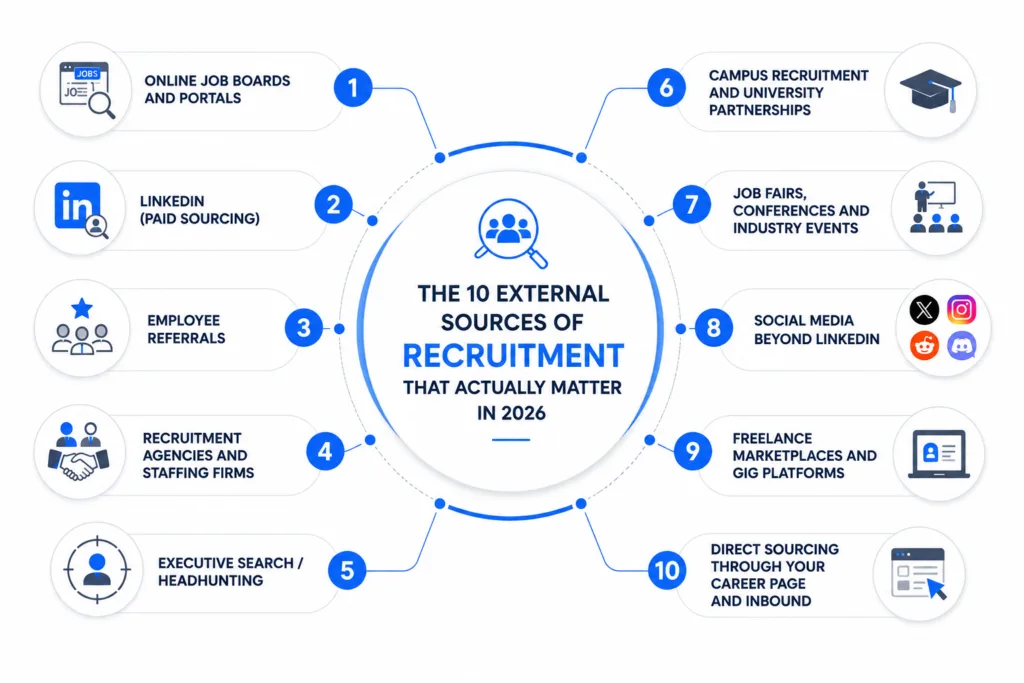
The 10 External Sources of Recruitment That Actually Matter in 2026
Older articles list fifteen sources, and half of them (newspaper classifieds, employment exchanges, walk-ins) barely function for white-collar hiring anymore. Here is the working list, ordered roughly by how much volume each one drives in a typical SMB services firm today.
1. Online job boards and portals
LinkedIn, Indeed, Naukri.com, Monster, Glassdoor, Wellfound (the startup and tech board formerly known as AngelList Talent), and category-specific boards such as Behance and Dribbble for design, Built In for tech, and FlexJobs for remote. This is the default channel for most active roles. Reach is broad, but conversion to quality is uneven. Popular roles drown you in applications, and niche roles can produce almost none.
2. LinkedIn (paid sourcing, not just posts)
This is worth separating from generic job boards, because LinkedIn Recruiter and LinkedIn Talent Solutions are a different product. Used well, they come close to executive search in capability. Used badly, they are an expensive way to send the same InMail to 200 people.
3. Employee referrals
Existing employees recommending people from their networks. Referrals are consistently rated among the highest-quality and longest-retaining sources across the industry, and they cost almost nothing beyond the referral bonus. The constraint is volume, because referrals cannot be turned on like a tap.
4. Recruitment agencies and staffing firms
Third-party recruiters who source, screen, and present candidates. Fee structures vary. Contingent recruiters are paid only on hire, usually 15 to 25 percent of annual CTC. Retained recruiters are paid in stages regardless of outcome and are used for senior roles. Contract and temp staffing firms charge an hourly markup on the consultant rate.
5. Executive search/headhunting
Used for senior, niche, or confidential searches. These are retained engagements, typically 25-33% of first-year compensation, often paid across three milestones (retainer, shortlist, placement). The model is slow and expensive, and it is the right answer when you need someone who is not currently looking.
6. Campus recruitment and university partnerships
Direct hiring from colleges, business schools, technical institutes, design schools, and bootcamps. This works for entry-level pipelines, brand building with future candidates, and high-volume trainee hiring. The lead time is long, but the flow is predictable.
7. Job fairs, conferences, and industry events
Both in-person and virtual. These work for volume (career fairs) and for niche reach (industry conferences where senior people gather). The value that gets overlooked is brand exposure rather than direct applications.
8. Social media beyond LinkedIn
X (Twitter), Instagram, Reddit, Discord communities, and niche Slack groups. Less direct than LinkedIn for hiring, but this is where developer, design, and creative communities actually gather. It works best for employer branding and inbound interest rather than direct posting.
9. Freelance marketplaces and gig platforms
Upwork, Toptal, Fiverr Pro, Contra, Catalant, and India-specific platforms. These suit project-based capacity more than permanent hires, and they matter increasingly for service firms that want to flex without growing fixed headcount.
10. Direct sourcing through your career page and inbound
A well-built careers page with a clear EVP, proper role pages, and an application flow that does not take 25 minutes. This is slow to build, and it becomes the lowest-cost-per-hire channel once it works, because candidates self-select and arrive already warm.
Newspapers, walk-ins, and employment exchanges are missing from this list on purpose. For most SMB service firms in 2026, they are not the primary channel for any non-trivial role. They still matter in some sectors, such as blue-collar manufacturing and retail at scale, but engineering, design, consulting, and agency hiring no longer happens there.
What Each Source Actually Costs and Delivers
This is the part most articles leave out. Each external recruitment source has its own cost profile, time-to-hire, and quality signature, and choosing the wrong source for a role costs you in two ways at once: you overspend, and you slow the business down.
The numbers below are working ranges for SMB service firms in 2026, blended across the India, UK, and US markets. Costs vary widely by role, market, and seniority, so treat them as orientation rather than precise figures.
| Source | Typical cost per hire | Time to hire | Best for | Quality / retention pattern |
| Employee referral | $500–$2,500 (bonus only) | 2–5 weeks | Trusted hires, culture fit, mid-level | Highest retention, strongest culture fit |
| Career page / inbound | $200–$1,500 | 3–6 weeks | All levels (when brand is strong) | High when brand is strong; low when it isn’t |
| Job boards (Indeed, Naukri) | $300–$2,000 | 3–6 weeks | High-volume, mid-level, generalist roles | Mixed; drowns in volume for popular roles |
| LinkedIn organic + paid posts | $500–$3,000 | 4–8 weeks | Mid-to-senior professional roles | Good for professional roles; mediocre for niche |
| LinkedIn Recruiter (active sourcing) | $3,000–$8,000 | 4–8 weeks | Specialized, passive candidates | High if used skillfully |
| Niche / industry job boards | $300–$1,500 | 3–6 weeks | Niche skills (devs, designers, finance) | Good for fit; volume is the constraint |
| Campus recruitment | $1,500–$5,000 amortized per hire | 3–9 months | Entry-level, predictable pipeline | High for entry; tested via internships |
| Recruitment agency (contingent) | 15–25% of annual CTC | 4–10 weeks | Mid-to-senior, hard-to-fill | Variable; depends on agency quality |
| Executive search (retained) | 25–33% of first-year comp | 8–16 weeks | Senior leadership, confidential | High when scoped properly |
| Freelance / gig platforms | Hourly markup or platform fee | 1–3 weeks | Project capacity, specialist short-term | Strong for project work; not for FTE roles |
| Job fairs / conferences | $5,000–$25,000 event + hires | Variable | Volume + brand | Brand value often exceeds direct hires |
| RPO (recruitment process outsourcing) | Monthly retainer or per-hire fee | Ongoing | High-volume or scale-up firms | High when sustained |
A few things are worth pulling out of that table.
Referrals and career pages are by a wide margin the cheapest sources, and they tend to produce the longest-tenured hires. Most firms underuse them for the same reason they overspend on agencies. Referrals and inbound require upstream investment in employer brand, a referral program, and a careers site, and that investment does not pay back immediately, whereas an agency feels like an on-demand button you can press today.
Agencies are not the problem, and they are the right answer for a specific kind of role: hard-to-fill, senior, market-rate-sensitive roles where you lack in-house sourcing capacity. The problem starts when they become the default for every role.
Executive search costs feel high until you have made a bad senior hire. The cost of a wrong VP runs well past a 30% retainer.
Freelance platforms are not a replacement for permanent hiring. They are a way to add capacity without adding fixed cost. The mistake is treating them as an either/or with full-time hiring, when in a project-based business, they work alongside it.
How to Pick the Right Source for the Role in Front of You
Most teams pick recruitment sources by habit: “we always post on LinkedIn,” or “we always call the agency.” Habit makes a poor strategy. A workable decision runs through five questions.
First, how urgent is this hire? If you need someone within days, look to freelance platforms or referrals. Within weeks, job boards or LinkedIn. Within months, an agency or search firm. Do not pick a slow channel for an urgent role and then complain that it is slow.
Second, how niche is the skill? Broad and generalist roles suit boards and inbound. Niche professional roles suit LinkedIn Recruiter or a niche board. Highly specialized roles point toward an agency or search.
Third, how senior is the role? Junior roles go to campus or boards. Mid-level roles suit boards, LinkedIn, and referrals. Senior roles suit LinkedIn Recruiter, agencies, and referrals. C-suite and first-of-its-kind leadership roles almost always go to retained search.
Fourth, how important is cultural fit relative to skill? When fit is the primary risk, as in a small founding team or an unusual culture, lean heavily on referrals and inbound. When skill is the primary risk, as in a specialized role, lean on sourcing channels even though fit takes longer to assess.
Fifth, how many hires do you actually need? For one role, use a focused channel. For five or more in the same function, consider a campus partnership or an RPO. For a continuous flow, invest in your employer brand and career page.
The biggest savings come from being honest about the first and third questions. Service firms routinely run slow, expensive channels for urgent roles, then wonder why time-to-hire is eroding utilization.
External vs. Internal Recruitment: A Working Comparison
This is here for completeness, with one caveat. For most growing service firms, the real question is not external or internal. It is how to combine the two in the right ratio for the role.
| Factor | Internal recruitment | External recruitment |
| Origin | Existing employees | Candidates outside the company |
| Speed to start | Days to weeks | Weeks to months |
| Cost per hire | Lowest (training cost only) | Highest (sourcing + onboarding) |
| Onboarding time | Minimal, since culture and systems are known | 30–90 days to full productivity |
| Cultural fit risk | Low | Moderate to high |
| Skill range | Limited to current capability | Whatever the market offers |
| Impact on morale | Boosts retention and motivation | Can demoralize if internal candidates feel skipped |
| Diversity of perspective | Low | High |
| Best for | Roles where institutional knowledge matters | Roles needing new skills or fresh thinking |
| Worst for | First-of-kind leadership roles | Roles where culture fit is the primary risk |
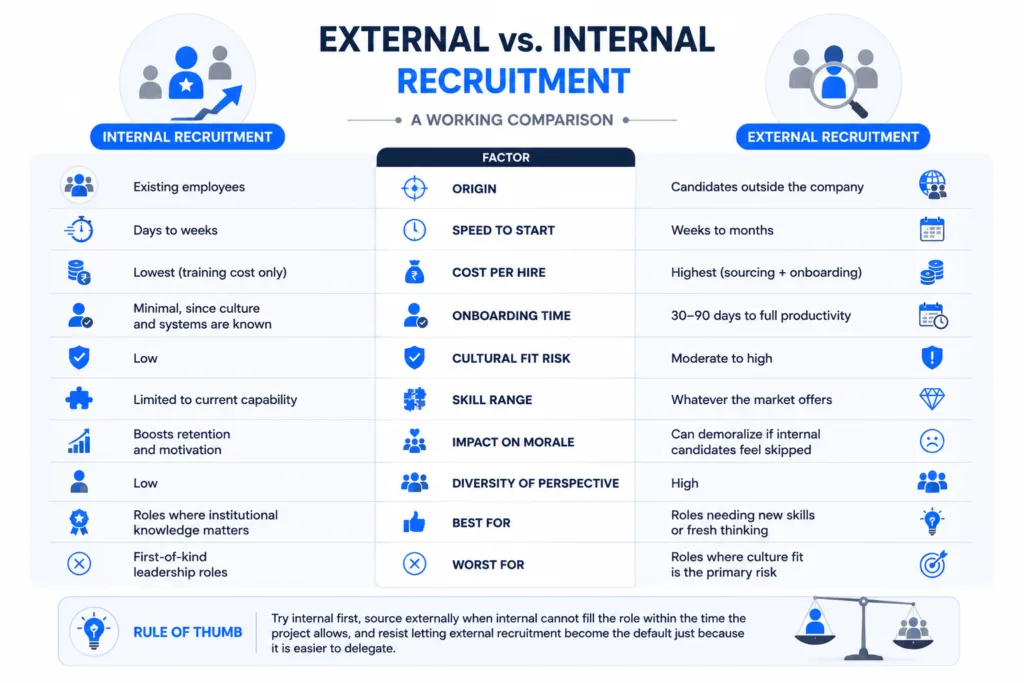
A useful rule of thumb for service firms: try internal first, source externally when internal cannot fill the role within the time the project allows, and resist letting external recruitment become the default just because it is easier to delegate.
What’s Different About Recruitment in a Project-Based Service Firm
Generic external recruitment advice assumes a stable-headcount business, such as a product company or a settled enterprise, where you hire when a seat opens. Service firms do not work that way.
In a project-based business, every external hire happens against three pressures that people tend to ignore.
- The first is a project deadline. You are not hiring “a senior consultant.” You are hiring a senior consultant to deploy on a specific engagement starting on a specific date. Time-to-hire stops being a metric and becomes a contractual risk.
- The second is utilization economics. Every week between hire and first billable hour is a week of fixed cost without revenue. A 12-week hiring process for a role with a $150 per hour billable rate carries more than $30,000 of unrealized revenue, on top of being slow.
- The third is pipeline uncertainty. You are often hiring against a pipeline that has not fully closed. Hire too late, and you cannot deliver the win. Hire too early, and you grow the bench. Both mistakes are expensive.
That is why recruitment in service firms cannot be treated as a standalone HR function. The source you pick has to connect to the project pipeline (what skills are coming and when they need to deploy), the current bench (who is rolling off projects and who can be redeployed), utilization targets (how much capacity you are already underusing), and the finance forecast (the cost of carry until the role is billable).
In the typical SMB setup, recruitment data lives in an ATS, the project pipeline lives in a CRM, bench data sits in a spreadsheet, and utilization sits in a different spreadsheet. When the data is scattered like that, none of these conversations happens cleanly. The recruitment decision gets made on incomplete information, and the firm overhires, underhires, or hires from the wrong source.
[See related: 6 Ways PSA Software Drives Efficiency and Growth for Businesses]
The Contingent Workforce Layer Most Articles Miss
A modern SMB service firm does not only hire full-time employees externally. It runs three layers at once: a core full-time team for stability, IP, and client continuity; a long-term contractor or consultant pool for specialized skills and variable demand; and a project-based freelance bench for specific deliverables and overflow.
External recruitment serves all three, but through very different channels. The same firm might use LinkedIn Recruiter for a full-time senior consultant, a long-standing relationship with two staffing agencies for contractors, and Upwork or Toptal for one-off project specialists.
In practice this means your external sources of recruitment strategy is really three strategies, each with its own channels, cost model, and process. Treating them as one is why so many service firms either underuse the contingent workforce and overhire full-time, or overuse it and end up with no team continuity.
The right blend changes by firm. A 40-person engineering consultancy with steady retainer clients might run an 80/15/5 split. A 40-person marketing agency with project-based work might run 50/30/20. No universal answer exists. The universal mistake is not deciding deliberately and ending up with whatever the last six months happened to produce.
Best Practices for Running External Recruitment Without Wasting Budget
After the source decision, execution determines whether external recruitment works. The practices below show up consistently in firms that hire well.
Define the role before you open the source. A vague role description produces vague candidates regardless of channel. A 30-minute conversation with the hiring manager about what the role must deliver in its first 90 days is the highest-leverage thing recruitment can do.
Be honest about must-haves versus nice-to-haves. A six-item must-have list with two real must-haves and four nice-to-haves dressed up as must-haves is the single most common reason searches drag on for months.
Move quickly. Strong candidates have three offers within a month of starting to look, so a 14-day decision cycle can be the difference between hiring them and losing them.
Run more than one channel. A single-channel strategy gives you a single-channel candidate pool. For any non-trivial role, run two or three channels in parallel and compare the results.
Measure source quality, not just source quantity. Track which channels produce the candidates who get hired and the ones who stay past twelve months. The cheapest source per application is often the most expensive source per retained hire.
Treat candidate experience as employer branding. Every rejected candidate is a future referrer, customer, or hire. Slow communication, ghosting, and disorganized interviews resurface as Glassdoor reviews 18 months later.
Build the pipeline before you need it. The roles you will hire in Q3 should be in your pipeline in Q1. Pipeline-driven hiring beats reactive hiring on cost, speed, quality, and retention.
Make the offer worth saying yes to. An offer at the 50th percentile of the market gets you 50th-percentile candidates. If you cannot pay market, sell the role, the team, or the trajectory, but do not pretend money is irrelevant.
Common Mistakes That Cost Service Firms Real Money
Five specific external recruitment mistakes account for most of the wasted budget in growing SMBs.
The first is defaulting to agencies for every role. Agencies are useful, but not at 22% of CTC for every mid-level designer. A firm making 30 external hires a year, half of them through agencies at 20% of average CTC, spends mid-six-figures on fees alone. Some of those hires were unavoidable. Many were not.
The second is treating job boards as a strategy. Posting on LinkedIn and Indeed is the bare minimum rather than a sourcing strategy. Firms that lean on boards for senior or niche roles tend to either underhire or overpay an agency to fix the gap.
The third is ignoring the referral program. Referrals consistently outperform every other channel on retention and culture fit, yet most SMBs run a program that is either underfunded (a $500 bonus for hires worth $80,000) or under-promoted (announced once and never mentioned again). A real referral program, with a ₹50,000-plus bonus paid in tranches, regular internal nudges, and public recognition, pays for itself many times over.
The fourth is hiring against a pipeline that does not exist. Adding heads on the assumption that the deal will close is one of the most expensive mistakes a service firm can make. Either tie hiring to signed contracts, or accept the bench cost and budget for it explicitly.
The fifth is hiring too senior, too soon. SMBs often pull the trigger on a senior external hire before the work justifies it. The senior person joins, has nobody to manage, gets bored, and leaves within 14 months. The role should have been mid-level or split into two.
How Software Helps (And Where It Doesn’t)
Recruitment software has settled into three real categories. Applicant Tracking Systems such as Greenhouse, Lever, Workable, and Zoho Recruit manage the pipeline from application to offer. Candidate Relationship Management tools nurture passive candidates and rebuild pipelines from previous applicants. Sourcing tools such as LinkedIn Recruiter, hireEZ, AmazingHiring, and a growing layer of AI-assisted tools help you find people in the first place.
What software does well is remove administrative friction. It tracks applications across roles, schedules interviews, keeps communication consistent, builds a searchable history of past candidates, and reports on which sources are working.
What it does not do is decide whether you should be hiring for this role at all, judge whether a candidate fits the team, or write the offer that gets them to say yes. Treating an ATS as a strategy is the same kind of error as treating LinkedIn as a sourcing strategy. It is necessary infrastructure, not a substitute for judgment.
For service firms, there is a layer above the ATS that matters more: connecting hiring to the project pipeline, the bench, and the financial forecast. When recruitment, HR, project allocation, and finance share a single source of truth, the questions that actually matter get answered with real data. Do we need this hire? When will they be billable? What does the carry cost until then?
A Real Example: Channel Mix in a 70-Person Engineering Consultancy
This is a pattern rather than a specific company, and the numbers are indicative.
A 70-person engineering consulting firm needed to make 24 hires over 18 months: 6 senior engineers, 11 mid-level engineers, 4 junior engineers, 2 BD and operations roles, and 1 head of delivery.
Their initial plan was to use an agency for all senior roles and LinkedIn for everything else. That plan would have cost roughly ₹78 to 95 lakhs in external fees for the agency-driven portion alone, with time-to-hire running around 9 to 11 weeks for the senior roles.
After auditing their channels, here is what they did instead.
For the Head of Delivery, they used retained search. One critical, market-rate-sensitive role, costing about ₹18 lakhs over 14 weeks. The hire was still in the seat 24 months later.
For the 6 senior engineers, they went hybrid. Two came through referral, at about ₹1.5 lakhs each in bonuses and 4 to 5 weeks each. Three came through LinkedIn Recruiter, at roughly ₹2 lakhs a month and 6 to 8 weeks each. One niche power-systems role went to a specialist agency at about 22% of CTC over 8 weeks.
For the 11 mid-level engineers, they used LinkedIn paid posts plus Naukri and Indeed, with an internal recruiter handling screening. That ran about ₹40,000 to 80,000 per hire, including ad spend and recruiter time, at 5 to 7 weeks each.
For the 4 junior engineers, they set up a campus recruitment partnership with two engineering colleges. The lead time was long but predictable, and the per-hire cost was close to zero beyond program overhead.
For the 2 BD and operations roles, they used referral plus LinkedIn: one referral, one LinkedIn-driven inbound.
Total external fees came to roughly ₹38 to 45 lakhs across the 24 hires, with average time-to-hire down to about 5.5 weeks across the board (excluding campus and the Head of Delivery).
The biggest single change was that the firm stopped defaulting to agency for mid-level roles and built internal sourcing capability for the volume tier. That one decision moved roughly ₹25 lakhs from external fees into internal recruiter cost, and it produced higher-retention hires. The lesson here is not that agencies are bad. It is that a single-channel default is what drains money, and a deliberate channel mix matched to role type is what protects it.
How Juntrax Fits
Juntrax is an integrated operations platform for SMB service firms that connects HR, projects, timesheets, approvals, and finance in one place.
For recruitment, this matters because the decision to recruit externally and the decision about when the new hire needs to be billable both depend on data that usually lives across four disconnected tools. The project pipeline sits in a CRM or spreadsheet. Bench and utilization sit in another spreadsheet. HR sits in an HRMS. Finance sits in an accounting tool. Recruitment data, if there is an ATS at all, sits in a fifth.
When those connect, the conversation changes. The hiring manager opens a role, and the system already shows current utilization, who is rolling off in the next 30 days, which skills are on the bench, what is in the pipeline that this role would deploy on, and the cost of carry until the first billable hour. The source decision gets made with the rest of the operational picture in view rather than in isolation.
Juntrax is not an ATS. It is the layer underneath one that makes the ATS’s data useful to the rest of the business.
What to Do This Week
If your firm is hiring externally and you have never sat down to think about channel mix, three things move the needle quickly.
Audit your last 12 months of hires by source. For each one, note which channel sourced them, the time from open to start, the all-in cost, and whether they are still here. Look at the source-by-retention table that falls out of that. You will usually find one channel producing most of the long-tenured hires and one producing most of the regret.
Pick one underused channel and invest in it for a quarter. For most SMBs that channel is either employee referrals, with a real bonus and active internal promotion, or the careers page, with proper content and a fast application flow. Both compound over time, and both are nearly free once running.
Stop defaulting to agencies for roles that do not need them. Senior, niche, and confidential roles suit agencies. Mid-level, well-defined, market-liquid roles suit your own sourcing or LinkedIn Recruiter. The line is fuzzy, and the habit of opening a role and immediately calling the agency is one of the most expensive ones in SMB hiring.
[See how integrated operations connect hiring, projects, and finance →]
Frequently Asked Questions
What are the main external sources of recruitment?
The most-used external sources today are online job boards (LinkedIn, Indeed, Naukri), employee referrals, recruitment and staffing agencies, executive search firms, campus recruitment, the company’s own career page, social media platforms, niche industry boards, freelance and gig platforms, and job fairs or industry events.
What is the difference between internal and external recruitment?
Internal recruitment fills roles with existing employees through promotion, transfer, or lateral move. External recruitment hires from outside. Internal is faster and cheaper, but limited to current capability. External is slower and more expensive, but reaches skills and perspectives that do not exist internally. Most growing firms use both.
What is the cheapest external source of recruitment?
Employee referrals and direct inbound through your career page, by a wide margin. Both rely on upstream investment in a referral program or employer brand, and both produce the lowest cost-per-hire and the highest retention rates once they are working.
What is the most effective external source of recruitment?
It depends on what you are optimizing for. For retention and culture fit, referrals. For speed, freelance platforms or referrals. For senior or niche roles, LinkedIn Recruiter or executive search. For volume, job boards plus campus. The most effective overall strategy is a deliberate mix matched to role type rather than a single channel.
How much does it cost to hire someone externally?
Cost per hire varies widely. SHRM’s 2025 Benchmarking Report puts the average at about $5,475 for non-executive roles, rising to roughly $35,900 for executives. For SMB service firms, factor in job board fees, agency fees (15 to 25 percent of CTC for contingent, 25 to 33 percent for retained), internal recruiter time, hiring manager interview time, background checks, and onboarding. Hidden costs such as vacancy time, manager time, and bad hires usually exceed the direct ones.
Should small businesses use recruitment agencies?
Selectively. For senior, niche, or hard-to-fill roles where the in-house team lacks sourcing capability, yes. For mid-level and volume roles where the role is well-defined and the market is liquid, building internal sourcing capability is usually cheaper over a 12-month window.
What is RPO (Recruitment Process Outsourcing)?
RPO is when an external provider takes over part or all of your recruitment function, usually at scale and often for high-volume hiring. It makes sense for fast-scaling firms hiring 30 or more people a year that do not want to build an internal recruiting team from scratch.
How do you measure the effectiveness of an external recruitment source?
Track four metrics by source: cost per hire, time to hire, quality of hire (90-day performance), and retention rate (at 12 and 24 months). The cheapest source by cost-per-application is often the most expensive once you correct for retention.
When should we use freelance platforms instead of hiring full-time?
When the work is project-bounded, the skill is specialized, you lack visibility past a quarter, or you want capacity without fixed cost. For service firms, freelance and contract layers are how you flex capacity to match the pipeline, rather than a substitute for permanent hiring of core delivery talent.
How long does external recruitment usually take?
For SMB service firms, expect 3 to 6 weeks for mid-level roles via job boards or referrals, 6 to 10 weeks for senior roles via LinkedIn Recruiter or agencies, and 10 to 16 weeks for executive search. The biggest variable is internal decision speed, because top candidates move fast and slow decision cycles lose them.