

In growing service firms, an HR audit usually falls short for a structural reason rather than a careless one. The review examines HR in isolation, looking at policies, handbooks, and leave records, while the real risk sits at the messy seams where HR meets projects, timesheets, approvals, and invoicing.
Consider three patterns. A 30-person engineering consulting firm gets pulled into an EEOC complaint and finds that half the offer letters in the drive do not match what is recorded in the HRMS. A 75-person marketing agency loses a client because a freelancer’s NDA was never countersigned. A staffing firm faces a ₹14 lakh PF demand after contract employees were misclassified for two years. Each of these began as an integration problem that a well-scoped audit should have surfaced. The audit missed them because it stopped at the HR door.
This guide is written for founders, COOs, and HR or finance heads at SMB service firms of roughly 20 to 200 people: engineering consultancies, EPC contractors, staffing companies, law firms, agencies, design studios, and IT services. If your business runs on billable projects, distributed teams, and a stack that mixes an HRMS, spreadsheets, project management, and accounting software, this guide is for you.
It covers what an HR audit is, the types that matter, a checklist you can use this week, the common mistakes that cost firms real money, and how to run an audit when your “HR system” is really three disconnected tools and a folder on Google Drive.
What this guide covers
- What is an HR audit?
- Why HR audits become critical during growth
- Types of HR audits
- What an HR audit actually covers
- The HR audit process, step by step
- HR audit checklist for SMB service firms
- Common HR audit mistakes and what they cost
- What makes audits harder in project-based SMBs
- How disconnected systems create audit failures
- HR audits and profitability
- HR audit software and automation
- Frequently asked questions
What Is an HR Audit?
An HR audit is a structured review of your people processes, policies, documentation, and systems, measured against legal requirements, internal standards, and operational goals. It produces a clear picture of what is working, what is exposed, and what to fix first.
It works much like a financial audit. A financial audit checks whether your records, controls, and processes can hold up to scrutiny, not simply whether you made money. An HR audit does the same for everything that touches your workforce, from how you hire, classify, and pay people, through to whether their timesheets reconcile with what you invoice the client.
A proper HR audit answers four questions:
- Are we compliant with the laws that apply to us today, not three years ago?
- Are our policies and documentation consistent with what actually happens day to day?
- Are our HR processes efficient, or are they leaking time, money, or accuracy?
- Are our people systems supporting the business, or quietly creating risk for it?
Most generic HR audit articles cover the first two questions thoroughly. The last two are where service firms tend to find the money.
Why HR Audits Become Critical During Growth
A 12-person consultancy can run on trust, a shared drive, and the founder’s memory. A 60-person consultancy cannot. Somewhere between those two numbers, the informal becomes a liability, and an HR audit moves from a nice-to-have to a necessity.
Several things shift as headcount climbs:
- Documentation drift. Templates get edited, then re-edited, then someone reuses an old one. Three versions of the offer letter exist. Two versions of the leave policy exist. Nobody can say which is current.
- Manager-by-manager interpretation. Five project managers handle WFH, comp-off, and approvals five different ways, none of it written down. When one employee compares notes with another, fairness perceptions collapse.
- Role drift. People hired as “Associates” are doing Senior Consultant work. Salaries have not kept pace. Job descriptions have not been updated since 2022.
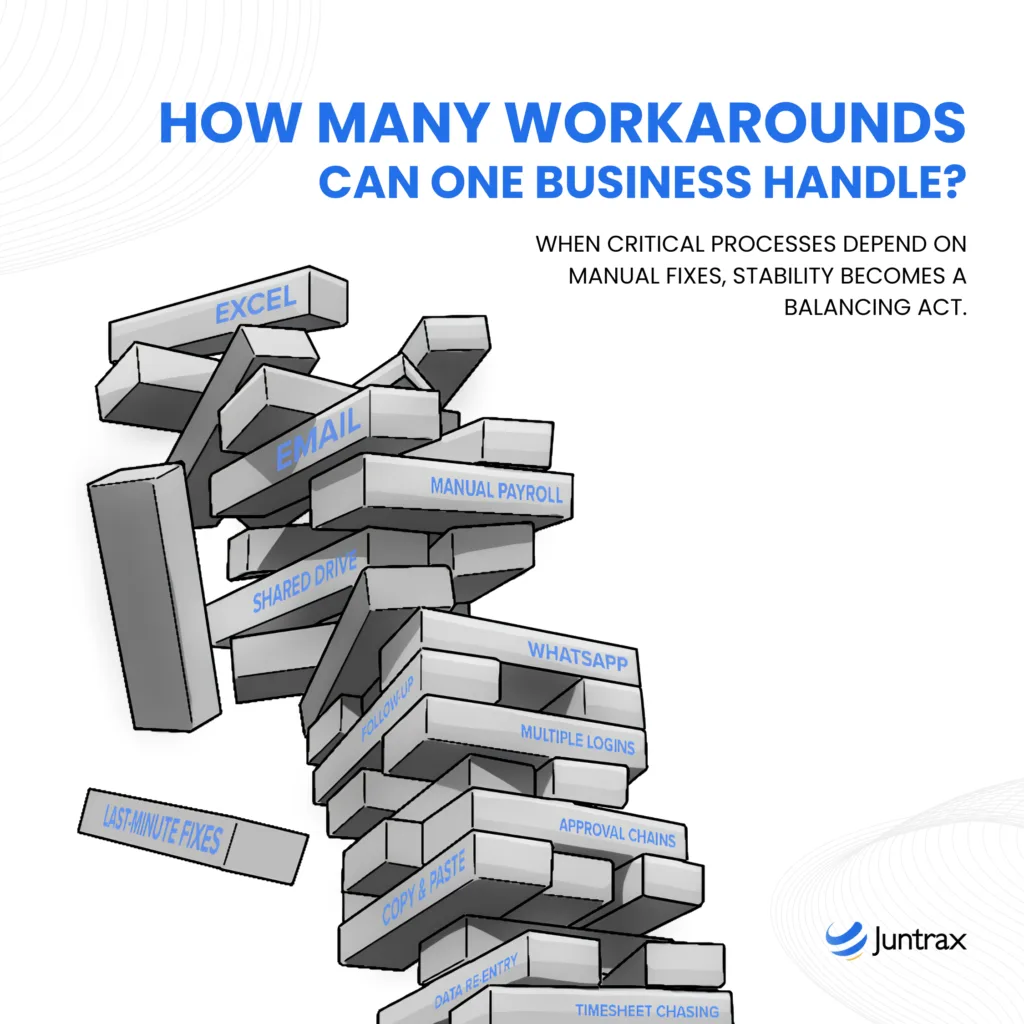
- System sprawl. HR data sits in one tool, timesheets in another, reimbursements in email, project allocations on a spreadsheet, and payroll on a fifth system. Nothing reconciles cleanly.
- Compliance complexity. At 20 employees, EPF applies. In many Indian states, Shops & Establishments registration applies at 10. Open an office in a second state and a new set of professional tax, labour welfare, and gratuity rules apply. Multi-country firms multiply this by every jurisdiction.
A common trigger for the first real audit is painful: a notice from a labour authority, a wrongful termination claim, an investor running pre-funding diligence, or a major client requesting proof of compliance before renewing. By that point you are auditing under pressure. The better time to audit is before any of that arrives.
Types of HR Audits (And Which One You Actually Need)
The textbook breakdown of HR audits looks like this:
| Audit type | What it focuses on | When to use it |
|---|---|---|
| Compliance audit | Adherence to labour, tax, and employment laws (EPF, ESI, PT, Shops & Establishments, FLSA, FMLA, EEO, anti-harassment) | Annually, plus any time you cross an employee threshold, open in a new state or country, or face a notice |
| Best practices audit | Comparison against industry benchmarks (time-to-hire, turnover, utilization, training hours) | Every 18 to 24 months, or when leadership wants competitive positioning data |
| Strategic audit | Alignment between HR practices and business goals (skills planning, succession, capacity) | Before scaling, fundraising, or entering a new service line |
| Functional audit | A deep dive into one function: recruitment, onboarding, payroll, performance, or exit | When metrics on a single function look off (for example, 90-day attrition spiking) |
| Risk-mitigation audit | Legal and litigation exposure | After a complaint, investigation, or change in leadership |
| Value-creation audit | Engagement, retention, and culture | When eNPS is dropping or attrition is hurting delivery |
| I-9 / records audit (US) | Right-to-work documentation | Before any DOL or ICE audit risk |
Most articles stop there.
For service firms, two more types matter and are rarely discussed:
| Audit type | What it focuses on | Why it matters for service firms |
|---|---|---|
| Operational HR audit | The seams between HR and projects or finance: timesheets, approvals, reimbursements, billable rate accuracy | This is where billing leakage hides |
| System audit | Whether your HRMS, PSA, payroll, and finance tools reconcile | Many HR issues in service firms are really integration issues |
If you have never run a formal audit, start with a combined compliance and operational scope. That single combination catches the legal risk most firms worry about and the operational leak most firms do not know exists.
What an HR Audit Actually Covers
A real audit at a service firm should examine seven domains. Not all need equal depth, but none should be skipped.
- Hiring and onboarding. Job descriptions, offer letters, background checks, reference checks, NDAs, IP assignment, document collection (PAN, Aadhaar or SSN, education proofs), and onboarding checklist completion. Are offer letters signed and stored? Does the HRMS data match payroll? Is onboarding finished, or does it trail off after week one?
- Employee classification and contracts. Full-time versus contractor versus consultant versus intern. This is the single biggest legal and financial risk for service firms. Misclassified contractors can trigger PF, ESI, gratuity, and tax demands going back years. In the US, the same misclassification can trigger FLSA back-pay claims and Department of Labor penalties.
- Payroll, compensation, and statutory compliance. Pay parity, salary structure compliance with minimum wage laws, overtime rules, bonus eligibility, PF/ESI/PT/LWF deductions and deposits, Form 16 or W-2 accuracy, exit settlements, and gratuity provisioning.
- Policies and documentation. Employee handbook, leave policy, POSH or anti-harassment policy, IT and data security policy, code of conduct, social media policy, and remote work policy. Are they current? Signed by every employee? Enforced consistently?
- Performance, training, and development. Review cadence, calibration, documentation of feedback, training hours per employee, mandatory POSH or safety training completion, and manager training.
- Records, data security, and access. Employee file completeness (especially for exits), data encryption, access control to sensitive HR data, retention schedules, and GDPR or DPDP Act compliance for personal data.
- Operational integration. Timesheet completeness and approval, leave-to-payroll reconciliation, reimbursement approval audit trails, project allocation accuracy, utilization tracking, billable versus non-billable hours, and whether HR data flows correctly into invoicing and revenue recognition. This is the domain most firms skip.
The HR Audit Process: Step by Step
A workable HR audit for an SMB service firm runs in six phases over four to eight weeks. Larger firms and first-time audits tend to run longer.
Phase 1: Scope and objectives (Week 1)
Decide what is in and what is out. A focused audit beats a sprawling one. Common scoping decisions include comprehensive versus functional, all locations or one, which risk areas come first (I-9s, classification, POSH compliance), and whether you use an internal team, an external consultant, or a hybrid.
Write down three to five concrete objectives. “Ensure compliance” is not an objective. “Confirm all 84 employees have current signed POSH acknowledgements on file and identify any classification risk for the 11 contractors engaged for more than 90 days” is an objective.
Phase 2: Team and tools (Week 1)
Assign a project owner, usually the HR head, with the COO or CFO as sponsor. Decide who else belongs in the room: legal counsel, payroll, finance, IT, and one or two managers who run people processes day to day. Confirm which tools you will use to gather and store findings, and how confidentiality will be maintained.
Phase 3: Data collection (Weeks 2 to 4)
Three streams run in parallel:
- Documentation review. Pull every relevant policy, handbook, contract template, payroll register, statutory return, training record, and exit interview. Compare what is filed against what is actually used.
- System extraction. Export employee master data, timesheets, leave balances, reimbursement records, and payroll registers from each tool. Reconciling these exports is where most discoveries happen.
- Stakeholder interviews. Talk to managers, recent hires, recent exits, and at least one person from each function. Ask what confuses them, what they work around, and where they ignore the official process.
Phase 4: Analysis and gap identification (Weeks 4 to 6)
Map every finding into one of four buckets:
| Bucket | Definition | Action stance |
|---|---|---|
| Compliance gap | Legal or statutory non-conformance | Fix immediately, document the remediation |
| Process gap | Inefficiency, inconsistency, or missing control | Redesign and roll out |
| Documentation gap | Missing or outdated records | Backfill and standardize |
| System gap | Disconnected tools, manual workarounds, data integrity issues | Plan integration or replacement |
Rate each finding high, medium, or low on both risk (legal, financial, reputational) and effort to fix. The high-risk, low-effort items are your quick wins. The high-risk, high-effort items become a roadmap.
Phase 5: Report and remediation plan (Weeks 6 to 7)
Build one document with three layers: an executive summary leadership can read in five minutes, a detailed findings register with risk ratings, root causes, and recommended actions, and a 30/60/90 day remediation plan with named owners. Resist the temptation to bury bad news. A clean report that hides three serious issues is worth less than a frank report that surfaces them.
Phase 6: Implementation and re-audit (Week 7 onward)
Audits without follow-through are expensive paperwork. Set a re-audit on a 12-month cadence for the full scope, and quarterly mini-audits for any function flagged as high risk. Track remediation in the same system you use for project work so it does not drift.
HR Audit Checklist for SMB Service Firms
Here is a working version you can adapt this week. The “Owner” and “Source of truth” columns are where service firms usually find their biggest gaps, because for most items the honest answer to “where does this live?” is “somewhere between three tools and an inbox.”
| Domain | Checkpoint | Frequency | Owner | Source of truth |
|---|---|---|---|---|
| Hiring | Job description on file for every active role | Annual | HR | HRMS |
| Signed offer letter for every employee | Continuous | HR | HRMS | |
| Background check completed before joining | Continuous | HR | HRMS | |
| NDA and IP assignment signed | Continuous | HR / Legal | HRMS / Legal vault | |
| Classification | FT / contractor / consultant list reviewed for misclassification risk | Quarterly | HR + Finance | HRMS + Contracts |
| Long-tenured contractors flagged for review (90+ days) | Quarterly | HR + Legal | HRMS | |
| Policies | Employee handbook current and version-controlled | Annual | HR | HRMS |
| POSH / anti-harassment policy signed by all employees | Annual | HR | HRMS | |
| Data security and AUP signed by all employees | Annual | IT + HR | HRMS | |
| Remote work / WFH policy current | Annual | HR | HRMS | |
| Payroll & statutory | EPF / ESI / PT / LWF deposits filed on time, all months | Monthly | Finance | Payroll system |
| Form 16 / W-2 reconciliation complete | Annual | Finance | Payroll system | |
| Salary structures compliant with current minimum wage | Annual | HR + Finance | Payroll system | |
| Gratuity provisioned correctly | Annual | Finance | Finance system | |
| Time and leave | Timesheets submitted and approved for every billable resource | Weekly | PMO | PSA / Timesheet tool |
| Leave balances reconciled with payroll | Monthly | HR | HRMS ↔ Payroll | |
| Comp-off and overtime tracked and approved | Monthly | HR + PMO | HRMS / PSA | |
| Reimbursements | Every reimbursement has approver trail, receipt, and project tag | Monthly | Finance | Finance system |
| Project-billable expenses tagged and recoverable | Monthly | Finance + PMO | Finance system | |
| Performance | Review cycle completed for every eligible employee | Annual / semi-annual | HR + Managers | HRMS |
| Calibration documented | Per cycle | HR | HRMS | |
| Records | Personnel file complete for every active employee | Annual | HR | HRMS |
| Exit checklist complete for every leaver (last 12 months) | Per exit | HR | HRMS | |
| Operational integration | HRMS, PSA / timesheet, and payroll headcounts match | Monthly | HR + Finance | Reconciliation report |
| Billable hours reconcile against invoices raised | Monthly | Finance + PMO | PSA ↔ Finance | |
| Utilization reported to leadership | Monthly | PMO | PSA | |
| Compliance (periodic) | Shops & Establishments / state registrations current | Annual | Legal / HR | Compliance register |
| POSH committee constituted and trained | Annual | HR + Legal | HR records | |
| Annual compliance calendar reviewed | Annual | Finance + HR | Compliance register |
Save this as a spreadsheet, assign owners, and put a date next to every “last checked.” That step alone puts you ahead of most firms in your size band.
Common HR Audit Mistakes (and What They Actually Cost)
Across dozens of growing service firms, the same mistakes recur.
Treating the audit as an HR-only exercise
Scoped purely as an HR function, the audit misses everything that crosses department lines, which is exactly where the expensive errors live. A misclassified contractor is invisible to an HR audit that never sees the project allocation, the timesheet, and the invoice together. Cost: multi-year statutory liability when it eventually surfaces.
Auditing the policy
The handbook says expense claims need manager approval and a project tag. The actual workflow is a WhatsApp screenshot forwarded to Finance. Auditing only the policy hands you a false clean bill of health. Cost: reimbursement fraud, billing leakage, and unrecoverable client expenses.
Skipping the contractor and consultant pool
Service firms scale by adding flexible capacity, and that capacity is rarely audited at the same depth as full-time staff. Contracts go unsigned, NDAs lapse, IP assignment is missing. Then a client asks for an audit trail before a major renewal. Cost: lost renewals, IP disputes, statutory back-payments.
Doing it once, never again
A one-shot audit produces a snapshot, and a snapshot from 14 months ago is decorative rather than protective. Firms that benefit run a quarterly mini-audit on one or two high-risk areas and a full audit annually. Cost: every gap that re-emerges in the 11 months after the audit.
Ignoring the timesheet, leave, and payroll triangle
In a service firm, these three datasets must reconcile or your books are wrong: leave taken but not deducted from pay, time logged on a closed project, overtime that bypasses payroll. Each one is small, and compounded across a year they add up to a meaningful number. Cost: underbilling clients, overpaying employees, and ugly surprises at year-end close.
Failing to close the loop
Findings get reported, nobody owns remediation, and twelve months later the same findings reappear. Cost: the entire audit budget, plus the credibility hit when leadership notices.
What Makes HR Audits Harder in Project-Based SMBs
Generic HR audit advice assumes a firm’s only complication is its own size. Project-based service firms carry an extra layer of complexity that breaks most off-the-shelf audit frameworks.
- Every employee is a billable unit, not just a headcount. When a designer takes unapproved leave, it is also a project slippage, a client conversation, and possibly a missed milestone. The audit needs to look at leave through the project lens as well as the policy lens.
- Approvals run on multiple axes. A consultant submitting an expense report needs sign-off from a project manager (was it billable to the project?), a department head (was it within policy?), and finance (does it reconcile?). When these three approvals live in three different tools, the audit trail fragments.
- Utilization is the silent metric. You can be fully compliant on every HR policy and still lose money because half your senior engineers are billing 38% of their hours. A real audit for a service firm flags utilization gaps and links them back to capacity planning and hiring decisions.
- Distributed and contractor-heavy teams. Statutory compliance in a 60-person agency with 22 contractors across three states is materially harder than in a 60-person product company in one office. Each location carries its own thresholds, registrations, and filing calendars.
- Spreadsheets as the integration layer. This is the most common technical reality and the hardest audit risk to fix. The system of record for half the HR-adjacent data is a shared Excel file that one person maintains and three people edit without telling each other. An audit that does not recommend a structural fix here keeps cataloguing the same drift every year.
How Disconnected Systems Create Audit Failures
This deserves its own section because it is the gap most writing on HR audits skips. Picture the typical 80-person services firm stack:
- An HRMS holding employee master data, leave, and policies
- A separate timesheet tool used by project managers
- A project management tool tracking allocations and deliverables
- Email or Slack for reimbursement requests
- A finance and accounting tool for invoicing and statutory filings
- A folder structure on Google Drive for contracts, offer letters, and approvals
Each tool does its job. The risk lives at the boundaries between them.
When an employee transfers from Project A to Project B mid-month, that change needs to update the HRMS (cost center), the timesheet tool (available project codes), the project tool (allocation percentage), and finance (revenue recognition). In most SMBs the update happens in zero, one, or two of those places, rarely all four, so by month-end close the numbers do not tie.
When an employee exits, the offboarding checklist should pull from a single source. Instead, IT removes access on its own track, HR processes full-and-final, finance settles reimbursements, and a manager reassigns the work. The audit question, “was every exit handled completely?”, has no clean answer because there is no single record.
When statutory authorities request a contractor list, three tools produce three different lists, and reconciling them takes a week. An HR audit that finds only the policy gaps misses these structural issues entirely. An audit that surfaces them, and recommends a single source of truth across HR, projects, time, approvals, and finance, is the one that changes the business.
HR Audits and Profitability: Where the Operational Money Hides
A finance-grade HR audit at a service firm should put a number on the operational findings, not only the legal ones. In a typical 50 to 100 person services firm, the cost of not auditing looks roughly like this:
| Hidden loss | How it shows up | Order of magnitude (annual) |
|---|---|---|
| Billing leakage from incomplete timesheets | Hours worked, never logged, never invoiced | 2 to 6% of revenue |
| Reimbursements not tagged to projects | Recoverable expenses absorbed as overhead | 0.5 to 2% of revenue |
| Misclassified contractors | PF / ESI / gratuity back-demands when caught | One-off, can run into ₹ lakhs or crores |
| Underutilized senior staff | Senior rates billed at junior utilization | 5 to 15% of gross margin |
| Delayed invoicing | DSO inflated by 10 to 25 days | Working-capital drag |
| Overpaid leave | Leave taken but not deducted | 0.3 to 1% of payroll |
| Payroll / headcount mismatches | People exit but stay on payroll a cycle | Variable, embarrassing |
These are not theoretical figures. Each one shows up when an HR audit is scoped operationally and the numbers are reconciled across tools. Many firms find that the operational savings from a properly scoped audit cover the cost of the audit several times over, before any of the legal-risk benefits are counted.
HR Audit Software and Automation
You can run an HR audit with spreadsheets, a checklist, and discipline, and most firms do. The trade-off is that the audit becomes a periodic event rather than a continuous state.
Software helps in five ways:
- Centralizing employee data, so the audit does not start with three days of reconciliation.
- Capturing approvals in-system, so the audit trail for reimbursements, leave, and timesheets already exists.
- Enforcing policy at the workflow level, for example blocking a timesheet without a valid project code, or blocking payroll for an employee with a missing PAN.
- Producing standing reports (utilization, attendance, reimbursement aging, statutory compliance) that turn an annual audit into a quarterly review and the quarterly review into a monthly habit.
- Tying HR data to project and finance data, which is the single biggest structural shift available to an SMB service firm.
What software does not do is replace judgment. An audit still needs someone who can look at a list of long-tenured contractors and ask whether they are really contractors. A tool surfaces the question. A person answers it. For a wider view of the tooling landscape, see our SaaS HR ultimate guide and why a dedicated leave management system matters.
How Juntrax Fits

Juntrax is an integrated operational platform built for SMB service firms. It connects HR, projects, timesheets, approvals, reimbursements, and finance in one place, so most of the structural audit gaps in this article are designed out of the workflow rather than discovered after the fact.
In practical terms, the HRMS, the project allocations, the timesheets, the approvals, and the invoicing share a single source of truth. Reconciliation between tools stops being an audit finding because there is nothing to reconcile. The utilization report the COO did not have becomes standing. The reimbursement-to-project tag the auditor could not find becomes mandatory at submission.
This is not an argument against running an audit. You should run one whether or not you use Juntrax. The firms that get the most from audits treat the findings as structural rather than as paperwork, and integrated operations is the structural answer. For the broader workflow, see how PSA software drives efficiency and growth.
Explore Juntrax PSA →
What to Do This Week
If you have read this far, you do not need another article. You need a start. Three paths, depending on where you are:
- If you have never run an HR audit: copy the checklist above into a spreadsheet, pick the three highest-risk lines for your firm (classification, statutory compliance, and timesheet integrity are usually the right ones), assign owners, set a date 30 days out, and report findings to leadership.
- If you have run audits before but findings keep recurring: the problem is structural rather than procedural. Scope the next audit explicitly for system and integration gaps, not just policy ones, and bring finance and operations into the audit team alongside HR.
- If your audit pain is that nothing reconciles across tools: that is an operational architecture problem more than an audit problem. Audits will keep telling you the same thing until the underlying system is integrated.
For more on scaling cleanly, read how to handle geography expansion for service firms and the benefits of a project management system for SMEs. For authoritative compliance references, the SHRM, the US Department of Labor, and EPFO India are good starting points.
See how Juntrax connects HR, projects, and finance →
Frequently Asked Questions
How often should an SMB run an HR audit?
Run a full HR audit annually, with quarterly mini-audits on the highest-risk functions, typically classification, timesheets, and statutory compliance. Re-audit immediately after any major change: a funding round, a new office, a leadership change, or a labour-authority notice.
Should we do the HR audit internally or use an external consultant?
For a first audit, a hybrid approach usually works best. Use the internal team for context and access, and an external consultant for objectivity, specialized compliance knowledge, and to push past internal blind spots. Subsequent audits can lean more internal once the framework is in place.
How long does an HR audit take?
For a 20 to 200 person service firm, a comprehensive audit runs four to eight weeks end to end. Functional audits, such as recruitment only or payroll only, can run in one to two weeks.
What is the difference between an HR audit and an HR compliance audit?
A compliance audit is one type of HR audit, focused specifically on legal and statutory conformance. A full HR audit includes compliance plus operational efficiency, alignment with business goals, and process effectiveness. Service firms usually need both, and the operational layer is where the financial recovery is.
Do we need a lawyer involved in the HR audit?
For anything involving classification, terminations in the last 24 months, POSH or harassment complaints, or wage-hour exposure, yes. For documentation and process review, it is not strictly necessary.
What is the biggest HR audit risk for a project-based service firm?
Contractor misclassification, almost universally. It is silent, it compounds, and when it surfaces, typically through a complaint or a statutory notice, the back-liability can run into significant numbers. The second biggest risk is timesheet integrity, because it touches both compliance and billing.
How much does an HR audit cost?
A comprehensive external HR audit for a 50 to 100 person SMB typically runs between ₹2 lakh and ₹8 lakh in India, or USD 7,000 to 25,000 in the US, depending on scope, location count, and complexity. Internal audits cost staff time. The right comparison is not cost versus zero, but cost versus the financial and legal exposure of not auditing.
Can we audit our HR processes without changing our HR systems?
Yes, though you will keep finding the same systemic gaps every cycle. A good audit recommends structural changes where the tools are the bottleneck, even if implementing those changes takes longer than fixing individual findings.
What should the HR audit report include?
An executive summary, a findings register (with risk rating, root cause, and recommended action), a remediation roadmap with named owners and dates, and a re-audit schedule.
How do we know if our HR audit was actually useful?
Three tests: did it surface things you did not know, did it produce a remediation plan with named owners and dates, and did the same findings stay gone at the next audit? If all three are yes, the audit was useful.