
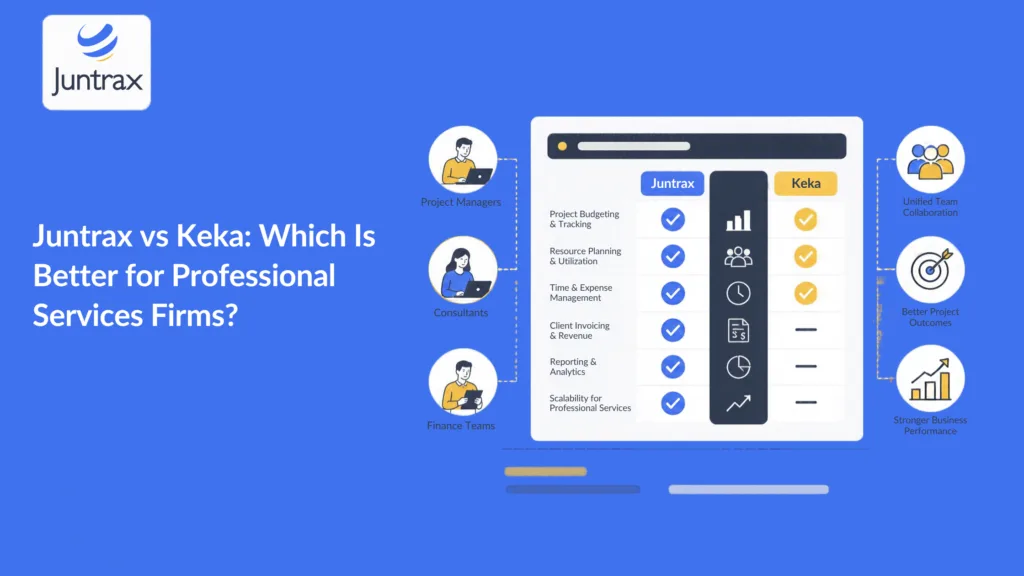
Juntrax vs Keka comes down to one question for any professional services firm: which platform protects your billable hours and your margin? Both serve small and mid-sized businesses, and both cover HR and payroll well. They are built on different foundations, though, and that foundation is what separates them from project-driven work. For IT consulting, project-driven consulting, and staffing firms whose revenue depends on capturing every billable hour, a single native platform that unifies HRMS, PSA, and Financials closes the gaps that a separately purchased module tends to leave open. This guide breaks down the comparison in full.
Juntrax vs Keka at a Glance
| Dimension | Juntrax | Keka |
| Core architecture | Native HRMS, PSA, and Financials in one platform | HR and payroll platform with PSA available as an add-on |
| PSA delivery | Built in, part of the core suite | Separate module purchased on top of the HR portal |
| Billable hours tracking | End to end, from timesheet to invoice in one system | Timesheets in the HR portal feeding the PSA add-on |
| HR and payroll | Workforce, attendance, leave, multi-country payroll | Strong HR and payroll feature depth |
| Financials and invoicing | Native financials, invoicing, and receivables | Project billing within the PSA module |
| Best-fit firm | Services firms (25 to 150 employees) billing by the hour | Firms that lead with HR and payroll needs |
| Deployment | Cloud, multi-location ready | Cloud |
Key Takeaways
- Juntrax and Keka both target SME services businesses, so the comparison is genuinely close on HR and payroll.
- The deciding difference is architecture: Juntrax delivers HRMS, PSA, and Financials as one native suite, while Keka offers PSA as an add-on layered on the HR portal.
- For billable-hours capture and project margin, a native suite keeps time, billing, and financials in a single record with no handoff between systems.
- Juntrax fits IT consulting, project-driven consulting, and staffing firms in the 25-to-150-employee range that bill by the hour and want people, projects, and money in one place.
- Confirm current pricing directly with each vendor, since the real cost comparison is about how many systems you end up paying for.
What Each Platform Is
Juntrax
Juntrax is a cloud business operations platform that brings HRMS, Professional Services Automation, and Financials together in one solution, purpose-built for small and mid-sized services firms. Workforce management, attendance, leave, timesheets, payroll, projects, invoicing, and receivables sit in the same system, so a billable hour logged on Monday flows into the invoice and into the books without leaving the platform. If you want a deeper primer on the category itself, the Juntrax guide to PSA software covers how these tools work end to end.
Keka
Keka is an HR and payroll platform serving small and growing organizations, with strong feature depth across workforce management, attendance, and payroll. Keka also offers a Professional Services Automation capability for firms that bill clients based on project time. That PSA capability is delivered as a separate module purchased alongside the standard HR portal, and it draws on data configured within that portal. For a firm that leads with HR and payroll, this structure works cleanly. For a firm that leads with billable project work, it means two layers that have to stay in step.
The category context matters here. The professional services automation software market reached USD 12.40 billion in 2024 and is projected to hit USD 40.25 billion by 2033, a 14.7% compound annual growth rate, according to Grand View Research. Demand is growing precisely because services firms want fewer disconnected tools, which is the lens through which this comparison applies throughout.
Billable Hours and Utilization Tracking
For a services firm, billable hours are the product. Every hour that goes uncaptured or gets reconstructed from memory at the end of the week is a margin walking out the door. The benchmarks make the stakes concrete. Average billable utilization fell to 66.4% in 2025, an all-time low and well below the 75% level that high-performing firms sustain, per SPI Research’s Professional Services Maturity Benchmark. IT consulting firms specifically averaged 71.0% billable utilization in 2024, according to SPI Research, and revenue leakage across the industry sat at a five-year low of 4.5%, which still represents real money for firms billing in the millions.
This is where the architectural difference shows up in daily operations. With Juntrax, a consultant logs time against a project, the timesheet feeds the PSA module, and that approved time converts straight into a client invoice and a financial entry within the same platform. There is one record, one approval trail, and one source of truth for utilization reporting.
Consider a 60-person IT consulting firm at month-end. On a native suite, the operations head pulls utilization, project margin, and outstanding invoices from one dashboard because the timesheet and the invoice share the same underlying data. On an HR platform with a separate PSA add-on, that same firm reconciles timesheet data in the HR portal against billing in the module, then against the accounting system, which adds steps and increases the chance for figures to drift. The Juntrax overview of PSA benefits walks through how automated time capture protects billable hours in practice.
HR and Payroll Capabilities
Both platforms are credible here, and Keka has earned a strong reputation for HR and payroll depth. Workforce records, attendance, leave management, and payroll processing are well covered on both sides, and a firm evaluating purely on HR features will find a lot to like in either.
Juntrax handles workforce management, attendance, leave, reimbursements, and multi-country payroll within the same system that runs projects and financials. The advantage is continuity. When an employee’s cost rate lives in the same platform as the projects they bill to, margin calculations stay accurate automatically, with no export and re-import between an HR tool and a project tool. For a side-by-side look at how integrated HR systems compare across the category, see the Juntrax roundup of the best HRIS systems.
Project Billing and Financials
This section is where the platforms diverge most for services firms. Juntrax includes financials natively, which means invoicing, expenses, receivables, and reporting are part of the core product rather than an integration you assemble. Billable hours become invoices, invoices become receivables, and the whole flow stays inside one ledger.
Keka’s project billing lives within its PSA module. For firms whose financial system of record sits elsewhere, that often means the PSA module handles billing while accounting happens in a separate tool, with data moving between them.
The practical difference appears at close. On a native financials platform, a finance head reconciles billed hours to recognized revenue inside one system, so the month-end close reflects project reality directly. When billing and accounting live in different tools, that reconciliation becomes a manual matching exercise, which is slower and more error-prone as the firm scales past 50 people and project volume climbs.
Pricing and Total Cost of Ownership
Public pricing for both platforms is limited, so the honest comparison is about structure rather than a single sticker number. Confirm current figures directly with each vendor before deciding.
The structural point is straightforward. Juntrax is a single subscription covering HRMS, PSA, and Financials, so one line item covers people, projects, and money. With Keka, the PSA capability is an add-on purchased on top of the standard HR plan, so a project-services firm pays for the HR portal plus the module and may still need a separate financial system for full accounting.
Total cost of ownership, therefore, includes more than license fees. It includes the integration effort to keep separate layers in sync, the staff time spent reconciling data across tools, and the risk of paying for two systems that a single native platform would cover on its own. For a firm where billable work drives revenue, those hidden costs often outweigh the headline subscription price.
Who Should Choose Which
Choose Juntrax if you run an IT consulting, project-driven consulting, or staffing firm in the 25-to-150-employee range, you bill clients by the hour, and you want workforce, projects, billing, and financials in one native system. Juntrax was purpose-built for SME services firms rather than offered as a trimmed-down version of enterprise software, which is why billable-hours depth and integrated financials sit at its core. The Juntrax list of top PSA software for 2025 puts that fit in context against the broader market.
Consider a leaner HR-first setup if your primary need is HR and payroll with little or no project billing, since the integrated PSA and financials layer matters most when billable work drives your revenue.
A note for firms operating across borders: Juntrax supports multi-country operations and multi-location visibility, which is relevant for services firms scaling across the US, India, and the GCC. Teams evaluating the India market specifically can review the Juntrax overview of the best HR software in India for regional context on compliance and payroll.
Pros and Cons
Juntrax
Pros:
- Native HRMS, PSA, and Financials in one platform, with no bolt-on required
- End-to-end billable-hours capture from timesheet to invoice to ledger
- Built specifically for SME services firms
- Multi-country payroll and multi-location reporting
Cons:
- Public pricing is limited, so cost requires a direct conversation
- The full value lands for firms that actually bill project work, less so for HR-only use
Keka
Pros:
- Strong HR and payroll feature depth for growing organizations
- A capable PSA option for firms that invoice based on project time
- Well-regarded user experience for core HR workflows
Cons:
- PSA is a separate add-on layered on the HR portal rather than part of one native suite
- Project-services firms may run billing and accounting across separate systems
- Total cost can rise once the HR plan, the PSA module, and any external financial tool are combined
The Verdict
For HR and payroll alone, Juntrax and Keka are both solid choices, and the decision can come down to preference. For IT consulting, project-driven consulting, and staffing firms whose revenue depends on billable hours, Juntrax pulls ahead because it unifies HRMS, PSA, and Financials in one native platform, so time flows into billing and into the books without a handoff. As utilization keeps sliding industry-wide, a single system that captures every billable hour and ties it to margin is worth more than a collection of connected parts.
See it on your own projects with the Juntrax 100-day free trial, or book a demo to walk through the billable-hours workflow end to end.
Frequently Asked Questions
What Is the Difference Between Juntrax and Keka?
Juntrax delivers HRMS, PSA, and Financials as one native platform, while Keka is an HR and payroll platform that offers PSA as a separately purchased add-on. For project-services firms, that means Juntrax keeps billable hours, invoicing, and financials in a single system, whereas a Keka setup may span the HR portal, the PSA module, and an external accounting tool.
Does Keka Have a PSA Module?
Yes. Keka offers a Professional Services Automation capability for firms that bill clients based on project time, covering timesheets, project tracking, and client invoicing. It is delivered as an add-on purchased alongside the standard Keka HR portal and uses data configured within that portal.
Which Is Better for IT Consulting, Juntrax or Keka?
For IT consulting firms that bill by the hour, Juntrax has the edge because billable time, project margin, and financials live in one native system. IT consulting averaged 71.0% billable utilization in 2024 per SPI Research, and protecting that utilization depends on capturing time accurately, which a single end-to-end platform supports without reconciliation across separate tools.
Which Software Is Best for Tracking Billable Hours?
A platform that connects timesheets directly to invoicing and financials is best for tracking billable hours, since it removes the gaps where time goes uncaptured. Juntrax does this natively, logging time against projects and converting approved hours into invoices and financial entries inside one system.
Is Juntrax a Good Keka Alternative?
Juntrax is a strong Keka alternative for project-services firms, particularly when integrated PSA and financials matter as much as HR and payroll. Firms that lead with billable project work tend to favor a native suite, while firms that need mainly HR and payroll may find either platform sufficient.