
By Juntrax Social at Juntrax · Published October 2026 · Fact-checked by Juntrax’s editorial team
Disclosure: this article is published by Juntrax, whose own offerings are among those ranked below; every entry here was assessed on the same criteria.
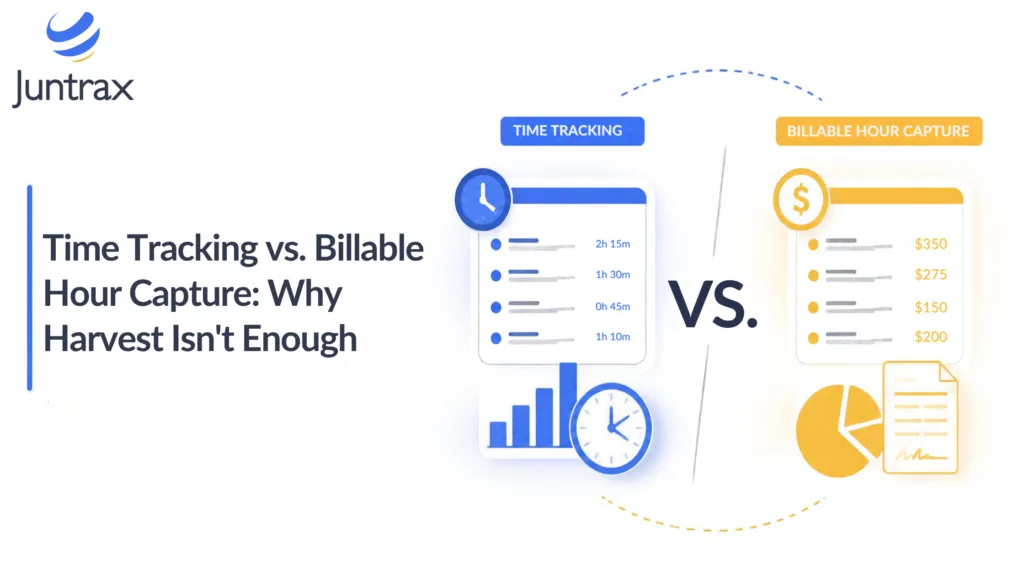
Billable hour capture validates time against projects and rates, while Harvest, Clockify and Toggl focus on time tracking, with invoicing, approvals and rates on paid tiers. Juntrax does both inside one platform, so firms that bill by the hour eventually need more than a timer.
Is a time tracker enough for billable hours?
A timer answers one question: how long did someone work? A billable firm needs three more answers. Was the entry assigned to the right project, was it priced at the right rate, and did it reach an invoice?
Juntrax’s consulting page cites a 31% median leak of billable advisory hours that never reach an invoice correctly. The same page walks through the billable-hour flow: 100% of hours worked, 84% on a timesheet, 76% approved at the correct rate and 69% invoiced. These are Juntrax’s own figures, so treat them as directional. What matters is the shape: the loss happens after the timer stops, in the steps a timer doesn’t touch.
A stopwatch measures the race; it can’t tell you whether the runner crossed the right finish line.
What separates billable hour capture from basic time tracking?
Billable hour capture is time tracking plus classification, validation and hand-off to invoicing. A tracker stores the entry. A capture system decides whether it is billable, at what rate, and whether it is ready to bill.
The first decision is the split itself. Billable hours are client-facing time chargeable to a project invoice, and non-billable hours cover internal work such as training, administration, business development and firm meetings. Getting that line right drives utilization and margin protection.
How does MyCase suggest billable time automatically?
Good capture reduces recall errors. MyCase’s Smart Time Finder shows the logic well: it passively tracks activity inside the platform, identifies billable actions with no time entry, and summarizes them for later review. The system observes activity, compares it with logged time, surfaces the gap, and lets a human confirm. Entries stay human-approved, and the software simply finds what memory drops by Friday afternoon.
Which validation rules prevent over- and under-billing?
Rules that matter in practice:
- Project required at entry: no entry saves without a project and task, so nothing floats unassigned.
- Rate resolved by role and location: Juntrax’s consulting page shows bill rates configured by role and location and auto-applied per timesheet entry, which the page ties to the rate card leak, a rate mismatch it estimates at 6-11% of revenue.
- Approval before invoicing: Harvest offers timesheet approvals only on its Enterprise tier.
- Required notes: the same Enterprise tier can require notes on every entry, which helps when a client disputes a line later.
- Bench check: unassigned billable people show up as bench time, cost without revenue, so capture has to connect to allocation.
Under-billing is the quieter failure. A late timesheet is rarely wrong, just missing, and Juntrax estimates roughly 5% of billable hours go uninvoiced that way.
How do Harvest, Clockify and Toggl handle billable tracking?
What Harvest, Clockify and Toggl do well
Time tracking is what Harvest, Clockify and Toggl do well, and each has real strengths. Harvest’s free plan covers 1 seat and 2 projects with invoicing and expense tracking, and its Teams plan costs $9 per seat per month billed annually, with Stripe, QuickBooks Online and Xero integrations. Clockify’s free plan covers up to 5 users, and its Standard plan at $5.49 per seat per month billed annually adds invoicing, approvals and a QuickBooks integration. Toggl’s Starter plan, which adds billable rates, is listed at $9 or $12 per user per month depending on the pricing set shown, and profitability analysis arrives on Premium.
How billable hour capture works in Juntrax
Juntrax’s PSA includes timesheets and time tracking, pay rate and bill rate management, location-specific bill rates and a project financials dashboard with live margins from invoices, POs and timesheets. On the integrated plan, PSA timesheets flow into HRMS attendance automatically, and margin is calculated per project from pay rate against bill rate.
On the Integrated Solution, HRMS Suite, PSA and Cash-Flow run on one shared database.
There’s a tradeoff. A unified platform asks for more setup than a timer app, and Juntrax cites 21 days implementation time.
Quick comparison: Harvest, Clockify, Toggl and Juntrax
| Criterion | Billable Hour Capture (Juntrax) | Harvest | Clockify | Toggl |
|---|---|---|---|---|
| Best for | Hourly-billing firms with concurrent projects and utilization targets | — | — | — |
| Standout capability | Timesheets, bill rates, margins and invoicing in one system | Time tracking with invoicing and expense tracking | Time tracking with invoicing and approvals on paid plans | Time tracking with billable rates on Starter |
| Free option | 14-day trial, no credit card | 1 seat and 2 projects | Up to 5 users | — |
| Paid pricing | Per active user, annual or quarterly; plan figures on the pricing page | $9 per seat per month, billed annually (Teams) | $5.49 per seat per month, billed annually (Standard) | $9 or $12 per user per month (Starter) |
| Approvals | Bill rates by role and location auto-applied per timesheet entry | Enterprise tier only | Standard plan | — |
| Billable rates | Configured by role and location, auto-applied per timesheet entry | — | Basic plan | Starter plan |
| Profitability reporting | Project financials dashboard with live margins | — | Premium plan | Premium plan |
| Utilization and bench view | Native | — | — | — |
Which is better for billable firms: Harvest or an integrated PSA?
Each handoff between separate tools is a place where an hour can change its rate, its project, or its existence.
Juntrax’s integrated plan removes those handoffs. Timesheets feed attendance, pay rate and bill rate produce margin per project, and one reporting layer spans people, projects and finances. Source Engineering Services’ engineering manager, a customer of the platform, says stakeholders now get accurate monthly updates on project profitability, though that is a testimonial published on Juntrax’s own site.
The counterpoint is fair: a firm with no utilization targets gains little from consolidating.
How to choose between a time tracker and a billable-hour platform
The decision turns on four signals: team size, project complexity, revenue leakage risk and resource planning needs.
- Choose a tracker (Harvest, Clockify, Toggl) if you are solo or under about 10 people, run simple projects, and invoice occasionally. The free tiers above cover small teams.
- Choose a billable-hour platform (Juntrax) if you bill by the hour, run several concurrent projects, track utilization, or want hours to flow into invoices and payroll without re-keying.
- Hybrid caution: a tracker plus a separate PSA works, but price the integration labor before committing.
If you’re unsure, test with real timesheets, since one billing cycle shows where entries get stuck. Juntrax lists a 14-day trial with no credit card, which is enough for that experiment.
FAQs
Can I use Harvest for billable hour tracking?
Yes, for the basics. Harvest tracks time, invoices and expenses.
Does Clockify validate billable hours automatically?
Not as a full validation layer. Billable rates arrive on its Basic plan and approvals on Standard, but project and rate discipline depends on how you configure them.
What does Clockify’s Standard plan add over its free plan?
Clockify’s free plan covers up to 5 users, and its Standard plan at $5.49 per seat per month billed annually adds invoicing, approvals and a QuickBooks integration.
Why does bench time matter for billable capture?
Unassigned billable people generate cost without revenue. Seeing bench time next to timesheets shows whether low billing is a capture problem or an allocation problem.
How do I prevent billable-hour errors?
Require a project at entry, auto-apply rates by role, and approve timesheets before invoicing. A consultant who logs Friday’s hours on Monday should hit those same checks.
Is Harvest cheaper than a billable-hour platform?
Add the labor of reconciling hours by hand to a tracker’s entry price, though, and the cheaper tool stops being cheaper.
Can I switch from Harvest to a PSA platform?
Juntrax says data migration is priced separately by the volume and format of your existing data, quoted up front before commitment, so project and rate mapping is where the real work sits.
Key takeaways
- A timer records effort, while capture decides what gets billed, at what rate, and whether it ever reaches an invoice.
- Harvest, Clockify and Toggl log time well, but approvals, billable rates and profitability often sit behind higher tiers.
- Checks at entry (project, rate, approval) prevent over-billing and the quieter under-billing from late timesheets.
- One system for timesheets, payroll data and invoicing removes the reconciliation step where hours leak.
- Solo and small teams with occasional invoicing can stay on a tracker; firms billing hourly across concurrent projects should move to a platform like Juntrax.
If your last billing cycle left you wondering where a few hours went between the timesheet and the invoice, run your own timesheets through a free 14-day Juntrax trial and see exactly where capture catches them.
Sources
- Plans & Pricing – Clockify™
- Juntrax for Consultancies — One Platform for Billable Firms
- Juntrax | Unified Business Operations Platform
- Billable vs. Non-Billable | Juntrax Glossary
- Complete Time Tracking Software for Law Firms | MyCase
- Time Management & Invoicing at Cost Effective Pricing | Harvest
- Bench Time | Juntrax Glossary
- Toggl Pricing Plans for Teams & Individuals | Toggl
- Juntrax Pricing — HRMS, PSA & Cash Flow Plans
- Juntrax | Start Free Trial
- accurate monthly updates on project profitability, Juntrax
A note on sources: every figure here comes from a published page. Last reviewed October 2026. Learn more about Juntrax by signing up for a demo.