
Learn how to calculate bench time, tell normal gaps from costly underuse of capacity, and keep consultants productive between projects.
What Is Bench Time?
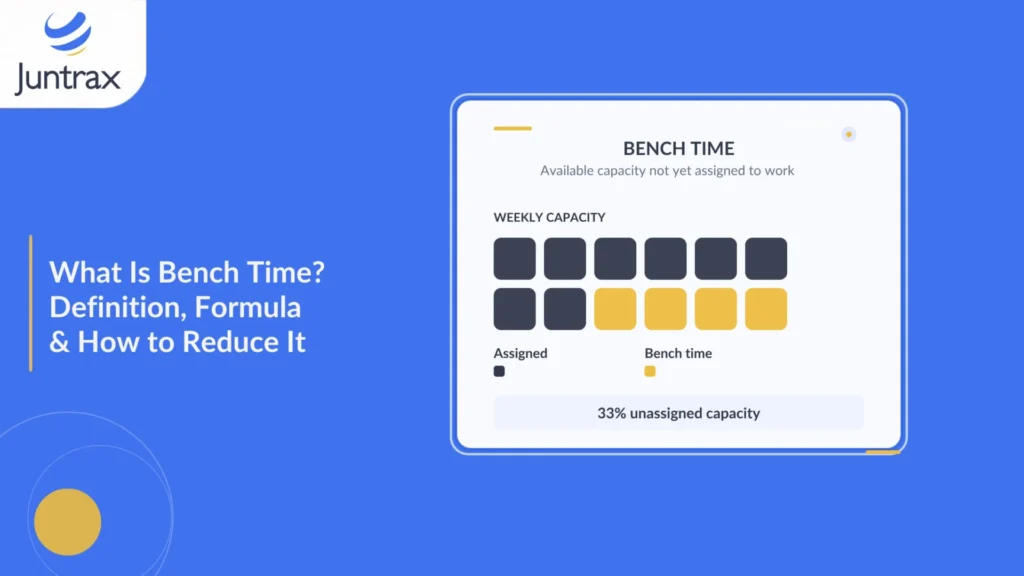
Bench time is the period when an employee has available working capacity but no active client work. The term is common in professional services businesses that depend on matching employee skills and availability with project demand.
Bench time can build up between projects, while a client approves a new phase, or when a project needs fewer people than planned. It can also appear when a firm hires ahead of demand or when an employee’s skills do not match the work currently available.
Some bench time is expected. Projects rarely start and end in perfect sequence, and firms need flexibility to handle changing demand. The real challenge is telling normal gaps between assignments apart from recurring underuse of capacity.
How to Calculate Bench Time (Formula)
A basic way to measure bench time is to count the available working hours during which an employee has no billable project assignment.
Bench Time = Available Working Hours – Hours Assigned to Billable Work
This simple calculation works only when both figures use the same reporting period and definitions. Some businesses also separate unassigned hours from assigned hours that generate no billable revenue. Track these categories separately when the distinction affects management decisions.
Bench Time Calculation Example
A consultant has 160 scheduled working hours in a month. After excluding 16 hours of approved leave and public holidays, the consultant has 144 available hours.
The consultant records 96 billable hours. Under this simple measure of unused billable capacity, the remaining time is:
144 – 96 = 48 hours
Those 48 hours do not automatically represent 48 hours of pure bench time. They may include internal meetings, training, business development, or non-billable project work. The manager should review the timesheets and assignments to see how the time was spent.
This distinction matters because the right response depends on the cause. An employee waiting for a client assignment may need a new project, while someone supporting an internal initiative may already be doing useful work.
Why Bench Time Matters for Profitability
Employees are usually a major cost for a professional services firm. When available capacity stays unassigned for long periods, the business keeps paying payroll without earning matching client revenue.
Bench time can also signal a problem with sales forecasting, staffing decisions, or project scheduling. For example, if several consultants keep finishing projects before new work begins, the firm may need better handoffs between sales and delivery.
At the same time, removing every gap between assignments is rarely realistic. Short periods of unassigned capacity create room for training, documentation, knowledge sharing, and preparation for upcoming work.
The goal is to manage bench time deliberately and understand its cost, duration, and causes.
How to Reduce Bench Time (4 Steps)
Start by reviewing upcoming project requirements and the skills available across the team. When a project nears completion, identify other work that needs similar expertise.
Next, coordinate staffing decisions with sales and account management. Early visibility into likely project start dates helps managers plan transitions before employees finish their current assignments.
Also check whether the firm repeatedly hires for short-term demand spikes. Depending on the business model, cross-training, subcontracting, or a more flexible staffing approach can lower the risk of long stretches of unassigned capacity.
Finally, record why employees remain unassigned. Separate gaps caused by weak demand from those caused by scheduling, skill mismatches, or client delays. This gives you a more useful basis for corrective action.
3 Common Bench Time Mistakes to Avoid
- Treating all bench time as employee underperformance: Staffing and sales decisions often determine whether work is available.
- Ignoring the cost of short gaps: Repeated gaps across several employees add up over time.
- Assigning unsuitable work to fill capacity: Poor skill matching can lower delivery quality and create rework.
Bench Time vs. Resource Utilization and Utilization Target
Bench time affects resource utilization because unassigned hours can pull billable utilization down. Compare the result with the team’s utilization target to judge whether the gap is material.
For worked examples and benchmarks, read our guide to bench time and utilization rate.
Track Bench Time with Juntrax PSA Software
Juntrax lets managers create projects with planned hour budgets, assign team members, estimate task durations, and record hours against projects and tasks. Project summaries also show unallocated hours, calculated as planned project hours minus hours assigned to tasks.
That project-level view helps managers see whether planned work has been distributed across tasks. Timesheets and project financial information then add context about the work completed and its cost.
Explore Juntrax PSA software for project and resource planning.
Bench Time FAQs
No. Some bench time is a normal part of project-based work and can support training, internal initiatives, or transitions between assignments. The concern is long or recurring unassigned capacity that the business has not planned or budgeted for.
Review how long and how often unassigned periods last, the payroll cost attached to them, and the reasons employees are waiting for work. Compare these patterns with project demand and staffing decisions to find recurring issues.
Balance your team’s capacity free for 14 days
Start Free Trial