
Learn how to calculate project margin, choose which costs to include, and tell whether a project earns a healthy return for the effort it takes.
What Is Project Margin?
Project margin measures how much revenue remains after the costs included in the calculation. Professional services firms use it to judge whether a project earns an acceptable return for the resources it takes to deliver.
Margin is expressed as a percentage of revenue. A project that earns $100,000 and incurs $70,000 in costs keeps $30,000, so its margin is 30%.
The result depends on which costs the firm includes. Direct labor, contractor fees, vendor expenses, and employee reimbursements may all form part of project cost. Some firms also allocate overhead, such as office expenses or management time. When you compare projects, use one consistent cost definition.
Project Margin Formula
Project Margin = ((Project Revenue − Project Costs) ÷ Project Revenue) × 100
This formula assumes project revenue is greater than zero. If revenue is zero or negative, the standard percentage is not meaningful and should be interpreted separately.
Project Margin Calculation Example
A professional services firm completes a project with the following results:
| Item | Amount |
|---|---|
| Project revenue | $80,000 |
| Employee delivery cost | $35,000 |
| Contractor and vendor costs | $10,000 |
| Other direct project expenses | $5,000 |
Total project costs are:
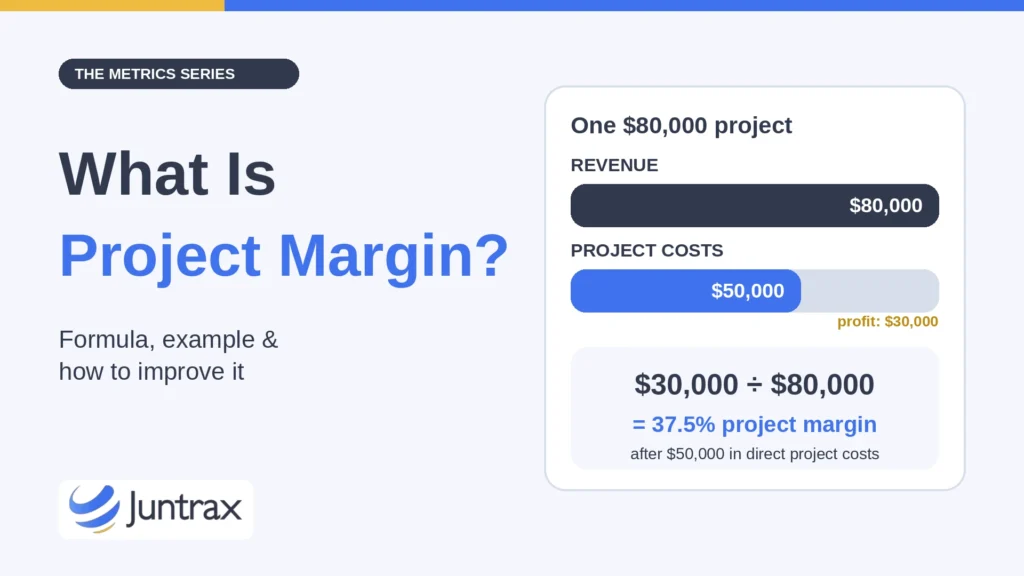
$35,000 + $10,000 + $5,000 = $50,000
Project profit before any excluded overhead is:
$80,000 − $50,000 = $30,000
Project margin is:
$30,000 ÷ $80,000 × 100 = 37.5%
Result: A 37.5% project margin.
In other words, the project keeps $0.375 of every revenue dollar after the costs in the calculation. This figure is not the company’s final net profit, because overhead, taxes, and other costs may sit outside the project calculation.
Why Project Margin Matters
Project margin shows managers the financial quality of the work they deliver. Revenue alone can mislead, because two projects with similar contract values may need very different levels of effort and expense.
A large contract can still produce a weak margin if the team needs far more hours than expected. Meanwhile, a smaller project may be more profitable when the scope is clear, delivery runs efficiently, and the team uses its time well.
Margin also supports better commercial decisions. Firms can use past project results to refine estimates, review pricing, find recurring delivery problems, and decide which types of work fit their operating model.
Still, read margin in context. A strategically important project may carry a lower margin because it opens a new client or service line. That choice should be deliberate and backed by a clear commercial rationale.
How to Improve Project Margin (4 Steps)
- Compare actual project costs with the original estimate. Identify whether the difference comes from extra labor, contractor spending, expenses, or a change in the work required.
- Review the scope and project plan. If the team keeps doing work that was never in the original agreement, tighten the change-control process and commercial approval requirements.
- Examine resource allocation and delivery practices. Aim to put the right skills on each task and cut avoidable rework. Cutting hours without regard for quality or client requirements can create bigger problems later.
- Compare margins across similar projects. Look for recurring patterns in pricing, project duration, resource mix, and client requirements instead of drawing conclusions from a single project.
3 Common Project Margin Mistakes to Avoid
- Confusing margin with markup: Margin divides profit by revenue, while markup divides profit by cost.
- Ignoring direct project costs: Missing contractor fees or expenses can make a project look more profitable than it is.
- Comparing inconsistent calculations: Projects should use the same revenue and cost definitions when you compare their margins.
Project Margin vs. Realized Rate and Revenue Leakage
Project margin moves with the realized rate and can fall when revenue leakage reduces revenue capture. It also depends on how the firm manages [billable vs. non-billable hours] and the delivery costs that come with them.
For benchmarks and the full metric set, read [the metrics every professional services firm should track].
Track Project Margin with Juntrax PSA Software
Juntrax links project work with the relevant financial information. Timesheets connect employee hours to projects, and the system calculates project payroll cost from each employee’s hourly pay rate. Vendor expenses and employee reimbursements can also be tagged to projects.
The project financial dashboard shows total purchase order value, invoiced amounts, pending invoices, remaining billing, net profit and loss, and estimated versus actual hours. It also provides resource-level bill and pay figures that help managers examine project economics.
Explore Juntrax PSA software for project billing and financial visibility.
Project Margin FAQs
The right margin depends on the service line, pricing model, cost structure, and commercial strategy. Compare similar projects using consistent calculations and set targets based on your own financial requirements.
Yes. A small project can post a high margin percentage while earning a modest amount of profit. Review both margin and absolute profit when you evaluate project performance.
Plan your next project in Juntrax, free for 14 days
Start Free Trial