Design for Manufacturability (DFM): The Strategic Key to Scaling Production
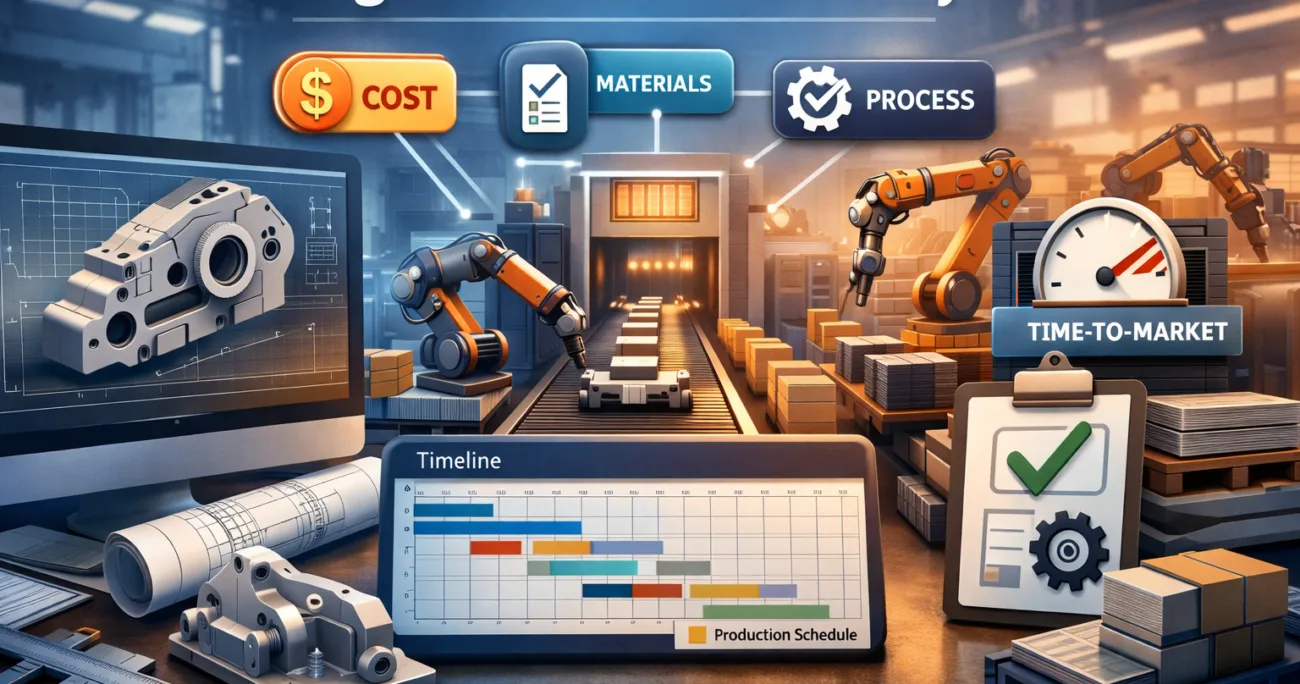
Design for Manufacturability (DFM): The Strategic Key to Scaling Production
Notably, engineers do not just design great products; they build them for long-term success. Specifically, Design for Manufacturability (DFM) stands as one of the most effective manufacturing cost reduction strategies because it aligns engineering vision with operational efficiency from the very first day. Furthermore, this discipline allows teams to create products that they can produce easily, cost-effectively, and reliably at scale. Consequently, when teams neglect these principles, even brilliant designs often become expensive or impossible to manufacture.
For growing companies, DFM ensures that engineering vision meets operational reality. Therefore, instead of simply asking “Can we design this?” high-performing teams must ask:
Can we build this without wasted motion or specialized labor?
Does our supply chain provide these raw materials readily?
Can our factory assemble this consistently 10,000 times?
Will the unit cost drop as our volume increases?
How DFM Acts as a Manufacturing Cost Reduction Strategy
In fact, small choices in the design phase create massive ripples in production. For instance, without a “manufacturability-first” mindset, production teams often inherit problems that they did not create. Specifically:
Lead Time Bloat: Choosing a custom part instead of a standard one adds weeks to a supplier’s timeline.
Labor Costs: Complex assemblies require more hands-on time and increase training costs.
Procurement Risk: Uncommon materials make your business vulnerable to sudden market fluctuations.
Rework Expenses: Ultimately, late-stage design changes cost ten times more than early-stage adjustments.
The 5 Core Principles of DFM Strategy
In addition, you should focus on these five pillars to optimize your product development lifecycle:
Reduce Part Count: Specifically, fewer components lead to faster assembly and fewer points of failure.
Standardize Materials: Similarly, using common inputs simplifies procurement and stabilizes your pricing.
Simplify Manufacturing Processes: Moreover, you should avoid overly complex steps that require specialized machinery or rare skills.
Design for Realistic Tolerances: As a result, your products will function under real-world conditions rather than just in a lab.
Plan for Serviceability: Ultimately, you must consider how the team will test and maintain the product to lower its total lifecycle cost.
The Coordination Challenge: Where Most Teams Struggle
However, DFM failure rarely stems from poor engineering. Instead, it usually results from a failure of coordination. Specifically, in many organizations, data lives in separate, disconnected silos. Consequently, engineering tools do not “talk” to procurement systems. Moreover, finance teams may not see the cost implications of a design choice until the budget disappears. Ultimately, these disconnected data points lead to reactive and expensive decision-making.
How Juntrax Drives Real-Time Project Profitability
Notably, Juntrax transforms how organizations track their most valuable asset: time. Specifically, high-growth companies reach their full potential only when they gain total visibility into their project margins as they happen. Consequently, our platform connects your team’s daily activity directly to your financial outcomes.
Live Budget Tracking: For example, leaders see exactly how labor hours affect project budgets in real-time. This prevents the “hidden” overages that usually destroy monthly margins.
Automated Resource Planning: Similarly, you can track employee utilization and capacity to ensure you assign the right people to the right tasks without causing burnout.
Streamlined Invoicing: As a result, you will convert approved timesheets and expenses into professional invoices with a single click—drastically reducing your billing cycle.
Ultimately, by linking your workforce activity with your project execution, Juntrax moves your organization away from “spreadsheet chaos.” Therefore, you can embrace a proactive strategy that ensures your business remains profitable while you scale.
Frequently Asked Questions (FAQ)
What is the primary goal of DFM? Primarily, DFM aims to create products that teams can manufacture easily, reliably, and economically while maintaining high quality.
Is DFM only for large-scale manufacturers? On the contrary, startups and mid-sized companies benefit even more because they have less capital to waste on production errors.
Who should be involved in the DFM process? Ideally, you should involve a cross-functional team including Engineering, Operations, Procurement, Quality Control, and Finance.
Final Thoughts: Innovation Meets Reality
Ultimately, a design only succeeds if your team can produce it consistently and profitably. Therefore, DFM ensures your innovation survives its first contact with the real world. When you support your design with strong operational visibility, you move beyond “fixing” problems and start preventing them entirely.
Ready to build products that scale with confidence? Align your design decisions with your operational outcomes today. Discover how Juntrax provides the visibility you need to grow with control.