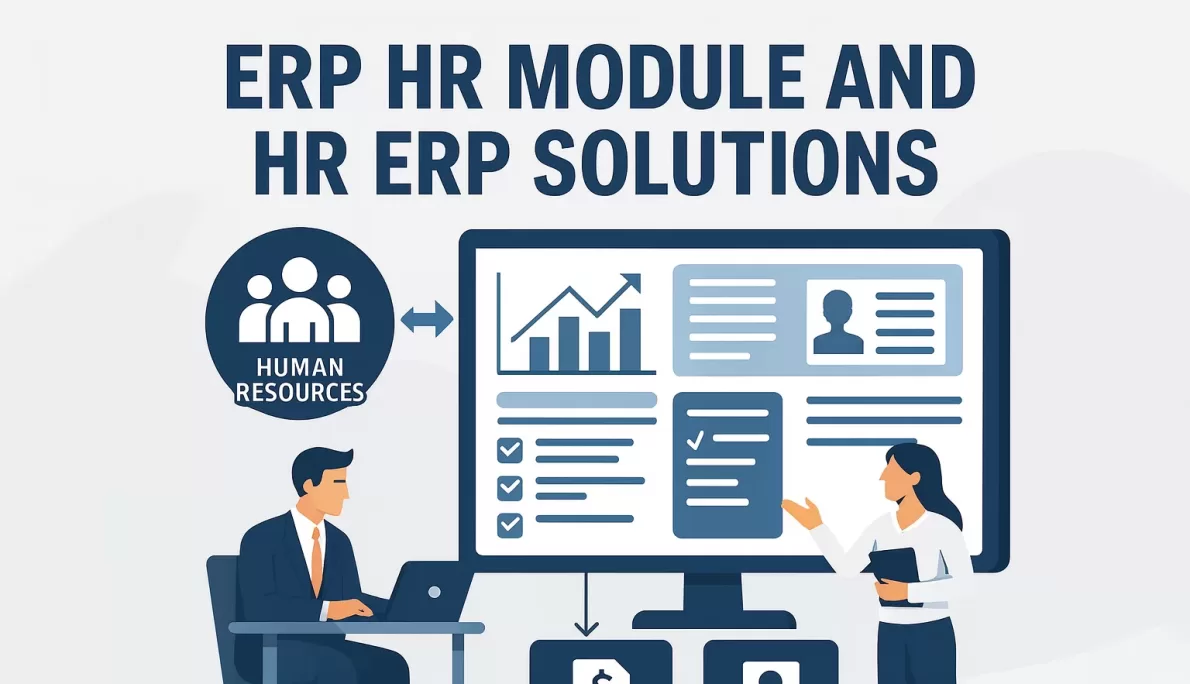
For many businesses, managing HR can feel overwhelming, juggling payroll errors, scattered employee records, manual leave tracking, and disconnected systems that waste time and resources. These challenges not only slow down operations but also prevent HR teams from focusing on other important HR management tasks. That’s why more organizations are turning to ERP HR modules.
An ERP HR solution integrates your HR department and HR management with every other part of the organization through a unified enterprise resource planning (ERP) system.
That means all HR data, from work hours and leave management to employee performance connects seamlessly with financial, operational, and management systems.
This integration turns HR into a central hub for productivity, strategy, and growth.
What Is a ERP HR module or HR ERP Software?
ERP HR module (or HR ERP software) is an integrated software that automates and manages human resource processes. Unlike standalone HR software, ERP HR connects HR data directly with broader business processes such as billing, project management etc.
With ERP HR, HR professionals can:
- Manage the entire employee lifecycle, from hiring to offboarding.
- Manage the payroll process.
- Automate repetitive administrative work
- Access real-time reports on workforce metrics
- Track compliance and benefits in one dashboard
The Purpose of the HR Module in ERP Systems
The ERP HR module goes beyond basic HR automation, it serves as the backbone of efficient, data-driven workforce management. By connecting HR with finance, operations, and other core business systems, it provides a unified view of your entire organization. This integration reduces manual work, minimizes errors, and enhances collaboration across departments. Businesses can run payroll, track performance, manage employee records, and plan workforce needs, all from a single platform.
It streamlines routine HR functions, enhances accuracy, and connects HR data with other critical departments like finance and operations.
With the HR module, teams can:
- Track employee records and attendance
- Automate payroll management and tax compliance
- Manage benefits administration and performance reviews
- Simplify leave management and approvals
This integration provides HR leaders with accurate insights for better workforce management and strategic planning.
Key Features of ERP Human Resource Management
Let’s break down what makes ERP human resource management so useful by understanding its key features:
1. Payroll Management and Process Automation
Payroll can be time-consuming and error-prone.
With an ERP HR module, salary calculations, tax deductions, and payslip generations happen automatically — saving hours of manual effort.
It also ensures compliance and eliminates payroll discrepancies.
2. Employee Records and Workforce Management
ERP HR systems create a single source of truth for all employee data.
HR teams can instantly access profiles, job histories, and attendance details — enabling better workforce planning and decision-making.
3. Leave Management and Benefits Administration
Digital leave management lets employees submit requests and track balances easily.
Meanwhile, HR can monitor work hours and manage benefits administration with transparency and fairness.
4. Performance Reviews and Talent Management
Modern HRM modules in ERP integrate tools for performance reviews, goal setting, and talent management.
This helps HR identify top performers, address skill gaps, and strengthen employee engagement and retention.
Benefits of Human Resources Management with ERP
1. Streamlined HR Functions and Data Accuracy
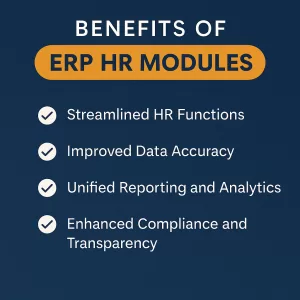
ERP HR brings all HR functions into one system, eliminating redundant data entry and errors.
It ensures real-time accuracy, allowing HR professionals to make informed decisions.
2. Better Decision-Making Through Integration
By linking HR with finance, operations, and management systems, it allows leaders to analyze how workforce performance impacts business results.
3. Improved Compliance and Risk Management
With built-in reporting, HR modules help maintain compliance with labor laws and internal policies.
It also ensures data transparency and reduces risks related to payroll and employee documentation.
4. Enhanced Employee Engagement
When processes are smooth and communication is transparent, employees feel valued.
An efficient HR module helps foster engagement and satisfaction across the workforce.
How to Choose the Right HR ERP Software
1. Define Your HR Needs
Start by identifying what your organization needs most. Is it payroll accuracy, performance tracking, or employee engagement?
Your ERP HR solution should match these goals.
2. Look for Integration and Scalability
Choose an ERP software that integrates easily with other systems and can grow as your workforce expands.
3. Prioritize User Training and Adoption
Even the best system fails without user adoption.
Train your HR professionals to understand and leverage every feature the ERP offers.
Challenges in ERP HR Implementation and Tips to Resolve them
While the benefits are clear, implementing an ERP HR module can bring challenges such as:
- Data Migration Issues: Moving existing employee data into the new system can be tricky. Use a phased approach to minimize risk.
- Change Management: Some employees may resist new technology. Communication and training are key to easing transitions.
- Customization vs. Stability: Customizing your ERP too much can affect performance. Balance personalization with system reliability.
Choosing Between an ERP HR Module and Standalone HR Software
When it comes to managing people and processes, both ERP HR modules and standalone HR software offer valuable benefits, the right choice ultimately depends on your business needs and scale.
If your company requires a comprehensive, integrated system that connects HR with finance, operations, and project management, an ERP HR module provides the advantage of centralized data and cross-departmental visibility. It’s ideal for growing or mid-to-large organizations looking to streamline workflows and make data-driven decisions across multiple business functions.
On the other hand, standalone HR software may be a better fit for businesses focused primarily on core HR tasks like recruitment, attendance, and payroll. It’s often easier to implement, more affordable upfront, and allows companies to adopt specialized HR tools without restructuring existing systems.
The decision isn’t about which option is “better,” but which aligns best with your company’s goals, resources, and future growth plans. Whether you choose a complete ERP HR module or a standalone HR software solution, the key is finding a platform that simplifies management, empowers your HR team, and supports long-term business success.
FAQs
1. What is an ERP HR module?
It’s a system that integrates all HR functions — like payroll, attendance, and performance reviews — into one ERP platform.
2. How does HR ERP software benefit organizations?
It automates processes, improves data accuracy, and supports strategic decision-making.
3. Can ERP HR help with workforce planning?
Yes, it uses analytics to forecast staffing needs and optimize employee placement.
4. Is ERP HR suitable for small businesses?
Yes. Modern ERP solutions such as Juntrax offer scalable HR modules tailored to SMEs.
5. What are the main features of ERP HR modules?
Key features include payroll management, employee records, leave management, and talent management.
6. What’s the difference between HR software and ERP HR?
HR software focuses on HR alone, while ERP HR integrates HR data across all business departments.