
Learn how fixed-fee projects work, how to calculate profit and margin, and how to protect profitability when costs or scope change.
What Is a Fixed-Fee Arrangement?
A fixed-fee arrangement is a billing model in which the service provider agrees to deliver a defined scope of work for a set price. The fee is agreed in advance, so the client’s payment does not rise each time the team spends extra hours on the agreed work.
For example, a consulting firm may agree to implement a reporting process for $20,000. If the firm delivers the agreed scope within the planned effort, it earns the contracted fee whether the team spends slightly more or fewer hours than expected.
Fixed-fee contracts give clients greater budget certainty. For service providers, profitability depends heavily on accurate estimates, scope control, and efficient delivery.
The contract should explain what the fee covers, what the client must provide, how changes are handled, and whether payments follow milestones or another schedule. Many firms set this out in a statement of work.
How to Calculate Fixed-Fee Project Profit and Margin
A fixed fee is a revenue commitment. The firm’s delivery costs decide how much of that revenue remains as profit.
Project Profit = Fixed Fee − Project Costs
Project Margin = (Project Profit ÷ Fixed Fee) × 100
These calculations assume the fixed fee is the project revenue used for the analysis and that the cost figure includes every category the firm intends to measure.
Fixed-Fee Project Example
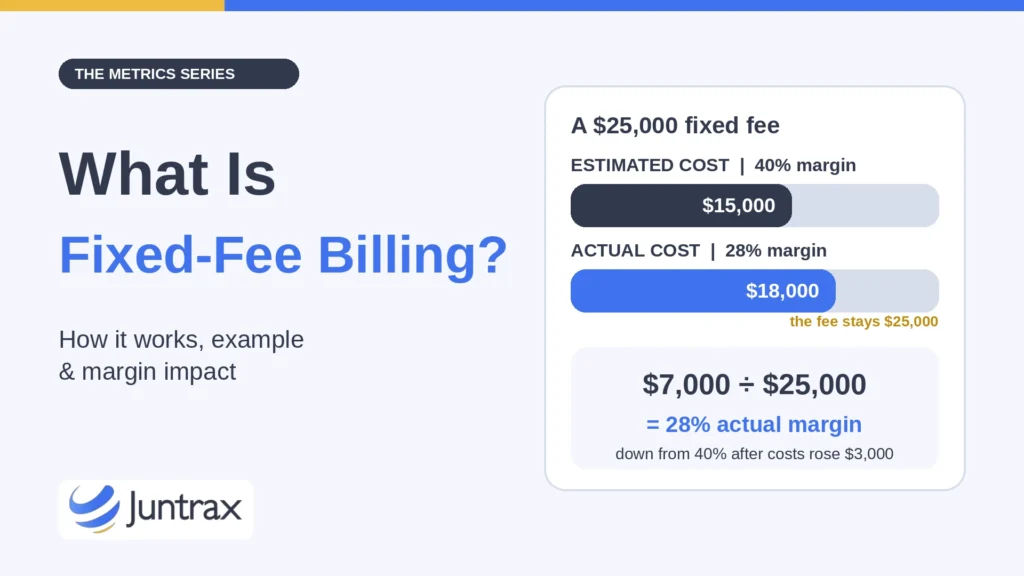
A consulting firm agrees to deliver a project for $25,000. Its estimated direct costs are $15,000.
The expected profit is:
$25,000 − $15,000 = $10,000
The expected margin is:
$10,000 ÷ $25,000 × 100 = 40%
During delivery, the project needs an additional $3,000 in direct costs, so actual costs rise to $18,000.
Actual profit becomes:
$25,000 − $18,000 = $7,000
Actual margin becomes:
$7,000 ÷ $25,000 × 100 = 28%
| Estimated | Actual | |
|---|---|---|
| Fixed fee | $25,000 | $25,000 |
| Direct costs | $15,000 | $18,000 |
| Profit | $10,000 | $7,000 |
| Margin | 40% | 28% |
Result: A $3,000 cost overrun cuts margin from 40% to 28%.
The firm earns less profit because delivery cost rose while the contracted fee stayed the same. Managers should investigate the extra costs and decide whether the cause was a poor estimate, rework, or a scope change that should have been handled commercially.
Why Fixed-Fee Billing Matters
Fixed-fee billing makes budgets easier for clients to plan. It also encourages service providers to improve delivery, since finishing the agreed work efficiently protects the project’s margin.
However, the model places heavy weight on the original estimate. If the team underestimates effort, overlooks dependencies, or accepts an unclear scope, the business may absorb extra costs without earning more revenue.
A well-defined scope is therefore essential. The agreement should list deliverables, assumptions, dependencies, acceptance criteria, and the process for handling requests outside the original plan.
Fixed-fee billing also makes project monitoring important. The contracted revenue may stay fixed, yet costs keep building as employees and contractors do the work.
How to Manage Fixed-Fee Projects (4 Steps)
- Break the deliverables into tasks and estimate the effort for each. Include review cycles, coordination, quality checks, and other activities that may not show in the final deliverable.
- Document the scope and assumptions. Agree on how the team will handle extra requests, delays caused by missing client inputs, and changes to acceptance criteria.
- Compare actual hours and costs with the estimate during delivery. If effort rises faster than expected, investigate the cause while the team still has room to adjust the plan.
- Run every change request through an explicit approval process. When a request changes the agreed scope, assess its effect on cost, timing, and commercial terms before you commit to the work.
3 Common Fixed-Fee Mistakes to Avoid
- Estimating only the visible production work: Reviews, meetings, coordination, and rework also consume resources.
- Accepting vague deliverables: Ambiguous scope makes it hard to tell whether a request is covered by the fee.
- Monitoring only the invoice schedule: A project may hit its payment milestones while delivery costs overrun the estimate.
Fixed Fee vs. Time and Materials, Project Margin and Scope Creep
Fixed-fee work makes project margin especially important, because extra delivery costs cut profit without raising the agreed fee. Scope creep can also erode a fixed-fee engagement when the team absorbs additional work with no commercial adjustment. For the alternative billing model, see time and materials.
To track the numbers that reveal a fixed-fee overrun early, read the metrics every professional services firm should track.
Manage Fixed-Fee Projects with Juntrax PSA Software
Juntrax supports project budgets set in planned hours, along with task estimates, resource assignments, and timesheets. Managers can record each team member’s pay rate and bill rate, while the financial dashboard shows purchase order value, billed amounts, pending invoices, remaining billing, net profit and loss, and estimated versus actual hours.
These records help managers compare the effort and costs involved in delivering a project.
Explore Juntrax PSA software for project planning and financial visibility.
Fixed-Fee FAQs
No. A fixed fee sets a total price for a defined scope of work. A fixed hourly rate sets the price per hour, so the final charge depends on the number of billable hours and the contract’s other terms.
The team should compare the request with the agreed scope. If it falls outside the contract, both parties can assess its effect on price, delivery time, and responsibilities before approving it.
Plan your next project in Juntrax, free for 14 days
Start Free Trial