
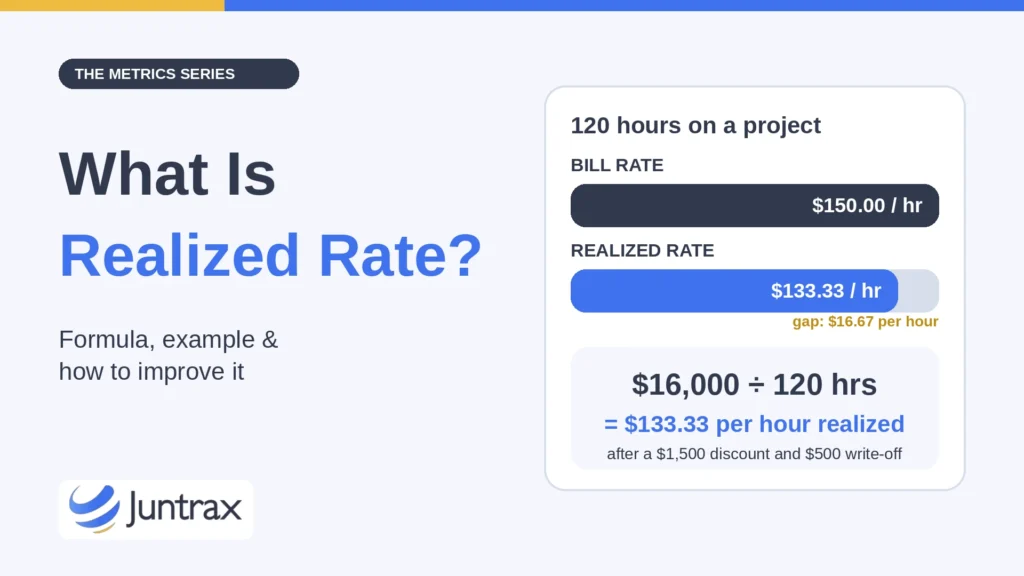
Learn how to calculate realized rate, see why it differs from your bill rate, and find where discounts and write-offs cut your revenue per hour.
What Is Realized Rate?
Realized rate measures the effective hourly revenue a professional services firm earns from work delivered to a client. It captures the difference between the nominal billing rate and the revenue the firm recognizes for the hours worked.
For example, a project may carry an agreed billing rate of $150 per hour. Discounts, write-offs, billing adjustments, or unbilled time can still pull the effective rate below that figure. Realized rate shows owners the revenue the team’s actual effort generates.
The exact calculation depends on the business’s accounting and reporting rules. Some firms use revenue invoiced, while others use revenue recognized or collected. These measures are related, yet they are not interchangeable, so define the revenue figure before you compare projects or reporting periods.
Realized Rate Formula
Realized Rate = Revenue Attributed to Work ÷ Hours Worked
For a consistent analysis, use the same revenue definition and the same set of hours across every project you compare. If the firm excludes non-billable hours, state that clearly, because the result will differ from a rate that includes all project effort.
Realized Rate Calculation Example
A consulting firm records 120 hours of work on a client project. At an agreed rate of $150 per hour, the potential billable value is:
120 × $150 = $18,000
However, the firm applies a $1,500 discount and writes off another $500. The resulting revenue figure is:
$18,000 – $1,500 – $500 = $16,000
The realized rate is:
$16,000 ÷ 120 = $133.33 per hour, rounded to two decimal places
The firm can now investigate the $16.67 gap between the nominal rate and the realized rate. The gap may reflect a deliberate commercial discount, a quality issue that required a write-off, or work that ran past the original estimate.
Why Realized Rate Matters for Profitability
Realized rate gives a more useful view of revenue per hour than the standard rate alone. It helps firms check whether pricing decisions turn into the revenue they expect.
A declining realized rate can point to several different issues. Teams may be granting more discounts to win or retain clients, recording more time than the scope allows, or failing to capture all billable work. Each cause calls for a different response.
For example, repeated discounts may call for a pricing review, while write-offs caused by rework may signal a delivery problem. If employees complete client work without logging the hours, the firm may need stronger time-recording and project-review processes.
Managers should also compare realized rate with project costs. A high rate does not guarantee a profitable project if delivery takes much longer than expected.
How to Improve Realized Rate (4 Steps)
Begin by comparing the agreed rate with the rate achieved on completed work. Break down discounts, write-offs, and unbilled hours where the data is available.
Next, review projects that repeatedly need extra effort. If a team keeps exceeding estimated hours, the original scope, delivery assumptions, or staffing plan may need adjustment.
Then set a clear approval process for discounts and write-offs. Commercial flexibility can be useful, but managers should understand how each adjustment affects project economics.
Finally, review realized rate alongside project margin and delivery quality. This stops the team from improving one metric through decisions that damage the wider client relationship.
3 Common Realized Rate Mistakes to Avoid
- Confusing realized rate with the standard bill rate: The standard rate is the agreed price, while the realized rate reflects the revenue attributed to actual work.
- Mixing revenue definitions: Invoiced, recognized, and collected revenue can differ.
- Reviewing the rate without project costs: Strong revenue per hour can still produce weak margins when delivery costs run high.
Realized Rate vs. Project Margin and Revenue Leakage
Realized rate affects project margin because revenue per hour shapes how much is left to cover delivery costs. It also relates to revenue leakage, which covers revenue the firm should have captured but did not.
To see how realized rate fits with other core numbers, read the metrics every professional services firm should track.
Track Realized Rate with Juntrax PSA Software
Juntrax lets managers set resource-specific pay rates and bill rates within projects. Bill rates can vary by work location, and team members can be marked as billable or non-billable.
Timesheets connect recorded hours with project tasks. The project financial dashboard shows total purchase order value, billed amounts, pending invoices, remaining billing, net profit and loss, and resource-level bill and pay figures.
These records help managers review the link between project effort and financial performance. Realized rate can then be calculated separately using the firm’s chosen revenue and hours definitions.
Explore Juntrax PSA software for project billing and financial visibility.
Realized Rate FAQs
Is Realized Rate the Same as Bill Rate?
No. Bill rate is the price assigned to a resource or service. Realized rate measures the effective revenue earned per hour under the chosen revenue and time definitions. Discounts, write-offs, and unbilled work can make the two figures differ.
Can a Project Have a High Realized Rate and Still Lose Money?
Yes. A project can generate strong revenue per hour while consuming too many hours or carrying high delivery costs. Review realized rate alongside project margin and total delivery effort.
See how project hours and costs stay connected. Full platform access, no credit card required.