
Learn how to estimate revenue leakage, see where unbilled hours, missed expenses and scope changes hide, and close billing gaps before they become lasting losses.
What Is Revenue Leakage?
Revenue leakage occurs when a business fails to capture revenue it was entitled to, or could reasonably expect to, earn. In professional services, this can happen when employees do not record all billable hours, teams overlook contractually billable expenses, or delivery grows beyond the agreed scope with no matching commercial adjustment.
Revenue leakage is hard to spot because the missing revenue rarely shows up as a rejected invoice or an overdue payment. Instead, the firm may complete work without recording it, miss an eligible expense, or absorb extra effort without revising the project agreement.
Not every difference between planned and actual revenue counts as leakage. A deliberate discount, a contractual cap, or a decision to waive a charge may be entirely appropriate. The key question is whether the firm failed to capture revenue it was entitled to under the agreement or its approved commercial policy.
How to Estimate Revenue Leakage
No single formula fits every business. A practical approach is to total the value of eligible work and expenses the firm completed but did not bill, after accounting for contract terms and approved adjustments.
Estimated Revenue Leakage = Value of Eligible Unbilled Work and Expenses
Avoid counting the same item twice. For example, if an unbilled timesheet entry already sits in a project’s estimated unbilled value, do not add it again under a separate category.
Revenue Leakage Example
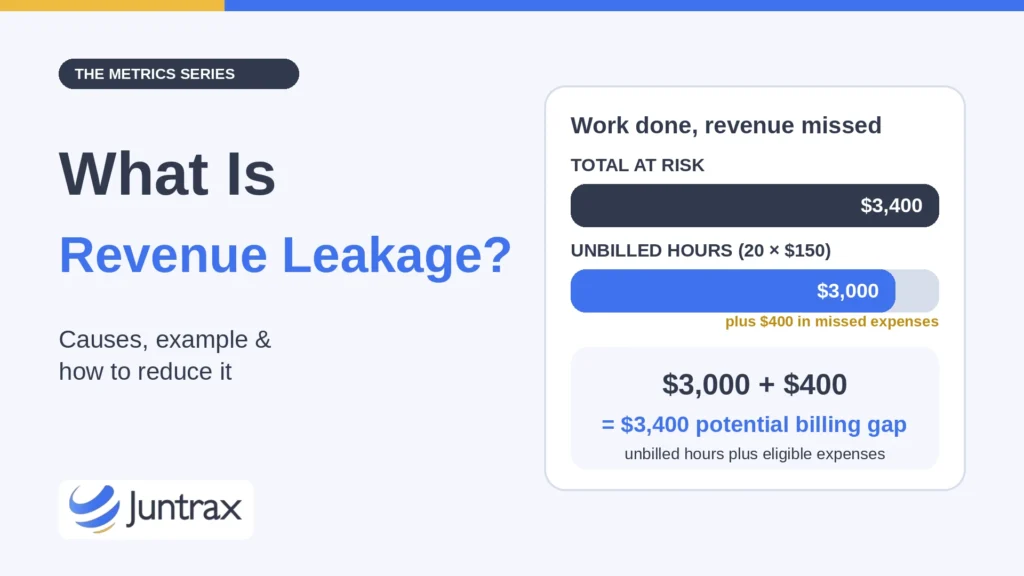
A consulting team records 20 hours of work that qualify for billing at an agreed rate of $150 per hour. The hours are missing from the draft invoice.
The potential billing value is:
20 × $150 = $3,000
The firm also finds $400 in eligible project expenses that the billing review missed. If both amounts are valid under the contract, the total potential revenue at risk is:
$3,000 + $400 = $3,400
Result: $3,400 in potential revenue at risk.
This figure represents a potential billing gap. The firm can still correct the invoice, and the client may still pay. The amount becomes a lasting loss only if the firm cannot recover it because of contract restrictions, client disputes, or late discovery.
Why Revenue Leakage Matters for Project Profitability
Professional services firms incur costs while they deliver client work. When they fail to bill eligible hours or expenses, those costs eat into the project’s return with no matching revenue.
Leakage also makes project reporting unreliable. Managers may see a project as less profitable than expected without knowing whether the cause is pricing, delivery effort, or incomplete billing.
Common causes include inconsistent time entry, unclear approval processes, poor communication between delivery and finance, and scope changes that never reach the commercial owner.
The earlier a firm finds these gaps, the more options it has to close them. A missing time entry may take minutes to fix, while an unapproved scope change found after project completion is much harder to recover.
How to Reduce Revenue Leakage (4 Steps)
- Define a clear process for recording work and expenses. Employees should know how to submit timesheets, classify billable work, and document eligible project expenses.
- Compare project activity with the commercial agreement. Check that the hours recorded, expenses incurred, and work completed line up with the billing rules. Investigate exceptions instead of assuming every difference is an error.
- Assign responsibility for reviewing project billing. Delivery managers know what work the team performed, and finance teams know the invoicing requirements. Both perspectives help catch missing information before the billing cycle closes.
- Document approved discounts and write-offs. A transparent approval process separates deliberate commercial decisions from revenue the firm unintentionally failed to capture.
3 Common Revenue Leakage Mistakes to Avoid
- Treating every unbilled amount as lost revenue: Some amounts are pending, excluded by contract, or deliberately waived.
- Reviewing leakage only after project completion: Older gaps are harder to resolve.
- Focusing only on timesheets: Eligible expenses, scope changes, and contract terms also affect billing.
Revenue Leakage vs. Realized Rate and Project Margin
Revenue leakage can lower the realized rate and weaken project margin. It also ties to [billable vs. non-billable hours], because correct time classification helps teams find eligible billable work.
For the wider set of numbers that expose leakage, read the metrics every professional services firm should track.
Track Revenue Leakage Gaps with Juntrax PSA Software
Juntrax connects project tasks, timesheets, expenses, and financial information. Employees record hours against projects and tasks, and vendor expenses and employee reimbursements can be tagged to projects. The project financial dashboard shows total purchase order value, billed amounts, pending invoices, overdue amounts, remaining billing, and net profit and loss.
These records help managers compare project activity with billing information and investigate gaps.
Explore Juntrax PSA software for project billing and financial visibility.
Revenue Leakage FAQs
Common causes include missing billable hours, unbilled eligible expenses, unapproved scope changes, incorrect billing classifications, and avoidable write-offs. The causes vary by contract and delivery process.
Review billing information often enough to correct gaps while the project is still active. The right cadence depends on the firm’s invoicing cycle, contract terms, and project complexity.
Track timesheets against every project, free for 14 days
Start Free Trial