
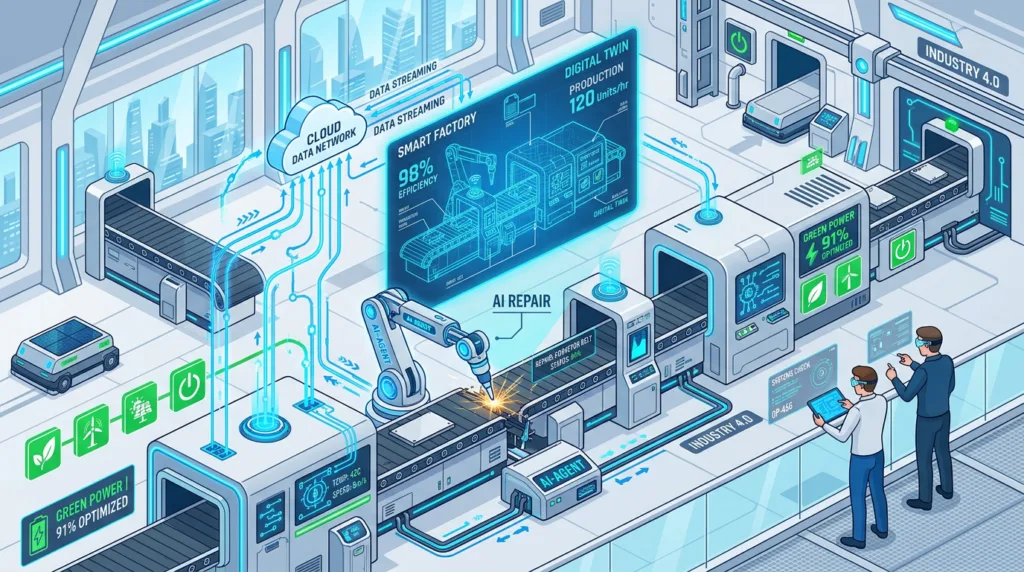
How IoT and real-time data are redefining efficiency
At the heart of smart manufacturing lies the ability to capture and act on real-time data. The Industrial Internet of Things (IIoT) connects machines, sensors, and operators across production lines, creating a seamless flow of information between the physical and digital layers of the manufacturing environment. This integration is not just about connectivity—it is about intelligence. By embedding IoT-enabled sensors throughout the production process, manufacturers gain continuous visibility into machine performance, energy usage, and material flows.
The benefits are transformative. IIoT-driven predictive maintenance can reduce equipment breakdowns by up to 70%, cut maintenance costs by 30%, and deliver savings of 12% over scheduled repairs. Real-time monitoring minimizes downtime, enhances resource utilization, and creates a data-rich environment where every decision is informed by live operational insights.
Why cloud computing and analytics power intelligent decision-making
The digital backbone of smart manufacturing is built on cloud computing and advanced analytics. With production systems generating massive volumes of data, cloud platforms enable companies to integrate disparate datasets into a unified view of their operations. This scalability allows manufacturers to analyze, interpret, and act on data without being constrained by traditional IT infrastructure.
The business case is clear. Deloitte’s 2025 Smart Manufacturing Survey found that 78% of manufacturers allocate more than 20% of their improvement budgets to smart manufacturing initiatives, focusing heavily on cloud analytics, AI, and sensors (Deloitte). Organizations adopting these tools are reporting 10–20% increases in production output, up to 20% higher employee productivity, and 15% greater capacity utilization (SmartIndustry).
This shift from data collection to data intelligence is enabling a new era of decision-making in which supply chains, production processes, and even product innovation are continuously optimized.
AI and machine learning: beyond automation to intelligence
While automation has long been central to manufacturing, artificial intelligence (AI) and machine learning (ML) are redefining what automation means. Instead of executing pre-programmed tasks, AI-driven systems analyze patterns in real-time data, identify inefficiencies, and autonomously recommend or implement corrective actions.
A recent study revealed that 95% of manufacturers have invested or plan to invest in AI/ML within the next five years (Plex Rockwell). These systems improve quality control by detecting microscopic defects invisible to human inspectors, ensure predictive maintenance is implemented before failures occur, and optimize production lines to minimize waste. In effect, AI and ML extend human decision-making capacity, transforming factories into adaptive, self-learning ecosystems.
Digital twins: bridging simulation and reality
Digital twin technology stands as one of the most promising advancements in modern manufacturing. It creates a virtual replica of a physical asset, machine, or production process that evolves alongside the real-world system. By integrating real-time data from IoT sensors, these digital models therefore allow manufacturers to simulate scenarios, test new processes, and optimize operations. As a result, companies can improve efficiency, reduce risks, and drive innovation without disrupting actual production.
The strategic advantage of digital twins lies in their ability to reduce errors, enhance customization, and accelerate innovation. Siemens, for example, emphasizes that digital twins allow companies to virtually design, test, and refine new products and workflows, resulting in shorter development cycles and fewer costly mistakes (Siemens). By bridging the gap between the physical and digital, manufacturers gain unprecedented control over outcomes in both production and product design.
Building resilient and sustainable supply chains
In today’s volatile global economy, resilience has become just as critical as efficiency, and smart manufacturing plays a pivotal role in achieving both. Moreover, its influence extends well beyond factory floors, as it increasingly strengthens supply chain management. By integrating IoT-enabled tracking systems and big data analytics, companies can therefore achieve end-to-end visibility across sourcing, inventory, logistics, and demand forecasting. As a result, this transparency not only allows organizations to anticipate disruptions but also enables them to respond proactively, thereby reducing the risks of material shortages or transportation delays. At the same time, sustainability is becoming deeply embedded within these processes, further amplifying their long-term value.
For instance, recent case studies demonstrate that IoT-based architectures can reduce energy consumption by 18%, decrease machine downtime by 22%, and improve overall resource utilization by 15% (arXiv). Consequently, smart manufacturing not only minimizes waste and lowers operational costs but also aligns seamlessly with global commitments to environmental responsibility, ensuring that efficiency and sustainability advance hand in hand.
The market outlook: investing in the intelligent factory of the future
The trajectory of smart manufacturing reflects its growing centrality to industrial strategy. Analysts project the global smart manufacturing market to reach USD 166.2 billion by 2025, expanding further to USD 386.4 billion by 2025 from USD 254.7 billion in 2022.
MetricStatisticSourceGlobal Market Value (2025)USD 166.2 billion Growth ProjectionUSD 254.7 B (2022) → USD 386.4 B (2025) Budget Allocation78% of manufacturers allocate >20% to smart manufacturing DeloitteAI/ML Adoption95% invested or plan to invest in next 5 years Productivity Gains10–20% output, 20% workforce productivity, 15% capacity gains.
Such growth signals that smart manufacturing is no longer optional; it is becoming a strategic imperative for companies seeking competitiveness, sustainability, and resilience in the decades ahead.
From automation to autonomy: the evolution of industry
The trajectory of manufacturing is clear: the sector is moving from automated systems reliant on pre-set rules to autonomous ecosystems capable of self-optimization and adaptive learning. Industry 4.0 represents this shift, emphasizing intelligent, interconnected factories. The future—sometimes called Industry 5.0—will further humanize this vision. This is by placing collaboration between humans and machines at the center, blending technological sophistication with human creativity and sustainability priorities.
Conclusion
Smart manufacturing is no longer a vision of the future; it is a present-day reality transforming the global manufacturing environment. By integrating IoT, AI/ML, digital twins, and cloud-based analytics, companies are reimagining their production processes and supply chains with unprecedented intelligence and adaptability. These advancements minimize waste, strengthen resilience, and open the door to sustainable, autonomous factories.
For Source Engineering Services, this transition therefore underscores the need to align engineering solutions with the evolving needs of manufacturers, while also helping clients not only automate but ultimately achieve true intelligence in their operations.
FAQs
1. What are the latest advancements in smart manufacturing and how do they improve efficiency?
Recent advancements in smart manufacturing increasingly center on the adoption of the Industrial Internet of Things (IIoT), artificial intelligence (AI). Additionally, machine learning (ML), digital twin technology, cloud-based data analytics. Specifically, IIoT enables real-time data collection across production lines, thereby reducing downtime and strengthening quality control through predictive maintenance. In parallel, AI and ML algorithms optimize workflows by detecting inefficiencies, reducing waste, and enhancing predictive decision-making. Furthermore, digital twins allow manufacturers to simulate production processes within virtual environments, which minimizes risks before physical implementation. When combined, these technologies significantly improve efficiency by enhancing equipment utilization. Also, streamlining production processes, and enabling adaptive, data-driven supply chain management.
2. What is the future of smart manufacturing?
The future of smart manufacturing lies in the convergence of intelligence-driven automation and sustainable production practices. By 2030, AI, cloud computing, and advanced robotics will integrate to create self-learning, autonomous manufacturing systems that continuously optimize themselves. Manufacturers will increasingly employ real-time monitoring and big data analytics. This is to achieve supply chain resilience, ensuring continuity even in volatile global markets. Moreover, the industry will prioritize sustainability through energy-efficient systems and waste reduction strategies, aligning with broader environmental and regulatory objectives. In this context, smart factories will evolve into adaptive ecosystems that not only maximize productivity but also minimize environmental impact.
3. What is the latest trend in advanced manufacturing?
One of the most significant trends in advanced manufacturing is the adoption of AI-enabled digital twins. Unlike traditional automation, digital twins allow manufacturers to simulate entire production environments virtually, integrating real-time operational data with predictive analytics. This enables proactive decision-making, from optimizing energy consumption to predicting material shortages. Edge computing and cybersecurity advancements ensure that IoT data is processed securely and efficiently at the source. These trends reflect a shift from isolated technological adoption toward fully integrated, intelligent manufacturing ecosystems.
4. What is smart manufacturing technology?
Smart manufacturing technology uses digital tools that make factories intelligent, connected, and adaptable. It combines IoT for real-time monitoring, AI and ML for predictive insights, cloud computing for data management. These technologies create smart factories where processes adapt automatically, decisions rely on data, and supply chains grow resilient. Unlike traditional mechanization, smart manufacturing adds digital intelligence to improve efficiency, minimize waste, and support sustainability.