

Most professional services firms believe they are audit-ready, right up until someone asks them to prove it. The belief holds because nothing has tested it. Invoices go out, payroll runs, projects close, and the long absence of a crisis quietly gets mistaken for the presence of control. Then a triggering event arrives: a statutory audit, an investor’s due diligence request, a cross-border compliance review. Within days, the firm is asked to produce one coherent, accurate, timely picture of its own operations, reconciled across its people, its projects, and its finances. That is the moment readiness gets tested, and for firms running each of those functions in a separate system, it is also the moment things start to come apart.
This guide is written for the CHRO, COO, and CFO of a 100 to 150-person firm that has either just lived through one of these events or can see one coming. It covers what audit and compliance readiness actually means, how disconnected systems manufacture risk that stays invisible until it is expensive, what genuine readiness looks like in practice, and why the infrastructure decisions made three to five years before an audit determine how the audit goes.
What Audit And Compliance Readiness Actually Means
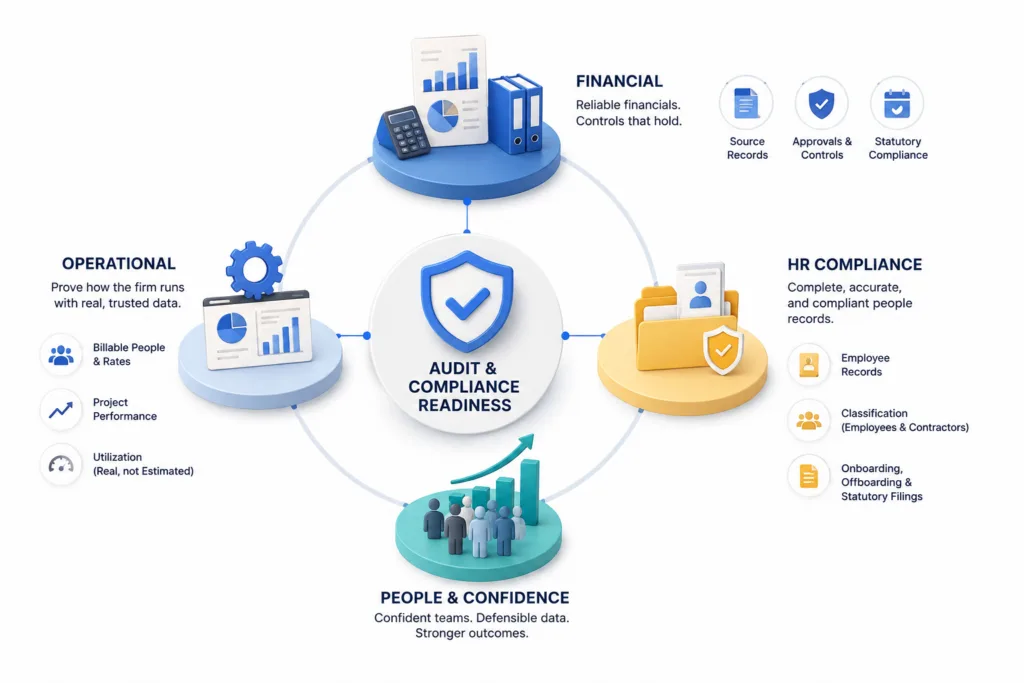
Readiness is often discussed as a documentation problem, as though it were a matter of finding the right files before the auditor walks in. In a firm of this size, it is closer to a property of the organization itself: its structure, its posture, its processes, and the confidence of the people who have to stand behind the numbers. Readiness shows up across four connected dimensions.
Financial Audit And Statutory Compliance
The financial layer is the one most leaders picture first. It is the ability to reconcile revenue, cost, and margin back to source records, to show that controls over approvals and adjustments functioned as intended, and to demonstrate that statutory obligations were met on time. For a project-driven firm, this is harder than it looks, because revenue is tied to engagements, engagements are tied to time and expense, and time and expense are tied to people. A clean financial picture depends on every one of those links holding.
Operational Readiness
Operational readiness is the ability to answer questions about how the firm actually runs. How many people are billable this quarter, and at what rate? Which projects are over budget, and by how much? What is the real utilization figure, measured rather than estimated? Auditors and acquirers test operational claims against operational data, and a firm that cannot produce that data quickly signals weak control long before any specific number is challenged.
HR Compliance Readiness
The HR layer carries obligations that are easy to underweight until they are examined: accurate employee records, correct classification of staff and contractors, complete documentation of onboarding and offboarding, and adherence to statutory timelines for filings, settlements, and benefits. Because people data feeds payroll, and payroll feeds finance, an error in the HR layer rarely stays in the HR layer. It propagates.
The Human Factor: How Readiness Shapes Confidence
There is a fourth dimension that rarely appears on a checklist, and it shapes the other three. When a firm is genuinely ready, the people who answer the auditor’s questions do so calmly, because the evidence is at hand and they trust it. When a firm is not ready, the same people spend the audit reconstructing the past under pressure, defending numbers they are not sure of, and absorbing the anxiety of leadership who can feel the ground shifting. Readiness is partly a state of the systems and partly a state of mind, and the second follows from the first.
How Disconnected Systems Create Audit Risk
When HR, projects, and finance live in separate tools that do not share a spine, the firm does not have one set of books with supporting detail. It has several overlapping versions of reality that mostly agree, until the day they are forced to agree exactly. The risk accumulates in three predictable ways.
Gaps And Mismatches In The Information On Record
A headcount number in the HR system, a billable roster in the project tool, and a payroll register in the finance system are supposed to describe the same group of people. In disconnected environments, they routinely do not. A contractor converted to full-time in one system but not another, a leaver still active in a third, a project reassignment that never reached finance: each is a small discrepancy on an ordinary day and a flagged exception during an audit. The mismatches were always there. The audit is simply the first event that requires them to be reconciled line by line.
No Single Source Of Truth Means A Versioning Problem
When the same figure can be pulled from three places, the firm has effectively decided to maintain three answers to every question and to hope they match. They seldom do. Utilization calculated from timesheets differs from utilization implied by the resourcing plan. Revenue in the billing tool differs from revenue in the ledger because of timing and adjustments that were never linked back. Without one reconciled system of record, every request during due diligence becomes an investigation into which version is correct, and that investigation is visible to the very people deciding whether to trust the firm.
Statutory Compliance Gaps That Surface Under Scrutiny
Statutory obligations are time-bound, and disconnected systems are poor at honoring deadlines that depend on more than one function. Consider a cross-border example that has become sharper recently. Under Section 17(2) of India’s Code on Wages, 2019, in force as part of the country’s new labour codes since 21 November 2025, an employee’s wage dues on exit must now be settled within two working days, a timeline that replaced the long-standing practice of thirty to forty-five days. Meeting that window requires HR, payroll, and finance to act in concert the moment a resignation lands. A firm whose offboarding depends on manual handoffs between three systems will miss it, and a missed statutory deadline is exactly the kind of finding an audit or compliance review is designed to surface.
The cumulative effect of these three failure modes is not a single dramatic error. It is friction. Requests that should take an hour take a week. Numbers that should be settled are debated. The finance team works late reconstructing what the systems should have recorded automatically, and with every delayed answer, the confidence of the auditor, the acquirer, and the firm’s own leadership erodes a little further. By the time the picture is assembled, the firm has spent its credibility proving competence it assumed it had already demonstrated.
What Audit Readiness Actually Looks Like
Readiness is far less about heroic preparation in the weeks before an audit and far more about infrastructure that keeps the firm ready by default. The firms that handle scrutiny well are not the ones that prepare hardest. They are the ones who built so that the preparation was already done. That infrastructure has a recognizable shape.
One System Of Record, Continuously Reconciled
The foundation is a single operational record that holds people, projects, time, expense, and the financial consequences of all three, reconciled continuously rather than at quarter-end. When a contractor is onboarded, the same action that creates the HR record provisions the project assignment and establishes the cost basis in finance. There is one headcount figure because there is one place where headcount lives. The versioning problem disappears because there are no longer competing versions to reconcile.
Evidence That Assembles Itself
In a ready firm, the audit trail is a byproduct of normal operation rather than a project undertaken when the auditor calls. Approvals, adjustments, time entries, and billing events are captured as they happen, attributed to a person and a moment, and queryable on demand. The question is no longer “can we reconstruct this?” but “which date range would you like?” Accurate operational data captured at the source is what turns a multi-week scramble into a same-day response.
What High-Readiness Firms Have In Common
The performance gap between firms that built this foundation and firms that did not is measurable. According to SPI Research’s 2025 Professional Services Maturity Benchmark, drawing on 403 firms across IT consulting, management consulting, software, accounting, marketing, and architecture and engineering, the most mature firms outperform the least mature by a wide margin: in 2024, organizations at the top maturity level recorded a 739% advantage in revenue growth, a 537% advantage in profit margin, and a 71% improvement in billable utilization over firms at the lowest level. The same study found that even average firms were under strain, with billable utilization at 68.9%, below the 75% optimal threshold, on-time project delivery slipping to 73.4%, and EBITDA margins falling to 9.8%, a five-year low, down from 15.4% the prior year.
Those numbers describe operational performance rather than audit outcomes directly, but they point at the same root cause. A firm that cannot measure its own utilization to the day is a firm that estimates rather than knows, and a firm that estimates is a firm that will struggle to prove anything under scrutiny. The high-maturity firms in that benchmark share a trait that is not glamorous: they run their people, projects, and finance on connected integrated infrastructure, which is why their numbers reconcile and their audits are quiet.
The table below shows how the two postures diverge across the dimensions an audit or due diligence event actually tests.
| Audit Dimension | When Systems Are Disconnected | When Infrastructure Is Integrated |
| Source of truth | Several overlapping records that mostly agree | One reconciled record |
| Producing an audit trail | Manual reconstruction across tools, taking weeks | A continuous, queryable trail |
| Statutory deadlines | Honored manually, often late | Triggered and tracked at the source |
| Headcount and utilization | Estimated, defended under pressure | Measured to the day |
| Due diligence response time | Days to weeks per request | Hours |
| Confidence of the team | Anxiety and scramble | Calm, with evidence on hand |
The Real Cost Of Being Unready
The financial penalties of a poor audit are real, but they are not the most expensive part. The deeper cost is what unreadiness does to the confidence of the organization. When a due diligence request exposes that the firm cannot quickly answer basic questions about itself, the finance team learns that the systems they rely on cannot be trusted, the operating teams learn that their leaders were working from approximations, and leadership learns, often in front of an investor, that the control they believed they had was assumed rather than verified. That loss of internal confidence outlasts the audit. It changes how people answer questions, how aggressively the firm pursues opportunities that require diligence, and how much energy is spent double-checking work that a sound system would have settled.
None of this is solved in the room. A firm cannot become ready during the audit that reveals it is not. Readiness is laid down earlier, in the unglamorous infrastructure decisions made three to five years before anyone asks to see the books. The firm that connected its people, projects, and finance back when it was crossing fifty employees is the firm that, at a hundred and fifty, answers the auditor’s questions in an afternoon. The foundation that looks like an operational nicety in a calm quarter turns out to be the thing that holds when compliance comes calling. The leaders who will be glad of it are the ones who built it before they needed it.
Frequently Asked Questions
What Does Audit Readiness Mean For A Professional Services Firm?
Audit readiness is the firm’s standing ability to produce an accurate, reconciled, and timely picture of its operations across people, projects, and finance, on demand. It spans financial accuracy, operational data, HR and statutory compliance, and the documented controls behind them. A firm is ready when answering an auditor or acquirer requires retrieval rather than reconstruction.
Why Do Disconnected Systems Increase Compliance Risk?
When HR, project, and finance data live in separate tools, the same fact can have several conflicting values, and statutory deadlines that depend on more than one function are easy to miss. These discrepancies stay invisible during ordinary operations and surface as flagged exceptions the moment an audit or due diligence review forces every record to reconcile exactly.
What Is A Single Source Of Truth, And Why Does It Matter For An Audit?
A single source of truth is one reconciled record that holds the firm’s people, projects, time, expense, and financial data together, so each figure has exactly one authoritative value. It matters because it removes the versioning problem: there is one headcount number, one revenue figure, and one utilization rate, each traceable to its source and ready to withstand scrutiny.
How Long Does It Take To Become Audit Ready?
Genuine readiness is built into infrastructure over years rather than assembled in weeks. A firm cannot become ready during the audit that exposes it. The practical answer is that readiness reflects decisions made well before the event, which is why firms that connect their systems early move through audits and due diligence quickly, while those that delay face a long and visible scramble.
Which Statutory Deadlines Catch Professional Services Firms Off Guard?
Time-bound obligations that span multiple functions are the most commonly missed because they require HR, payroll, and finance to act together. Full and final settlement timelines on employee exit are a clear example: under Section 17(2) of India’s Code on Wages, 2019, effective since 21 November 2025, wage dues must be settled within two working days, far tighter than the historical norm.
How Does Audit Readiness Affect Employee And Leadership Confidence?
Readiness shapes how the organization experiences scrutiny. When evidence is at hand and trusted, teams answer calmly, and leadership stays steady. When it is not, people defend numbers they are unsure of under pressure, and the discovery that leadership was operating on approximations erodes confidence in a way that persists well after the audit closes.