
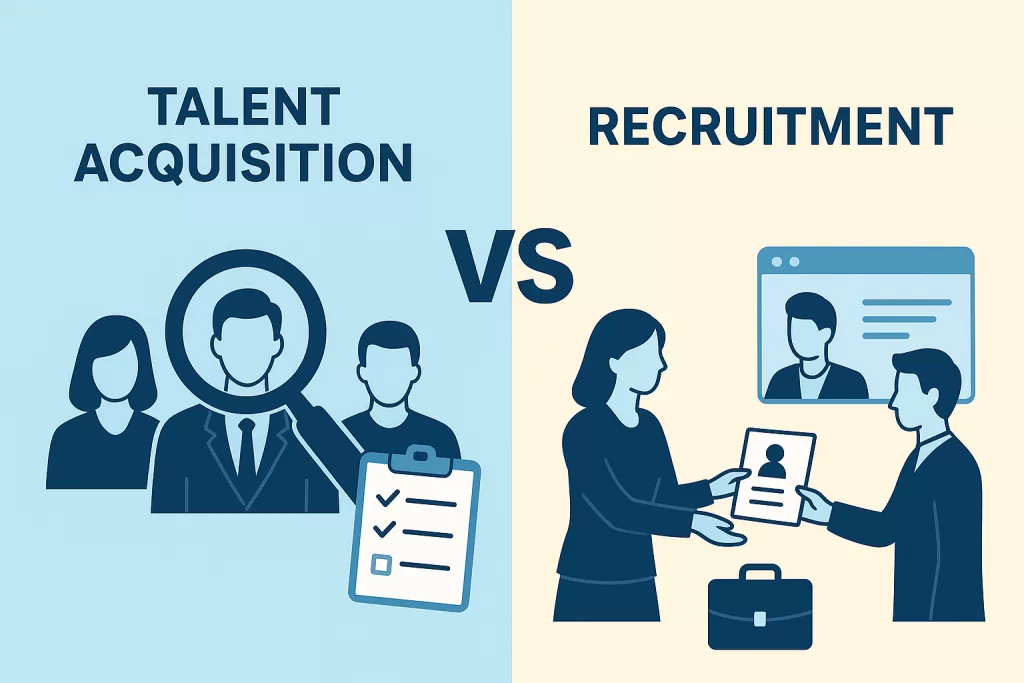
Attracting and retaining the right talent has become one of the biggest competitive advantages for businesses today. Whether you’re a growing startup, an SMB, or a global enterprise, building a strong workforce is no longer just about filling vacancies, it’s about aligning people with long-term business goals. This is where many organizations can face issues: the difference between talent acquisition and recruitment are often ignored, even though they reflect two very different approaches.
Understanding the difference isn’t just HR jargon. It directly impacts hiring quality, retention, and overall business growth. Understanding this distinction helps HR professionals, managers, and business leaders align hiring efforts with business goals.
This blog will break down the difference between talent acquisition and recruitment, compare both processes, and explain why modern organizations need to integrate them effectively.
What is Talent Acquisition?
Talent acquisition meaning goes beyond posting jobs and hiring candidates. It is a comprehensive, long-term strategy for identifying, attracting, and retaining high-quality employees who align with an organization’s business goals.
The talent acquisition process includes:
- Workforce planning: Aligning hiring needs with future growth.
- Sourcing passive candidates: Engaging talent not actively looking for jobs.
- Strong employer branding: Showcasing company culture to attract top talent.
- Interview process & assessment: Ensuring candidates fit both job requirements and organizational values.
- Job offer and onboarding support: Creating a smooth candidate experience during onboarding such HR software training, team introduction, and resolving issues that might come up during the process.
Talent acquisition teams focus on building a pipeline of candidates that ensures the quality of hires. Unlike recruitment, it’s proactive, not reactive.
What is Recruitment?
Recruitment, on the other hand, is more tactical. It focuses on filling specific vacancies quickly. Recruitment is the process of attracting and selecting candidates for current openings.
The recruitment process typically includes:
- Defining the job description and requirements.
- Posting job listings on portals or leveraging employee referrals.
- Screening resumes and shortlisting candidates.
- Conducting the interview process.
- Performing background checks.
- Making the job offer.
Recruitment strategies often leverage applicant tracking systems (ATS) to streamline the workflow. It’s an essential function of HR departments, but it tends to be more short-term in focus.
Also, Read: Top 10 Best HR Software in India (2025)
Difference between Talent Acquisition and Recruitment
Although closely related, talent acquisition and recruitment differ significantly in scope, purpose, and approach.
| Aspect | Talent Acquisition | Recruitment |
|---|---|---|
| Purpose | Long-term, strategic workforce planning | Short-term, filling current vacancies |
| Focus | Employer branding, engaging passive candidates | Job postings, sourcing active candidates |
| Approach | Ongoing and proactive | Transactional and reactive |
| Alignment | Future business goals | Current job requirements |
| Outcome | Builds pipelines and improves quality of hires | Fills roles quickly |
In simple terms, talent acquisition is strategy, while recruitment is execution. Both are vital but serve different business objectives.
Difference between Recruitment and Selection
Between recruitment and selection, difference is obvious even though they are both interconnected stages of the hiring process. Recruitment vs selection can be understood from their definitions:
- Recruitment is the initial stage where organizations focus on attracting as many suitable candidates as possible. This involves activities like writing job descriptions, advertising openings through job postings, leveraging employee referrals, and engaging with potential candidates. The goal is to create a large, qualified pool of applicants from which the organization can choose.
- Selection, on the other hand, comes after recruitment. It is the process of carefully evaluating the applicants from that pool to identify the most suitable candidate for the role. Selection methods often include resume screening, interviews, skill assessments, cultural fit evaluations, and background checks. The emphasis here is on quality, ensuring the chosen candidate not only meets job requirements but also aligns with company culture and long-term business goals.
Difference between Recruitment and Hiring
While recruitment and hiring are often mentioned together, they are not the same. The difference between recruitment vs hiring can be understood from their definition:
- Recruitment refers to the process of identifying, attracting, and engaging potential candidates. It includes defining job requirements, posting job ads, managing applications, and conducting interviews. Recruitment strategies may be ongoing to keep pipelines active, even if there are no immediate vacancies.
- Hiring, however, is the final step in the process. It involves extending a job offer, negotiating terms, and formally onboarding the candidate into the organization. Hiring transforms a potential candidate into an actual employee.
In simpler terms: recruitment finds the talent, hiring secures the talent.
Talent Acquisition vs Talent Management
Another common mix-up is the difference between talent acquisition and talent management.
- Talent acquisition: Focuses on sourcing and hiring the right talent.
- Talent management: Focuses on retaining and developing talent through performance reviews, employee lifecycle management, and succession planning.
An effective HR strategy requires both. While acquisition brings in fresh talent, management ensures increased productivity and long-term growth.
Recruitment Strategies vs Talent Acquisition Strategies
Recruitment strategies typically include:
- Writing clear job descriptions.
- Posting roles on job boards and portals.
- Using employee referrals.
- Running background checks.
Meanwhile, talent acquisition focusing strategies involve:
- Building a strong employer brand.
- Creating talent pipelines.
- Engaging with passive candidates.
- Aligning workforce planning with business goals.
Both are vital, but while recruitment addresses urgent needs, talent acquisition is about building resilience.
Why Understanding the Difference is Important
In many organizations, the line between recruitment, selection, and hiring can become blurred. This often leads to confusion between HR teams, managers, and employees about who is responsible for each stage.
By clearly defining these processes:
-
HR professionals can streamline workflows and reduce delays.
-
Managers can better understand their role in candidate evaluation.
-
Businesses can ensure a structured, fair, and effective approach to building their workforce.
When HR professionals, managers, and leadership teams understand the distinction, they can align hiring strategies with both short-term staffing needs and long-term business goals.
Conclusion
The debate of talent acquisition vs recruitment isn’t about choosing one over the other. Instead, businesses need to understand that recruitment is the process of filling roles now, while talent acquisition is about shaping the workforce for tomorrow.
For HR managers, and business owners, leveraging both strategies ensures better hiring outcomes, stronger teams, and alignment with business goals.
By investing in both talent acquisition and recruitment, organizations can achieve a balance between speed and strategy — ensuring they attract, select, and retain the best people for long-term success.
FAQs: Talent Acquisition and Recruitment Difference
Talent refers to skilled individuals an organization wants to hire and retain, while recruitment is the process of finding and hiring those individuals.
End-to-end recruitment covers sourcing to hiring for immediate needs, while talent acquisition is a broader, ongoing strategy focused on future workforce planning.
TA (Talent Acquisition) is a proactive approach to sourcing and engaging top talent, whereas recruitment is more transactional and immediate.
Talent acquisition is sometimes referred to as strategic hiring or workforce planning.