

When a single consultant bills one rate from your office, a different rate from home, and a premium rate at the client’s site, you are already running location-based billing rates, whether your system supports it or not. Most professional services firms discover this the hard way: the work has gone hybrid, but the rate card still assumes everyone sits in one place. The gap between those two realities is where margin quietly leaks.
This guide covers what location-based billing rates are, why managing multiple billing rates in projects breaks down at scale, how to build a rate card that varies by work location, and a worked example showing exactly how much a single misapplied rate can cost over a project. It is written for project managers, finance controllers, and operations leads at services firms where the same person bills differently depending on where the work happens.
What are location-based billing rates?
Location-based billing rates are billing rates that change according to where the work is physically performed: at your office, remotely, or on the client’s premises. Instead of tying one flat rate to a person or a role, you tie the rate to the work location captured on the timesheet, so each logged hour carries the correct commercial value.
This sits alongside the more familiar ways services firms vary rates. A consulting firm might already set rates by seniority (partner versus analyst), by service type (advisory versus implementation), or by client tier. Location is the dimension that hybrid and distributed work has made unavoidable, and it is the one most billing systems still ignore.
Why work location changes the right billing rate
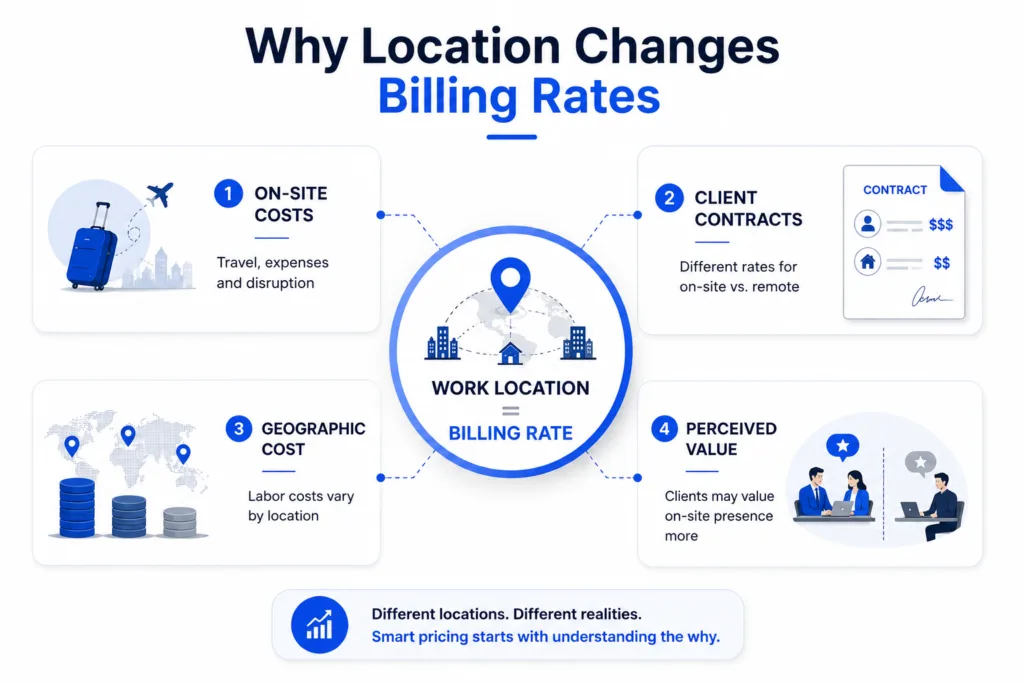
Rates differ by location because the cost and the value of an hour differ by location. A few drivers show up again and again in services contracts:
- On-site effort carries more cost. Travel time, expenses, and the disruption of working away from base all attach to client-site work, and contracts often price that in through a higher on-site rate.
- Client agreements specify it. Master service agreements and statements of work frequently lock in separate rates for on-site versus remote delivery, sometimes at the client’s insistence.
- Cost-to-serve varies by geography. A team member working from a high-cost metro, a regional office, or a different country can have a materially different cost basis, which flows into the rate.
- Perceived value differs. Many clients still attach higher value to someone physically in the room, and pricing reflects that perception.
The complexity compounds when the same employee moves between locations inside one project. A developer who spends Monday and Tuesday on-site for a workshop, then finishes the sprint from home, should generate two different billable values from one week of work. Apply a single blended rate and you misstate revenue on every line.
What managing multiple billing rates in projects actually requires
Defining the numbers is the easy part. Making them apply correctly, automatically, on every timesheet line across every project is where systems fall short. Managing multiple billing rates in projects requires five things working together:
- Rates assigned at the employee level, not just the project or role level, so the same person can hold more than one rate.
- A rate for each relevant work location (office, remote, client-site, and any geography-specific variants the contract demands).
- Automatic rate selection driven by the work location logged against each time entry, with no manual switching.
- Consistency across projects and clients, so a remote hour means the same thing everywhere and reports stay comparable.
- No manual overrides at invoicing, because every override is an opportunity for error and a reason finance cannot trust the numbers.
When any one of these is missing, teams fall back to spreadsheets, side notes, and post-billing corrections. That works at five projects. It collapses at fifty.
A worked example: what one misapplied rate costs
Numbers make the risk concrete. Consider a senior consultant on a three-month engagement with this rate card:
| Work location | Billing rate (per hour) |
|---|---|
| Office | $150 |
| Remote | $135 |
| Client-site | $185 |
Suppose the engagement runs 480 billable hours, split roughly 30% office, 45% remote, and 25% client-site. Billed correctly, the revenue looks like this:
| Location | Hours | Rate | Billed |
|---|---|---|---|
| Office | 144 | $150 | $21,600 |
| Remote | 216 | $135 | $29,160 |
| Client-site | 120 | $185 | $22,200 |
| Total | 480 | $72,960 |
Now apply one flat blended rate of $150 across all 480 hours, the shortcut most teams reach for when the system cannot vary rates by location. You bill $72,000. The difference looks small at $960, but it hides two offsetting errors: you have over-billed the remote hours by $3,240 (a client dispute and trust problem) while under-billing the client-site hours by $4,200 (pure margin you will never recover). The net masks the gross, and the gross is where the damage lives. Multiply that pattern across a portfolio and the leakage runs into real money every quarter.
This is the case for billing rates by work location that flat averages cannot make: accuracy on each line protects both the client relationship and the margin, and a blended rate sacrifices both while looking fine on the summary.
Why manual billing adjustments fail at scale
Most firms that have not automated location-based billing rates manage them by hand, and the same failure modes recur.
Wrong rates on logged hours: When the work location is not captured at the point of time entry, or rates are adjusted after the fact, the wrong rate gets applied. The result is under-billing or over-billing, and both erode trust and revenue.
Slower invoicing cycles: Manual rate verification means finance has to confirm hours, check work locations, and recalculate before invoices go out. Cash flow waits on that reconciliation.
Knowledge trapped offline: When rate logic lives in spreadsheets and email threads, billing depends on who remembers the rules rather than on a shared system. People leave; the rules leave with them.
Errors caught too late: Teams routinely find billing mistakes only after the invoice has been generated or sent. Fixing them then is slow, awkward to explain to the client, and damaging to the relationship.
Each of these gets more frequent as projects multiply and more employees split time across locations. The manual approach does not scale because the number of rate decisions grows faster than the team can check them.
How to set up a location-based rate card
A workable structure does not need to be elaborate. It needs to be consistent and automated. A practical sequence:
- Define your work-location categories. Start with office, remote, and client-site. Add geography-specific variants only where a contract or cost difference genuinely requires it, since every extra category adds reconciliation work.
- Set a rate per employee per location. Anchor each rate to the contract terms and the underlying cost-to-serve, not to a round number that feels right.
- Capture work location at time entry. The location has to be logged with each timesheet line, because that field is what drives automatic rate selection. Reconstructing it later is guesswork.
- Let the system apply the rate automatically. The correct rate should attach to each line based on the logged location, with no manual switching during the period or at invoicing.
- Review before invoicing, not after. Surface hours, locations, rates, and resulting margin while work is in progress so issues are caught early rather than corrected post-invoice.
The principle underneath all five steps: the rate decision happens once, at the point of time entry, and flows through automatically. Every place a human re-touches the rate is a place an error can enter.
Why billing accuracy and financial visibility matter together
Accurate rates only pay off if you can see what they add up to. For firms using professional services automation to run projects, time, and billing in one place, even small rate errors compound quickly into distorted margins and decisions made on bad numbers.
When projects and billing live in separate systems, teams lose the line of sight between delivery and revenue. That is why integrating projects with billing is central to keeping financial clarity as a firm grows. Without it, managers cannot reliably answer basic questions: how many hours are being delivered, whether billed amounts match actual effort, what a project costs versus what it earns, and which projects actually help the margin.
When financial insight only arrives after invoicing, the chance to act during delivery is already gone. Pairing accurate location-based rates with real-time visibility lets project teams monitor performance while work is live, catch margin risk early, make better staffing calls, and keep operations and finance working from one set of numbers.
How Juntrax handles location-based billing rates
Juntrax applies the correct billing rate automatically based on where work is performed. When a team member works from the office, remotely, or at a client site, the matching rate attaches to those hours without manual correction later. That removes the post-billing fixes and the dependence on side spreadsheets, so the billing data reflects the actual conditions of delivery.
It also brings the financial picture into one view: total hours worked, billed amounts, total pay, and estimated margin, available as work progresses rather than after invoices ship. As a firm expands across more people, locations, and clients, that combination of automatic rate application and live margin visibility is what keeps billing consistent without adding administrative load. The financials and project modules read from the same data, so delivery and finance never drift apart.
Benefits of location-based billing rates for growing teams
Done well, varying rates by work location produces compounding operational gains:
- Accurate billing without manual effort, because each hour carries the right rate for where it was worked, which cuts disputes and rework.
- Clearer margin visibility at the project level, since hours, billing, and cost line up and managers can see performance through the project lifecycle.
- Lower operational overhead, as automated rate application frees finance and operations from reconciling and correcting.
- Consistency as the firm scales, giving a stable framework that absorbs more locations and clients without new admin burden.
- Tighter alignment between delivery and finance, because both sides work from the same accurate, visible numbers.
Keeping billing clear as work scales across locations
Growth adds employees, locations, and client requirements, and each one adds billing complexity. Location-based billing rates contain that complexity by standardizing how rates are applied, reducing reliance on manual tracking, surfacing financial insight earlier, and supporting scale without proportional overhead. Clear billing and live visibility let a firm grow without losing confidence in how its projects are actually performing.
Conclusion
As services work spreads across office, home, and client sites, managing location-based billing rates has moved from a nice-to-have to a core requirement. When rates vary by where the work happens, flat averages and manual fixes hide the real economics of each project, and the errors surface too late to act on. A system that applies the right rate automatically based on the logged work location, and shows the financial result in one place, lets you reduce errors, keep clients confident in your invoices, and make better decisions while the project is still live rather than after the money has already moved.
FAQs
What are location-based billing rates?
Location-based billing rates are billing rates that vary depending on where work is performed, such as office, remote, or client-site locations. Instead of tying a single rate to a person or role, the rate is tied to the work location logged against each hour, so every billed hour reflects the correct commercial value of where it was worked.
How do you bill different rates for remote versus on-site work?
You define a separate rate for each work location, capture the location with each timesheet entry, and let your billing system apply the matching rate automatically. On-site work often carries a higher rate to cover travel, expenses, and the value clients place on physical presence, while remote work is typically priced lower. Automating the rate selection removes the manual switching that causes most errors.
Can one employee have multiple billing rates?
Yes. A single employee can hold different rates for office, remote, and client-site work, and those rates can change automatically based on where each block of time is logged. This is common in hybrid services teams where the same person delivers from several locations within one project.
Why do multiple billing rates cause billing errors?
Errors happen when rates are applied manually or tracked outside a shared system. If the work location is not captured at time entry, or rates are adjusted after the fact, the wrong rate gets applied, leading to under-billing or over-billing. Automating billing rates by work location, with the rate selected from the logged location, removes most of that risk.
How do you set up a location-based rate card?
Define your work-location categories (office, remote, client-site, plus any geography-specific variants), set a rate per employee per location based on contract terms and cost-to-serve, capture the work location on every timesheet entry, and configure the system to apply the correct rate automatically. Review hours, locations, and resulting margin before invoicing rather than correcting after.