
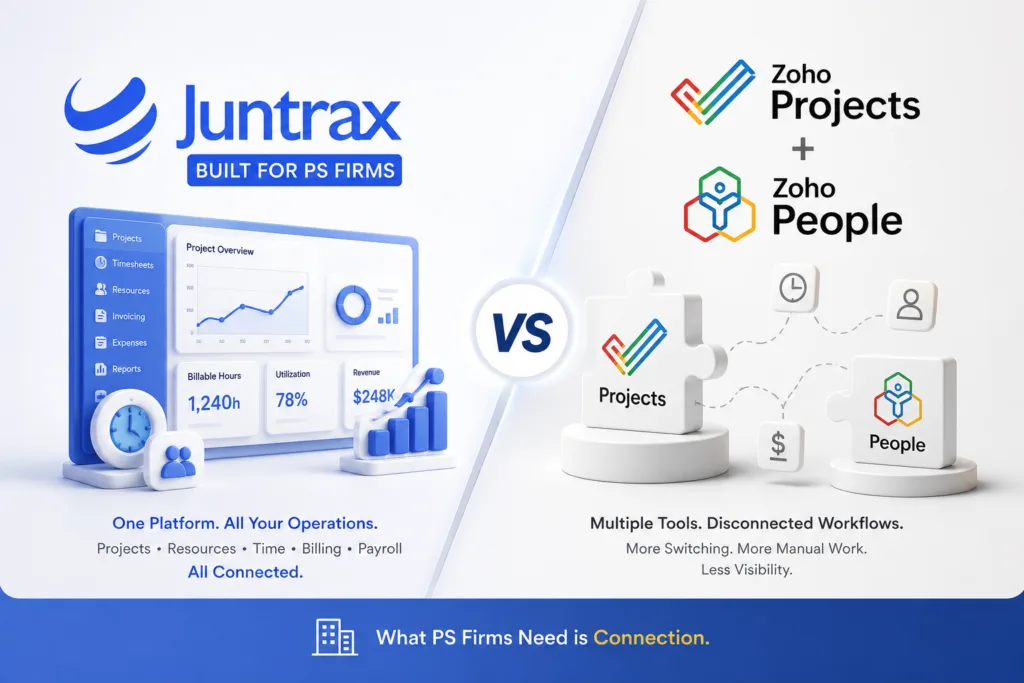
If you run a project-driven services firm, you have probably ended up here for one reason. You started with Zoho Projects to run your work. You added Zoho People to run your team. And somewhere along the way, you noticed the two never quite talk to each other. Your CEO asks what utilization looked like last month, and you open a spreadsheet, not a dashboard.
This guide compares two very different answers to that problem. On one side sit Zoho Projects and Zoho People, two capable apps from the same suite that you stitch together yourself. On the other sits Juntrax, a single platform that runs HRMS, PSA, and Cash-Flow on one data model. We will look at what each was built to do, where the seams show, how the pricing really adds up, and how to decide which fits the way your firm delivers.
Quick Summary
Zoho Projects and Zoho People are separate applications. Project delivery, billable utilization, invoicing, and cash flow live in different systems and often require manual reconciliation.
Juntrax is a unified HRMS, PSA, and Cash Flow platform built for professional services firms. Hours logged on a project flow directly into utilization reporting, invoicing, and receivables without duplicate data entry.
Choose the Zoho stack if you want two low-cost point solutions and are comfortable managing integrations. Choose Juntrax if you want your entire project-to-cash workflow to run on a single platform.
What Each Tool Was Built To Do
The fairest way to compare these options is to start with what each was built for, because that shapes how it behaves in a real firm.
Zoho Projects: A Project Management Tool
Zoho Projects is a project management tool, and it is good at that job. It gives you task hierarchies, dependencies, Gantt charts, Kanban boards, milestones, and built-in timers for logging hours against tasks. For a team that mainly needs to plan work and track progress, it is capable and affordable, and it slots neatly into the wider Zoho ecosystem.
Zoho People: An HR Platform
Zoho People is an HR platform. It handles employee records, onboarding, leave, attendance, shift management, and performance reviews, with timesheets and project billing on its higher tiers. As a system of record for your workforce, it does the job well. Like Projects, it is priced to be easy to adopt.
Juntrax: A Unified HRMS, PSA, and Cash-Flow Platform
Juntrax starts from a different place. It was built specifically for professional services firms as one operations platform across three areas:
- PSA. The PSA suite runs projects, timesheets, resource allocation, and bill rates.
- HRMS. The HR side covers everything from onboarding and attendance to payroll and performance.
- Cash-Flow. The finance side handles quotes, purchase orders, invoicing, expense reimbursements, and accounts receivable and payable.
The point is not that Juntrax has more boxes on a feature list. The point is that all three areas share one record, so a single timesheet entry drives payroll, utilization, and the client invoice at the same time.
The Gap Two Separate Apps Leave
Here is the crux of the whole comparison. Zoho Projects and Zoho People were built as separate products. Even when you run both, and even inside a Zoho One subscription, they share a login and basic contact data, but they were not architected around a single project-to-cash workflow. Getting hours tracked in one app to become a billable invoice in another, or getting resourcing decisions to reflect real cost, usually means integration work, Deluge scripting, or a manual export.
For most kinds of business, that is fine. For a professional services firm, that seam sits right on top of your most important number. Your product is your people’s time, so utilization, realization, and margin are the whole game.
What You Lose When Hours and Billing Live in Different Apps
When the app that tracks hours is not the app that runs billing, and neither one runs your cash flow, three things slip away:
- Visibility mid-project. You find out a project ran underwater in the post-mortem, not while you can still intervene, because margin only becomes visible after someone reconciles time, cost, and invoices across systems.
- Billable hours. Site visits, client calls, and late revisions that never make it onto a connected timesheet quietly never make it onto an invoice either. For a refresher on how those hours turn into revenue, see our guide on what billable hours are.
- Time to reconciliation. Someone on your team spends hours each week exporting from one tool, cross-referencing another, and rebuilding the same numbers in a spreadsheet to answer a question the software should answer on its own.
Why Utilization Visibility Matters More in 2026
This matters more now than it used to. According to SPI Research’s 2026 Professional Services Maturity Benchmark, drawn from 509 professional services organizations employing over 245,000 consultants, billable utilization across the industry fell to 66.4% in 2025. That is an all-time low. It sits below the 70% mark SPI treats as a healthy floor, and well under the 75% level that top performers sustain.
When the market gives you less margin for error, the cost of not seeing utilization and margin in real time climbs fast. Keeping delivery data and financial data in one place is how high performers catch overruns before they become write-offs.
That single-system design is the reason a unified PSA platform tends to serve growing services firms better than two apps bolted together. It is also the lens for the rest of this comparison.
Feature Comparison: Juntrax vs Zoho Projects + Zoho People
The table below maps the capabilities that matter most to a professional services firm. Read it with the previous section in mind. The meaningful differences are less about which features exist, and more about whether they share one record.
| Capability | Zoho Projects | Zoho People | Juntrax |
| Project planning and task management | Strong (Gantt, Kanban, dependencies) | No | Yes, built into PSA |
| Timesheets | Built-in timers on tasks | Timesheets on higher tiers | Yes, flow straight to invoicing |
| Resource allocation and capacity planning | Partial, deeper analytics on higher tiers | No | Yes, see who is over-allocated and who is on bench |
| Billable utilization roll-up | Limited, not tied to billing | No | Yes, across the portfolio |
| Invoicing and billing | Through Zoho Books integration | No | Native, hours to invoice on one platform |
| Accounts receivable and payable, cash flow | Not native | No | Yes, Cash-Flow module |
| HR: onboarding, leave, attendance, payroll | No | Yes | Yes, HRMS module |
| Expense tracking and reimbursements | Basic | Partial | Yes, tied to projects |
| Multi-entity and multi-currency | Varies by setup | Varies by setup | Yes, within one instance |
| Client portal | Basic, needs a Zoho account | No | Yes |
| One data model across HR, projects, and finance | No, separate apps | No, separate apps | Yes |
| Works alongside your accounting system | Pushes to Zoho Books | No | Integrates with Tally, QuickBooks, Xero, SAP |
One clarification is worth making, because it comes up often. Juntrax is not accounting software, and it does not try to replace your ledger. Most firms keep their accountant in their existing system. Juntrax handles project, time, and invoicing data, then pushes the journal entries across to Tally, QuickBooks, Xero, or SAP. It is the project-to-cash layer that sits between delivery and your books. That is precisely the layer a Zoho Projects plus Zoho People setup leaves you to assemble yourself.
Where Zoho Projects + Zoho People Fit Best
A fair comparison names the cases where the Zoho stack is the right call, and there are several.
When the Zoho Stack Makes Sense
The two-app approach fits best when one of these describes you:
- You are small and need the basics: Task coordination plus a basic HR record is often all a small team requires, and two low-cost apps cover it.
- You are already in the Zoho ecosystem: If you run Zoho CRM for sales and Zoho Books for accounting, Projects and People slot in with data you already have.
- Budget is the hardest constraint: If you have the internal appetite to wire the apps together and maintain those connections, the entry price is hard to beat.
Zoho Projects is also a strong pure project management tool. Its Gantt and dependency features are more mature than what many all-in-one platforms offer. A team whose core need is scheduling complex, interdependent work, without a heavy billing or cash-flow requirement, may be well served.
Where the Trade-Off Shows Up as You Grow
The trade-off appears with scale. A setup that works at 20 people managing 10 projects tends to create real friction at 60 people managing 50, because every gap between the apps becomes a manual process someone owns, and the reconciliation load scales with you.
Run your projects, timesheets, and billing in one place
Ready to simplify your operations? Start managing your projects, timesheets, and billing from one unified platform.
Where Juntrax Fits Best
Juntrax is built for a specific kind of company, and it is worth being just as precise about that.
Who Juntrax Is Built For
The best fit is a project-driven services firm of roughly 25 to 150 people that bills for its people’s time and has outgrown the spreadsheet-and-point-tools stage. Think IT and technology consultancies, engineering and EPC or MEP firms, staffing agencies, legal practices, marketing and creative agencies, and interior design and architecture studios. The fit gets stronger if your firm runs across multiple regions or entities. Juntrax runs each entity with its own currency, tax rules, and compliance inside one instance, while leadership sees a consolidated view of margin, utilization, and cash flow.
Signs You Have Outgrown Two Separate Apps
The value is clearest when your pain is the seam between delivery and finance. If you can answer yes to any of these, a unified platform earns its place:
- Your team keeps a resourcing spreadsheet alongside your project tool.
- You cannot say what utilization looked like this quarter in under a minute.
- Phase or milestone invoices go out weeks after the work is done.
- Billable hours regularly go untracked and unbilled.
Juntrax closes that loop. Hours flow into utilization reporting, into the invoice, and into receivables, without anyone rekeying data.
Firms across the US, India, and the Middle East already run this way on Juntrax, from Source Engineering Services to Casad Consultants. The common thread is simple. They stopped treating delivery and finance as separate systems.
Pricing: What You Pay in Practice
Pricing is where an apples-to-apples comparison gets slippery. Treat the figures below as published guide prices at the time of writing, and confirm current rates on each vendor’s own pricing page before you budget.
What the Zoho Stack Costs
For the Zoho stack, you are buying two products:
- Zoho Projects: Paid tiers run roughly from about 4 US dollars per user per month up to about 14 US dollars per user per month on annual billing, with a free plan for very small teams.
- Zoho People: Plans run roughly from about 1.25 US dollars per user per month up to about 4.50 US dollars per user per month on annual billing, again with a small free tier.
On paper, that looks inexpensive, and for a small team, it is. Two things tend to move the real number, though. First, the features a services firm cares about, such as timesheets with project billing, deeper resource analytics, and performance management, often sit on the higher tiers, so you rarely stay on the entry price. Second, if you want the apps to work together properly, you are often looking at Zoho One, bundled at a per-user rate for the whole suite, plus the internal or partner time to integrate and maintain the connections.
What Juntrax Costs
Juntrax prices as one platform rather than a stack of separately licensed apps, with module-based and bundle plans and volume discounts for larger user counts. Because HRMS, PSA, and Cash-Flow are one system, there is no second license to buy and no integration layer to build between them. You can see the current structure on the Juntrax pricing page. There is also a 14-day free trial with no credit card required, if you would rather see the numbers against your own setup.
Total Cost of Ownership: The Line That Hides on the Pricing Page
The honest way to compare cost is not sticker price per app. It is total cost of ownership, which adds up three things:
- The licenses for each product or platform.
- The integration work to connect delivery to billing to cash flow.
- The weekly hours your team spends reconciling what the tools cannot reconcile themselves.
That last line is invisible on a pricing page, and often the largest.
Migration and Setup
A common worry with any switch is the disruption. In practice, a unified platform can be faster to stand up than most people expect, because you configure one system instead of integrating several.
A Typical Juntrax Go-Live Timeline
For a firm of roughly 25 to 100 people, a typical go-live runs about two to four weeks:
- Week 1: HRMS data and payroll.
- Week 2: PSA, covering projects, timesheets, and rate cards.
- Week 3: Cash-Flow setup and integrations.
- Week 4: Pilot and team training.
Larger firms with multi-region and multi-entity setups usually land around six to eight weeks. Smaller teams can move faster still, with a Starter tier deployed in under a week.
You Keep Your Accounting System
Crucially, you do not have to disturb your accounting system to adopt Juntrax. Your finance team keeps working in Tally, QuickBooks, Xero, or SAP, and Juntrax feeds it the journal entries. That keeps the migration scoped to operations and billing, rather than turning into a finance-system replacement project.
How To Choose: A Decision Framework
Strip away the feature lists, and the decision comes down to a few honest questions about how your firm runs and where it is headed:
What is your real pain?
If it is purely scheduling and task tracking, and HR and billing are already handled elsewhere and working, Zoho Projects on its own may be enough. If your pain is the disconnect between people, projects, and money, that is a platform problem, not a project-tool problem.
How quickly do you need answers?
If a leader cannot get current utilization or project margin without a manual build, and that question comes up often, the reconciliation cost is already real, and it will grow.
Where will you be in eighteen months?
A stack that works today at your current size, but needs more manual glue as you scale, can cost more to unwind later than choosing more deliberately now.
How much integration are you willing to own?
Two-point tools give you flexibility and a low entry price, in exchange for the ongoing work of connecting and maintaining them. One unified platform trades some of that modularity for a single source of truth you do not have to assemble.
If your answers point toward best-of-breed point tools, and you have the appetite to integrate them, the Zoho stack is a reasonable and affordable choice. If they point toward wanting project-to-cash to simply run on one system built for services firms, that is the case for Juntrax.
The Bottom Line
Zoho Projects and Zoho People are two solid, affordable apps. For firms that mainly need task management and an HR record, or that are committed to the Zoho ecosystem and happy to integrate, they are a sensible choice. The limitation for a growing professional services firm is structural, not cosmetic. Because delivery, HR, and finance live in separate systems, the numbers that decide your profitability have to be assembled by hand.
Juntrax was built to remove that assembly. HRMS, PSA, and Cash-Flow run on one platform, so logged hours flow through utilization, into the invoice, and into your receivables, while your accountant keeps working in the system they already use. For a project-driven firm that bills for its people’s time and wants project-to-cash to run end-to-end, running delivery and finance on a single system built for services firms keeps those numbers visible and under control.
If that sounds like your firm, the fastest way to judge the fit is to see it against your own projects and rates.
Frequently Asked Questions
Can Zoho Projects and Zoho People Be Integrated?
They share a login and basic data within the Zoho ecosystem, and Zoho People timesheets can sync with Projects, but the two remain separate applications. Making delivery data flow cleanly into billing and cash flow across the wider Zoho stack often needs additional integration, scripting, or manual export, especially once you add invoicing and receivables to the picture.
Is Zoho Projects Good for Professional Services Firms?
It is a capable project management tool, and it works well for planning and tracking client work, particularly for teams already using other Zoho apps. Its limitation for services firms is that it tracks work rather than running service delivery end to end, so billable utilization, invoicing, and project-level cash flow are not native and depend on other systems.
Does Juntrax Replace Our Accounting Software?
No. Juntrax is a Cash-Flow and operations layer, not an accounting ledger. It handles quotes, purchase orders, invoicing, expense reimbursements, and accounts receivable and payable, then pushes journal entries to your existing accounting system, whether that is Tally, QuickBooks, Xero, or SAP.
What Is the Difference Between a Project Management Tool and a PSA?
A project management tool helps you plan and track tasks. A professional services automation (PSA) platform runs the full delivery-to-billing lifecycle: resource allocation, timesheets, billable utilization, bill rates, invoicing, and margin, connected so that the work you deliver becomes the revenue you recognize with no manual re-entry.
How Much Does It Cost To Run Zoho Projects Plus Zoho People?
You license two products, each on per-user tiers, with the service-relevant features generally on higher plans. Connecting them meaningfully often points toward a Zoho One bundle plus an integration effort. The total cost of ownership therefore includes licenses for both apps and the work to integrate and maintain them, which is easy to underestimate from the entry prices alone.
Is Juntrax Suitable for a Small Team?
Yes. A ten-person firm leaks margin in the same places a hundred-person firm does, just at smaller numbers. Juntrax offers a Starter tier for small teams with the same core PSA and HRMS modules, and a 14-day free trial with no credit card, so you can test it against your own workflow.