

You spent weeks finding the right candidate. They accepted the offer. Everyone’s excited.
Then their first day rolls around, and nobody remembered to set up their laptop. Their manager is in back-to-back meetings. They sit at a half-ready desk, reading a dusty employee handbook, wondering if they made the right call.
This happens more often than anyone likes to admit. Gallup’s workplace research found that only 12% of employees strongly agree their organization does a great job of onboarding new hires. That means roughly 88% of people walk into a new role feeling like the company wasn’t really prepared for them.
The cost of that disconnect adds up fast. Brandon Hall Group found that companies with a strong onboarding process see 82% better new hire retention and over 70% higher productivity. SHRM puts the cost of replacing an employee at 50% to 200% of their annual salary, depending on the role.
This guide gives you a complete employee onboarding checklist. It covers every phase from the day someone signs the offer letter to their six-month mark. You will find a ready-to-use template, India-specific compliance steps (PF, ESI, Form 11, gratuity), a remote/hybrid section, and real case studies from companies that have gotten this right.
Whether you are onboarding five people a year or fifty, the goal stays the same: make every new hire feel prepared, connected, and productive from the start.
Table of Contents
- What Is an Employee Onboarding Checklist?
- Why a Structured Onboarding Checklist Matters
- The 4 C’s Framework
- The Complete Employee Onboarding Checklist (Phase by Phase)
- India-Specific Onboarding Compliance Requirements
- Remote and Hybrid Employee Onboarding Checklist
- 30-60-90 Day Onboarding Plan
- Free Employee Onboarding Checklist Template
- How Google, Buffer, and HubSpot Handle Onboarding
- Common Onboarding Mistakes and How to Fix Them
- How Onboarding Software Simplifies the Process
- FAQs About Employee Onboarding
What Is an Employee Onboarding Checklist?
An employee onboarding checklist is a step-by-step document that lists every task, resource, and milestone a new hire needs to complete when they join your company. It covers pre-joining paperwork, IT setup, team introductions, training schedules, and performance check-ins at the 30, 60, and 90-day marks.
Think of it as a shared roadmap for HR, hiring managers, IT, and the new employee. When every stakeholder knows what needs to happen and when, things stop falling through the cracks.
A well-built onboarding checklist does a few important things. It standardizes the experience so every new hire gets the same level of support regardless of department or manager. It cuts down on administrative overhead by giving HR teams a repeatable process instead of starting from scratch every time. It also creates accountability by assigning clear ownership for each task, whether that task belongs to HR, IT, or the hiring manager.
Without a checklist, onboarding tends to be inconsistent. One manager handles it well. Another forgets to introduce the new hire to the rest of the team. The result is a patchy experience where some people feel welcomed, and others feel like an afterthought.
Why a Structured Onboarding Checklist Matters
Every major piece of onboarding research points in the same direction: structured onboarding significantly outperforms ad-hoc onboarding across retention, productivity, engagement, and cost.
Retention and turnover
- Companies with structured onboarding see 82% better new hire retention (Brandon Hall Group).
- 20% of employee turnover happens within the first 45 days (SHRM).
- About one in three new hires leave within their first 90 days (Jobvite).
- Employees who go through a great onboarding experience are 69% more likely to stay with the company for over three years (O.C. Tanner).
Productivity
- Strong onboarding programs boost new hire productivity by over 70% (Brandon Hall Group).
- SHRM data shows structured onboarding drives 50% greater new hire productivity compared to unstructured approaches.
Engagement and satisfaction
- Employees who go through exceptional onboarding are 2.6 times more likely to be extremely satisfied at work (Gallup).
- BambooHR research found that employees who report effective onboarding are 18 times more committed to their employer.
Cost
- The average cost to onboard a new employee is roughly $4,700 per hire (SHRM). But the cost of getting it wrong is much higher: replacing a failed hire can run six to nine months of their salary.
- When managers are actively involved in onboarding, the experience is 3.4 times more likely to be rated successful by new hires (Gallup).
You are already spending money on onboarding whether you have a formal process or not. A checklist makes sure that investment actually produces results.
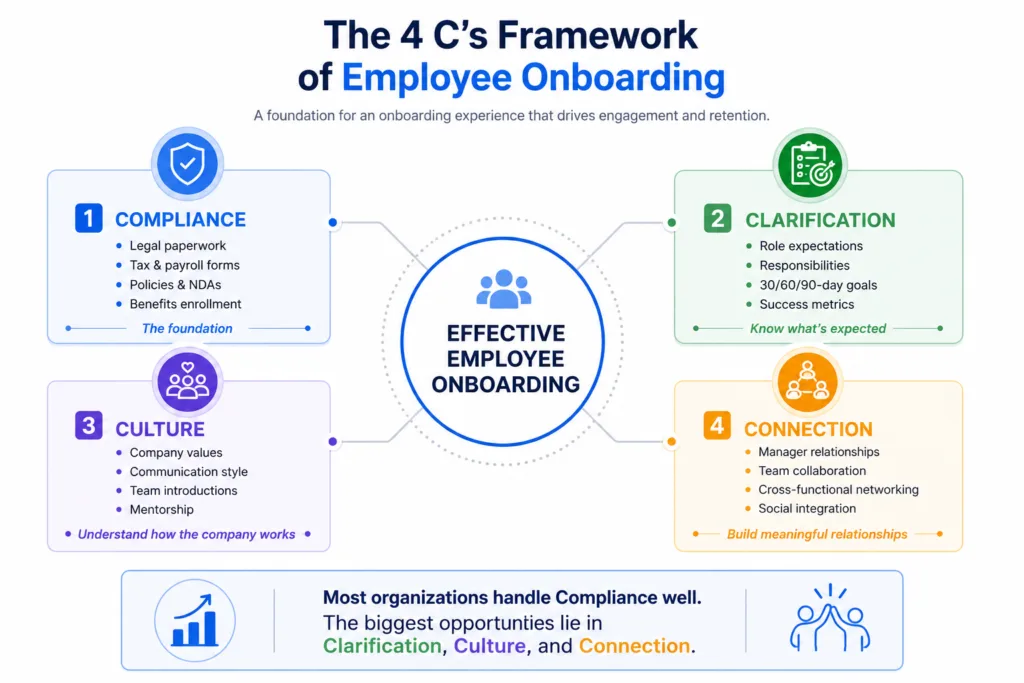
The 4 C’s Framework: A Foundation for Your Onboarding Checklist
Before getting into the phase-by-phase checklist, it helps to understand the framework behind effective onboarding. Dr. Talya Bauer, in research for the SHRM Foundation, identified four levels of onboarding known as the “4 C’s”:
1. Compliance
This is the basics: legal paperwork, policy acknowledgments, tax forms, and regulatory requirements. In India, this includes PF enrollment, ESI registration, Form 11 declarations, and gratuity nominations. Globally, it covers contracts, NDAs, benefits enrollment, and safety training. Compliance is the floor of onboarding, not the ceiling.
2. Clarification
Making sure the new hire genuinely understands their role, responsibilities, and what success looks like. This means giving them a clear job description, explaining who they report to, walking through what you expect from them at 30/60/90 days, and showing how their work connects to team and company goals.
3. Culture
Introducing the new employee to the company’s values, norms, communication style, and unwritten rules. Culture onboarding happens through team introductions, shadowing opportunities, mentorship pairings, and participation in meetings and events.
4. Connection
Helping new hires build relationships with colleagues, managers, and people outside their immediate team. Research consistently shows that employees who form meaningful workplace connections early on are more engaged and more likely to stick around. Gallup has found a strong link between having close relationships at work and overall engagement.
Most companies handle Compliance well enough. Where they tend to fall short is on Clarification, Culture, and Connection. A strong onboarding checklist addresses all four levels on purpose, not by accident.
The Complete Employee Onboarding Checklist (Phase by Phase)
Phase 1: Preboarding (Offer Accepted to Day 1)
Preboarding is the period between the signed offer letter and the first day. This phase is where a lot of companies drop the ball. They go silent after the offer, and the new hire shows up on Day 1 to a half-prepared setup.
High-performing organizations are significantly more likely to engage new hires before their start date. A little preparation here goes a long way in making someone feel expected.
HR Tasks
- ☐ Send the signed offer letter and collect digital acceptance
- ☐ Send a welcome email with Day 1 logistics: date, time, location, dress code, what to bring, parking or transit info, and who to ask for at reception
- ☐ Collect required documents: identity proof (Aadhaar/PAN in India, passport or driver’s licence elsewhere), educational certificates, previous employer relieving letter, bank account details for salary deposit
- ☐ Kick off background verification and reference checks
- ☐ Enroll the new hire in payroll and benefits systems
- ☐ Prepare the employment contract and any NDAs for signing on Day 1
- ☐ Assign a buddy or onboarding mentor from the team
- ☐ Add the new hire to the onboarding schedule and let all stakeholders know
IT and Admin Tasks
- ☐ Set up company email, communication tools (Slack, Teams), and project management access
- ☐ Provision a laptop or desktop with all required software installed
- ☐ Create login credentials for every system they will need (HRMS, CRM, ERP, cloud storage)
- ☐ Prepare the physical workstation (for in-office employees) or ship the welcome kit (for remote employees)
- ☐ Set up access badges, key cards, or VPN credentials
Manager Tasks
- ☐ Review the new hire’s resume, interview notes, and role expectations
- ☐ Draft a 30-day plan with initial projects and learning milestones
- ☐ Tell the team about the new hire’s arrival and their role
- ☐ Schedule one-on-one introductions with key team members for the first week
Phase 2: Day 1 (Making the First Day Count)
The first day shapes how a new employee feels about the company for months to come. According to Recruiting Roundtable data, 4% of new hires quit after a terrible first day. The bar on Day 1 is actually pretty low: make the person feel expected, welcomed, and oriented.
HR and Admin
- ☐ Greet the new hire at reception (do not leave them sitting in the lobby wondering what to do)
- ☐ Complete employment contract signing and collect all remaining documents
- ☐ Walk through the employee handbook: leave policy, attendance, code of conduct, grievance mechanisms, anti-harassment policy
- ☐ Explain compensation structure, pay cycle, benefits enrollment, and insurance options
- ☐ Give a proper office tour covering workstation, meeting rooms, pantry, restrooms, and emergency exits
- ☐ Introduce the assigned buddy or mentor
Manager
- ☐ Have a real welcome conversation: share why you are glad they are here, explain team goals, and describe how their role fits into the bigger picture
- ☐ Walk through the first week’s schedule
- ☐ Set expectations for the initial period and let them know that questions are welcomed
- ☐ Introduce the new hire to their immediate team members (in person or via video call)
IT
- ☐ Verify all systems and tools are working: email, chat, project tools, VPN
- ☐ Walk through IT security policies, password protocols, and data handling guidelines
- ☐ Fix any access issues right then, not “sometime this week”
Phase 3: First Week (Building Context and Connections)
The first week is about helping the new hire understand how the organization works, who does what, where to find help, and what their initial priorities are.
- ☐ Run a deeper orientation session: company history, mission, vision, organizational structure, key products and services
- ☐ Schedule one-on-one introductions with cross-functional stakeholders, not just the immediate team
- ☐ Begin role-specific training on tools, processes, systems, and workflows
- ☐ Share access to internal documentation, knowledge bases, wikis, and training materials
- ☐ Assign a small, low-risk starter project to build early confidence (Google does this with all new engineers, and it works)
- ☐ Have daily or every-other-day check-ins between the new hire and their manager
- ☐ Invite the new hire to team meetings, standups, and relevant cross-team sessions
- ☐ Discuss communication norms: preferred channels, meeting cadence, expected response times
Phase 4: First Month (Gaining Momentum)
By the end of the first month, the new hire should be contributing in a meaningful way, even if they are not at full speed yet. Research from Zippia suggests that new employees typically operate at about 25% of their full productivity during the first 30 days. The work this month is about closing that gap steadily.
- ☐ Conduct a formal 30-day check-in meeting with the employee, their manager, and HR
- ☐ Review progress against initial goals and the onboarding plan
- ☐ Ask the new hire for feedback: What is going well? Where do they need more support? Does the role match what they expected?
- ☐ Confirm completion of all mandatory training modules (compliance, safety, tool-specific)
- ☐ Verify all statutory and compliance documentation is complete and filed (especially important in India: PF registration, ESI enrollment, TDS declarations)
- ☐ Begin expanding the scope of work and assigning progressively more complex tasks
- ☐ Introduce the new hire to broader company culture through social events, team lunches, interest groups, or ERGs
India-Specific Onboarding Compliance Requirements
If your company operates in India, your onboarding checklist needs compliance steps that global templates almost always miss. Getting these wrong can lead to penalties, delayed employee benefits, and legal trouble.
Statutory Document Collection
Collect the following from every new employee at the time of joining:
- ☐ PAN Card (mandatory for TDS deduction under Section 192 of the Income Tax Act)
- ☐ Aadhaar Card (required for EPFO KYC seeding and ESI registration)
- ☐ Bank account details (for salary disbursement via NEFT/RTGS)
- ☐ Previous employer relieving letter and experience certificate
- ☐ PF Form 11 (declaration under the Employees’ Provident Funds Scheme, 1952; this tells you whether the employee was a PF member at their previous job and determines whether their account gets transferred or a new one is created)
- ☐ PF Form 2 (nomination for PF and EPS benefits)
- ☐ Gratuity nomination form (Form F under the Payment of Gratuity Act, 1972)
- ☐ Form 12BB (investment declaration so the employer can compute the correct monthly TDS for the financial year)
PF (Provident Fund) Registration
Under the Employees’ Provident Funds and Miscellaneous Provisions Act, 1952, PF registration is mandatory for establishments with 20 or more employees.
- ☐ Generate or link the employee’s Universal Account Number (UAN) on the EPFO employer portal before the first payroll run
- ☐ Seed the UAN with Aadhaar and PAN for KYC compliance
- ☐ Employer contribution rate: 12% of Basic + DA (split as 3.67% to EPF and 8.33% to EPS)
- ☐ Employee contribution rate: 12% of Basic + DA
- ☐ Monthly contributions must be deposited via Electronic Challan cum Return (ECR) by the 15th of the following month
- ☐ Late payment attracts 12% annual interest plus damages of 5% to 25%
ESI (Employee State Insurance) Registration
Under the Employees’ State Insurance Act, 1948, ESI is mandatory for establishments with 10 or more employees (the threshold varies by state).
- ☐ Register employees whose gross monthly salary is at or below ₹21,000 on the ESIC employer portal within 10 days of joining
- ☐ Employer contribution: 3.25% of gross salary; employee contribution: 0.75%
- ☐ Generate the employee’s ESI IP (Insured Person) number
- ☐ ESI provides medical, sickness, maternity, and disability benefits
Professional Tax
Professional Tax rates and applicability vary by state. Check whether your state requires registration and deduction from the employee’s first salary itself.
Probation Period
No central Indian law mandates a probation period, but most companies use one (typically 3 to 6 months). The terms, including notice period, performance expectations, and confirmation process, need to be clearly stated in the appointment letter. If probation ends without a formal confirmation letter being issued, the employee may be treated as confirmed by default under labour tribunal precedent. Do not leave this ambiguous.
Remote and Hybrid Employee Onboarding Checklist
Remote onboarding comes with its own challenges. Gallup found that only 28% of remote workers feel strongly tied to the mission and purpose of their organizations. When you are not sharing a physical space, you have to be much more deliberate about every part of the process.
Atlassian, which has onboarded over 1,200 employees virtually, found that successful remote onboarding comes down to proactive planning, digital-first documentation, and intentional relationship building.
Preboarding (remote-specific)
- ☐ Ship the welcome kit (laptop, peripherals, company swag) well before Day 1 and confirm delivery
- ☐ Test all remote access tools (VPN, cloud apps, video conferencing) before the start date
- ☐ Send a digital welcome packet with team bios, org chart, links to key documents, and communication norms
Day 1 (remote-specific)
- ☐ Start with a video call from the manager or HR, not a wall of Slack messages
- ☐ Walk through a virtual tour of your digital tools and shared workspaces
- ☐ Set up introductory one-on-one video calls with each team member (a group call where the new hire barely speaks is not the same thing)
First Week (remote-specific)
- ☐ Schedule virtual coffee chats with colleagues outside the immediate team
- ☐ Give the onboarding buddy clear instructions to check in daily for the first two weeks
- ☐ Set expectations about camera usage, meeting etiquette, and when to use async vs. sync communication
- ☐ Make sure the new hire joins relevant Slack or Teams channels and understands what each one is for
Ongoing
- ☐ Over-communicate during the first month. Remote hires cannot absorb context through proximity the way office employees do
- ☐ Build in social touchpoints: virtual team lunches, casual Slack channels, interest-based groups
- ☐ Increase check-in frequency to at least weekly during the first month, then move to biweekly
30-60-90 Day Onboarding Plan
Good onboarding does not stop after the first week. Employees who strongly agree they have a clear plan for their professional development are 3.5 times more likely to rate their onboarding as exceptional.
Days 1 to 30: Learn
The first month is about absorption, not peak performance.
- Complete all compliance and admin tasks
- Finish mandatory and role-specific training
- Understand team workflows, tools, and communication norms
- Build relationships with immediate team members and key stakeholders
- Complete the starter project
- 30-day check-in: talk about what they have learned, address confusion, and set goals for the next phase
Days 31 to 60: Contribute
The second month shifts from watching to doing.
- Take ownership of recurring tasks and processes
- Start contributing to team projects independently
- Participate actively in team meetings and brainstorms
- Expand their internal network beyond the immediate team
- Identify areas for improvement or efficiency gains in their own work
- 60-day check-in: evaluate performance against goals, discuss challenges, and refine expectations
Days 61 to 90: Own
By the end of the third month, the employee should be working with increasing independence.
- Own specific deliverables or work streams end to end
- Demonstrate alignment with team goals and company values
- Actively seek and incorporate feedback
- Identify professional development interests and talk about growth opportunities
- 90-day check-in (doubles as the probation review in many Indian companies): formal performance assessment, confirmation decision, and goal setting for the year
Beyond 90 Days: Sustain
Research increasingly points to full integration taking eight to twelve months. Dropping all support abruptly at Day 90 undoes a lot of the work you put in.
- Schedule quarterly check-ins for the first year
- Invite the employee to share feedback on the onboarding process so you can improve it for the next person
- Shift from onboarding into ongoing performance management and career development
Free Employee Onboarding Checklist Template
Below is a ready-to-use template covering each phase. Customize it for your company’s tools, compliance requirements, and team structure.
Employee Name: ___________________________
Department/Team: ___________________________
Reporting Manager: ___________________________
Start Date: ___________________________
Buddy/Mentor Assigned: ___________________________
Preboarding (Before Day 1)
| Task | Owner | Due Date | Status |
|---|---|---|---|
| Send offer letter and collect signed acceptance | HR | Offer date | ☐ |
| Send welcome email with Day 1 logistics | HR | 5 days before start | ☐ |
| Collect identity documents (PAN, Aadhaar, bank details) | HR | 3 days before start | ☐ |
| Set up email and system access | IT | 2 days before start | ☐ |
| Provision laptop with required software | IT | 2 days before start | ☐ |
| Prepare workstation or ship remote kit | Admin/IT | 2 days before start | ☐ |
| Notify team about new hire arrival | Manager | 3 days before start | ☐ |
| Assign onboarding buddy | Manager/HR | 1 week before start | ☐ |
| Add to payroll and benefits systems | HR/Finance | Before first payroll | ☐ |
| Initiate background verification | HR | Offer date | ☐ |
Day 1
| Task | Owner | Due Date | Status |
|---|---|---|---|
| Welcome and reception | HR/Manager | Day 1 | ☐ |
| Sign employment contract and NDA | HR | Day 1 | ☐ |
| Collect PF Form 11, Form 2, gratuity nomination (India) | HR | Day 1 | ☐ |
| Office tour or virtual workspace walkthrough | HR/Buddy | Day 1 | ☐ |
| Employee handbook review | HR | Day 1 | ☐ |
| Verify all IT systems and access working | IT | Day 1 | ☐ |
| Manager welcome meeting (role overview, team goals) | Manager | Day 1 | ☐ |
| Team introductions | Manager/Buddy | Day 1 | ☐ |
Week 1
| Task | Owner | Due Date | Status |
|---|---|---|---|
| Company orientation (mission, values, org structure) | HR | Week 1 | ☐ |
| Role-specific training begins | Manager | Week 1 | ☐ |
| One-on-ones with key stakeholders | Manager | Week 1 | ☐ |
| Assign starter project | Manager | Week 1 | ☐ |
| Review communication norms and tools | Manager/Buddy | Week 1 | ☐ |
| Daily check-ins with manager | Manager | Week 1 | ☐ |
30-Day Check-In
| Task | Owner | Due Date | Status |
|---|---|---|---|
| Formal 30-day review meeting | Manager/HR | Day 30 | ☐ |
| Confirm all mandatory training completed | HR | Day 30 | ☐ |
| Verify statutory compliance docs filed (PF, ESI, TDS) | HR/Finance | Day 30 | ☐ |
| Collect onboarding feedback from new hire | HR | Day 30 | ☐ |
| Set goals for Days 31 to 60 | Manager | Day 30 | ☐ |
60-Day Check-In
| Task | Owner | Due Date | Status |
|---|---|---|---|
| 60-day performance review | Manager | Day 60 | ☐ |
| Assess skill gaps and plan development | Manager | Day 60 | ☐ |
| Expand scope of responsibilities | Manager | Day 60 | ☐ |
| Collect second round of onboarding feedback | HR | Day 60 | ☐ |
90-Day Check-In / Probation Review
| Task | Owner | Due Date | Status |
|---|---|---|---|
| Formal 90-day performance appraisal | Manager/HR | Day 90 | ☐ |
| Probation confirmation decision | Manager/HR | Day 90 | ☐ |
| Issue confirmation letter (if confirmed) | HR | Day 90 | ☐ |
| Set annual performance goals | Manager | Day 90 | ☐ |
| Update HRMS with confirmed status | HR | Day 90 | ☐ |
| Final onboarding feedback survey | HR | Day 90 | ☐ |
How Google, Buffer, and HubSpot Handle Onboarding
Google: Manager Nudges and Starter Projects
Google’s onboarding program for new hires, internally called “Nooglers,” is one of the most studied in the industry. Through their re:Work initiative, Google has publicly shared how they use data to continuously improve the process.
One experiment stood out. The Sunday before a new hire’s start date, Google sent some managers a simple email with an actionable checklist. The email reminded them to have a role-and-responsibilities conversation, match the new hire with a peer buddy, help them build a social network within the company, and set up monthly check-ins for the first six months.
Nooglers whose managers acted on that checklist became fully effective 25% faster than peers whose managers did not receive the email. Google made the nudge system a permanent part of its onboarding after that.
They also assign every new engineer a low-risk “starter project” in their first two weeks. The project gives new hires a sense of accomplishment early and helps them learn the codebase, tools, and team dynamics in a practical way rather than through passive training.
What you can take from this: The nudge email is free. You can set it up with a calendar reminder and a one-page manager checklist. The starter project concept works across all roles, not just engineering.
Buffer: Dual Buddies for Remote Teams
Buffer is a fully remote company that has publicly shared its onboarding process and updates it regularly. New hires get paired with two people: an “Onboarding Buddy” for cultural integration and a “Role Buddy” for job-specific guidance. The first six weeks follow a structured program with weekly goals, and Buffer collects feedback at the end of each week.
Buffer also gives new hires access to company financials, salary data, and decision-making frameworks from Day 1. That level of transparency might not work for every company, but it aligns with Buffer’s values and gives new employees an immediate sense of trust.
What you can take from this: Having two buddies instead of one, one for culture and one for the actual job, addresses both the Culture and Clarification layers of the 4 C’s framework. It costs nothing extra and covers more ground than a single mentor.
HubSpot: Treating Onboarding Like a Product
HubSpot measures NPS (Net Promoter Score) from new hires, tracks completion rates across every onboarding step, and iterates based on that data. Their new employees go through a week-long orientation that includes customer empathy exercises where they actually use HubSpot’s products the way a customer would. Only after that do they move into their specific role training.
HubSpot also maintains a Culture Code document that every new hire reads during their first week. The document gives everyone a shared understanding of how the company operates.
What you can take from this: You do not need HubSpot’s resources. Even a simple 5-question satisfaction survey at 30 and 90 days gives you actionable data to improve. If you are a product company, having new hires use your own product during onboarding builds understanding and surfaces usability problems you might have missed.
Common Onboarding Mistakes and How to Fix Them
1. Treating onboarding as a one-day event
If your “onboarding” wraps up after orientation, you are leaving retention and productivity gains on the table. Effective onboarding takes 90 days at minimum, and full integration realistically takes eight to twelve months.
2. Dumping everything on Day 1
Giving someone every policy, process, and system login in their first two days leads to poor information retention. Space things out across the first month. Make documentation searchable so employees can revisit it when they actually need it.
3. Leaving managers out of the process
Gallup data shows that manager involvement makes onboarding 3.4 times more likely to succeed. When managers see onboarding as “HR’s problem,” the new hire loses the most critical relationship for their early success.
4. Ignoring social integration
Research from Nectar found that 77.6% of employees consider workplace connections important or very important to company culture. Onboarding that only focuses on tasks and training while skipping relationship building misses a major driver of engagement.
5. Using the same checklist for office and remote hires
Remote employees need more frequent check-ins, more deliberate social connection, and clearer communication norms. A Paychex survey found that 52% of employees feel undertrained during onboarding, and the number is higher for remote workers at 63%.
6. Never measuring whether it works
According to Kronos research, more than half of organizations do not measure the effectiveness of their onboarding at all. Without feedback and metrics (time to productivity, 90-day retention rate, new hire satisfaction), you have no way to improve.
7. Delaying compliance paperwork (India-specific)
In India, late PF or ESI registration does not let the employer off the hook. Contributions are owed from the date of joining regardless. Late filing attracts 12% annual interest plus damages between 5% and 25% of the arrears. Build statutory compliance into the first-week checklist. Do not treat it as something you will get to later.
How Onboarding Software Simplifies the Process
Managing onboarding manually with spreadsheets, email chains, and paper forms works up to a point. Once you are hiring more than a handful of people per quarter, the admin load grows fast, and the chance of missing steps goes up with it.
An HRMS with built-in onboarding workflows can automate preboarding tasks like sending welcome emails, collecting documents digitally, and triggering IT setup requests. It tracks task completion across HR, IT, and managers in a single dashboard. It generates statutory forms (Form 11, PF registration, ESI enrollment, Form 12BB) and keeps audit-ready records. It assigns ownership and deadlines for each task with automatic reminders when things are overdue. It also collects feedback through scheduled surveys at the milestones that matter.
The biggest win is consistency. When every hire goes through the same structured workflow, you stop relying on individual managers to remember every step.
Juntrax’s HRMS module is built for growing professional services firms that need onboarding workflows, attendance tracking, leave management, and compliance tools in one integrated platform. If your current process involves chasing managers over email to find out whether a new hire has been set up properly, this kind of tooling takes that coordination off your plate.
Also Read: Employee Engagement: A Comprehensive Guide
FAQs About Employee Onboarding
How long should the employee onboarding process last?
90 days is the minimum. Most research suggests that full integration takes eight to twelve months, though the intensity of the process tapers off after the first quarter. The first week covers logistics and orientation, the first month handles training and relationship building, and the rest of the time is about performance ramp-up and development.
What is the difference between onboarding and orientation?
Orientation is usually a one-day or one-week event focused on admin tasks, policies, and workplace logistics. Onboarding is a longer, more strategic process that includes orientation but extends to role training, culture integration, relationship building, and performance milestones over several months.
What documents are mandatory for employee onboarding in India?
At minimum: PAN card (for TDS), Aadhaar card (for EPFO KYC), bank account details (for salary transfer), PF Form 11 (EPF declaration), PF Form 2 (nomination), gratuity nomination form, and Form 12BB (investment declaration for TDS computation). Additional documents may be needed depending on the role and industry.
What is Form 11 in employee onboarding?
Form 11 is a declaration under the Employees’ Provident Funds Scheme, 1952. Every new employee submits it when they join. It tells the employer whether the employee was a PF member at their previous job. If they were, it enables a PF account transfer. If not, a fresh PF account is created.
Who is responsible for onboarding: HR or the manager?
Both, along with IT. HR handles compliance, documentation, policy orientation, and process coordination. The manager handles role-specific training, goal setting, team integration, and ongoing check-ins. IT handles systems and access. The most effective programs hold all three accountable through a shared checklist.
How do you onboard remote employees effectively?
Ship equipment early. Test access before Day 1. Assign a dedicated onboarding buddy. Use video calls instead of text-only messages for the first week. Schedule deliberate social touchpoints. Increase check-in frequency to at least weekly during the first month. Remote hires need more structure than office hires because they do not pick up on context through proximity.
How do you measure onboarding effectiveness?
Track these: 90-day retention rate, time to full productivity, new hire satisfaction score (via surveys at 30, 60, and 90 days), manager satisfaction with new hire readiness, and task completion rate across the onboarding checklist. Compare over time and act on what the data tells you.
Does good onboarding actually reduce turnover?
Yes, research suggests that strong onboarding improves new hire retention by 82%. O.C. Tanner data shows employees with a great onboarding experience are 69% more likely to stay beyond three years. Your 90-day turnover rate is one of the clearest signals of how well your onboarding is working.