
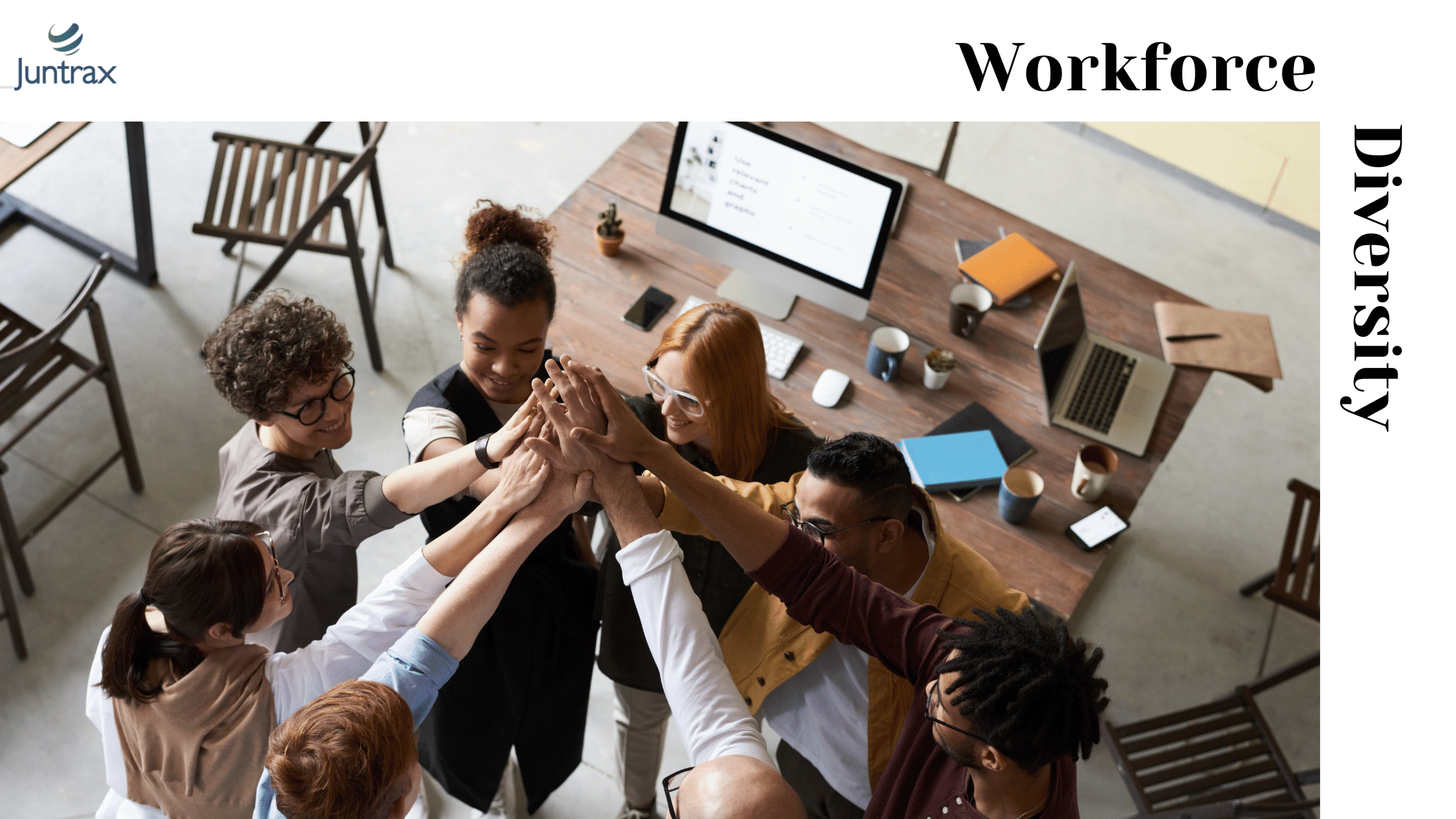
Most professional services firms in India and the GCC are already running a diverse workforce, whether they planned for it or not. Different nationalities, age groups, languages, locations, and skill backgrounds sit on the same project team every day. So the real question is rarely whether you have workforce diversity. It is whether you are managing it well, and whether you can show what it is doing for the business.
This guide covers what workforce diversity means, the main types, why it matters, where the evidence is strong and where it is weaker than people claim, and how firms running billable teams across locations can manage a diverse workforce day to day without drowning in admin.
What Is Workforce Diversity?
Workforce diversity is the range of differences and similarities among the people an organization employs. It covers visible characteristics such as age, gender, ethnicity, and nationality, and less visible ones such as religion, sexual orientation, disability, education, socio-economic background, language, and ways of thinking.
In plain terms, a diverse workforce reflects the variety of the society and markets it operates in, rather than a single narrow profile of a person. The understanding of the term has widened over time. It once centred mostly on gender and race. Today, it includes a much broader set of dimensions, from generational differences to neurodiversity to functional and educational background.
It helps to separate two ideas that often get blurred. Diversity is about who is in the room. Inclusion is about whether those people can contribute, are heard, and want to stay. You can hire a varied team and still run an exclusive culture, which is why representation numbers on their own do not tell you much.
What Is The Goal Of Workforce Diversity?
The goal of workforce diversity is to build a team where a wide mix of perspectives and experiences improves how the organization thinks, decides, serves clients, and grows, while every employee feels respected and able to do their best work. For a project-driven firm, that translates into sharper problem-solving on client work, a wider talent pool to staff from, and a workforce that mirrors the markets you sell into.
Diversity, Inclusion, Equity, And Belonging: What The Terms Mean
These four words get used as if they are interchangeable. They are not, and treating them as the same thing is one reason diversity programs stall.
- Diversity is the mix itself. The presence of people with different identities, backgrounds, and perspectives across the organization, including at senior levels.
- Inclusion is whether that mix is put to use. Do people get to speak, influence decisions, and access the same information and opportunities?
- Equity is about fair treatment given different starting points. It looks at whether policies, pay, and progression are fair in practice, not just in theory.
- Belonging is the felt experience. Whether people feel accepted and valued for who they are, which is closely tied to whether they stay.
A firm can score well on diversity and poorly on the other three. Getting the mix right is the entry point, and the rest is where the value either materializes or leaks away.
Types Of Workforce Diversity
Workforce diversity goes well beyond gender and race. These are the dimensions most firms track or should consider.
| Type | What It Covers |
| Cultural and ethnic diversity | Differences in culture, ethnicity, and nationality. Common in GCC firms where one project team can include a dozen nationalities. |
| Gender diversity | Balanced representation across genders, including at management and leadership levels. |
| Age and generational diversity | A multigenerational team, from early-career hires to experienced senior staff, each with different working styles and expectations. |
| Disability diversity | Including people with physical, sensory, or cognitive disabilities, supported by reasonable accommodations. |
| Sexual orientation and gender identity | A workplace that respects and supports LGBTQ plus employees through fair, non-discriminatory policies. |
| Educational and socio-economic diversity | Varied degrees, institutions, training routes, and economic backgrounds that shape how people approach problems. |
| Cognitive and neurodiversity | Different thinking styles and neurological profiles, including conditions such as ADHD and dyslexia, that bring distinct strengths. |
For service firms, two of these tend to matter more than the rest, day to day. Cultural and national diversity drives how teams communicate and how you stay compliant across locations. Generational diversity shapes how you onboard, train, and retain people, because a recent graduate and a twenty-year veteran rarely want the same things from work.
Why Workforce Diversity Matters: The Business Case And Its Limits
The case for diversity is usually made with a wall of statistics. Some of those numbers are solid and well-sourced. Others get repeated so often that nobody checks where they came from. Here is the honest version.
The most cited research is McKinsey’s long-running diversity series. Its 2023 study, Diversity Matters Even More, found that companies in the top quartile for gender diversity on executive teams were 39 percent more likely to financially outperform those in the bottom quartile, with the same 39 percent likelihood for ethnic diversity. On innovation specifically, Boston Consulting Group’s study of 1,700 companies across eight countries, How Diverse Leadership Teams Boost Innovation, reported that firms with above-average management diversity earned innovation revenue 19 percentage points higher than less diverse firms, 45 percent of total revenue against 26 percent.
Beyond the headline numbers, the practical benefits show up in a few consistent ways:
- Better problem solving and decisions. Teams that bring different experiences tend to question assumptions and consider a wider set of options, which matters on complex client work.
- A wider talent pool. Hiring across backgrounds, generations, and locations gives you more people to staff projects from, which is a real constraint for growing firms.
- Stronger client and market fit. A team that reflects your client base understands it better, which helps in markets as varied as India and the Gulf.
- Attraction and retention. Many candidates weigh inclusion when choosing employers, and people who feel they belong are more likely to stay, which lowers the cost of churn on billable teams.
These studies show correlation and not proof of cause and effect. A diverse leadership team and strong financial performance can both be results of a well-run company rather than one causing the other. Some academic researchers have questioned whether the McKinsey results replicate on other datasets. None of this means diversity does not help. It means you should treat the numbers as supportive evidence rather than a guarantee and build your own case around your own goals.
Workforce Diversity In India And The GCC
Generic diversity advice tends to assume a Western workplace. For firms operating in India and the Gulf, the realities are different and, in some ways, more demanding.
In the GCC, national diversity is the defining feature of the workforce. The Gulf states together host one of the largest migrant populations in the world. According to the Migration Policy Institute, foreign nationals made up more than half of the region’s total resident population, with around 30 million foreign nationals as of 2020. In countries such as the UAE, the private-sector workforce is overwhelmingly expatriate, drawn from South Asia, the wider Arab world, Africa, Europe, and beyond. An engineering or consulting firm in Dubai or Riyadh can easily field a single project team with ten or more nationalities, several first languages, and multiple faiths.
On top of that, Gulf governments run workforce nationalization programs, known as Emiratisation in the UAE, Saudization in Saudi Arabia, and their equivalents in Qatar, Oman, Bahrain, and Kuwait. These set targets and quotas for hiring nationals, often by sector and company size, with penalties for non-compliance. For a project-driven firm, this means the national mix is not only a diversity question but a compliance and reporting one. You need to know your workforce composition accurately and at all times.
In India, the diversity picture is led by gender and generation. India’s IT and business-services sector has made real progress on gender. Industry body NASSCOM reports that women make up around 34 percent of the IT-BPM workforce, roughly 1.3 million people, and account for about 51 percent of entry-level hiring. That is well ahead of the national picture. The World Economic Forum’s Global Gender Gap Report 2025 ranked India 131st of 148 countries, with economic participation among its weakest areas. India is also young and multigenerational, multilingual across states, and increasingly distributed across offices and remote teams. A consultancy headquartered in Bengaluru may run teams across several states, time zones, and client sites.
Put together, the message for firms in these markets is simple. You are not deciding whether to have a diverse workforce. You already have one. What you decide is how well you manage it, stay compliant, and turn it into an advantage.
Common Challenges Of A Diverse Workforce
A diverse team does not automatically perform better. Without the right support, differences can create friction. These are the challenges firms run into most often.
- Communication and language gaps: Different first languages and cultural norms can lead to misunderstandings. Clearly written processes and shared working languages help close the gap.
- Unconscious bias: Bias can shape hiring, project staffing, and promotion decisions even with good intentions. Structured processes and awareness training reduce their effect.
- Resistance to change: Some employees see diversity initiatives as a threat to how things have always worked. Explaining the why and tying it to client and business outcomes lowers resistance.
- Coordination across locations and time zones: Distributed and multi-location teams, normal in this sector, make scheduling, leave, and approvals harder to keep consistent.
- Inconsistent policy across regions: Leave rules, holidays, statutory requirements, and pay practices vary by country and state. Applying them unevenly creates unfairness and compliance risk.
- Measuring progress: Many firms cannot say what their workforce composition actually is, let alone whether it is improving. Without data, diversity stays a talking point.
How To Manage A Diverse Workforce
Managing diversity well happens on two levels. There is the cultural and strategic work, which is human and cannot be automated. And there is the operational backbone that makes the cultural work possible.
On the cultural side, the levers are familiar: visible leadership commitment, fair and structured hiring, inclusive everyday management, clear policies on conduct and non-discrimination, and channels for people to be heard. This is the part no software does for you.
The operational side is where a lot of firms quietly struggle, because a diverse, distributed workforce multiplies the admin. You are maintaining accurate employee records across entities and locations. You are running leave and attendance against different regional holiday calendars and statutory rules. You are processing payroll and reimbursements across geographies. You are onboarding people from varied backgrounds and keeping compliance documentation and HR reports clean enough to stand up to an audit or a nationalization filing. When all of that lives in scattered spreadsheets, your HR team spends its time chasing data instead of building an inclusive culture.
This is the gap a unified HRMS is meant to close, and it is where Juntrax HRMS fits for project-driven firms. Paperless onboarding gives every new hire the same clean start regardless of where they join from. Automated leave management and attendance can be configured to the rules and calendars of each location, so a team spread across India and the GCC is handled fairly and consistently. A self-service portal lets employees manage their own attendance, leave, payslips, and personal details in one place, which matters when your people speak different languages and sit in different time zones. Payroll, reimbursements, and HR reporting run from the same system, and because Juntrax keeps your workforce records structured and current, you can actually see your team’s composition rather than guessing at it.
That last point is the quiet advantage. Juntrax does not run your diversity strategy, and it should not pretend to. What it does is remove the operational drag and give you accurate workforce data, so HR has the time and the clarity to focus on the inclusion work that genuinely moves the needle. Because the HRMS sits alongside Juntrax’s project management and cash-flow tools in one platform, the same diverse team you are managing on the HR side is the team you are planning, staffing, and billing on the project side, with no double entry between systems.
How To Measure Workforce Diversity
You cannot manage what you do not measure. A workable starting set of metrics looks like this:
- Representation by dimension and by level. Not just overall headcount mix, but composition at entry, management, and leadership. A diverse base with a uniform leadership team is a warning sign.
- Hiring and promotion rates by group. Where in the funnel do candidates from different backgrounds drop off?
- Retention and attrition by group. Higher churn in one group points to an inclusion problem, not a hiring one.
- Pay equity. Comparable pay for comparable work across groups.
- Compliance metrics. For GCC firms, current national-versus-expatriate ratios against the relevant nationalization targets.
- Inclusion signals. Engagement or belonging scores, gathered through regular pulse surveys, to capture the experience behind the numbers.
The practical barrier is usually data, not intent. If your records are clean and centralized, most of these reports take minutes. If they are scattered, you will not produce them reliably, which is why the operational backbone above matters as much as the strategy.
Final Thoughts
For a project-driven firm in India or the GCC, workforce diversity is less a choice than a starting condition. Your teams are already multinational, multigenerational, and spread across locations. The firms that get value from that are the ones that pair real inclusion work with an operational setup that keeps the data clean, the compliance current, and the admin light.
Get the operational backbone right and your HR team stops firefighting and starts building the culture that turns a diverse workforce into a genuine advantage.
Run your distributed, multi-location team on one platform
Frequently Asked Questions
What Is Workforce Diversity In Simple Terms?
Workforce diversity is the range of differences among the people an organization employs, including age, gender, ethnicity, nationality, religion, disability, education, background, and ways of thinking. A diverse workforce reflects the variety of the society and markets it serves rather than a single narrow profile.
What Are The Main Types Of Workforce Diversity?
The main types are cultural and ethnic diversity, gender diversity, age and generational diversity, disability diversity, sexual orientation and gender identity, educational and socio-economic diversity, and cognitive or neurodiversity. For service firms, cultural and national diversity and generational diversity tend to matter most in daily operations.
Why Is Workforce Diversity Important?
A diverse workforce is linked to better decision making, stronger innovation, a wider talent pool, and a better fit with varied markets. Research from McKinsey and Boston Consulting Group associates greater leadership diversity with higher financial and innovation performance, though these are correlations rather than proof of cause and effect.
What Is The Difference Between Diversity And Inclusion?
Diversity is the mix of people in the organization. Inclusion is whether those people can contribute, are heard, and want to stay. You can have a diverse team and a non-inclusive culture, which is why representation numbers alone do not tell you whether diversity is working.
What Are The Biggest Challenges Of A Diverse Workforce?
Common challenges include communication and language gaps, unconscious bias in hiring and promotion, resistance to change, coordination across locations and time zones, inconsistent policy across regions, and the difficulty of measuring progress without clean workforce data.
How Do You Measure Workforce Diversity?
Track representation by dimension and by level, hiring and promotion rates by group, retention by group, pay equity, compliance ratios where relevant, and inclusion signals such as belonging scores from pulse surveys. Reliable measurement depends on centralized, current employee records.