
Management by objectives is one of the oldest and most widely used goal-setting methods in business. For a professional services firm, where revenue depends on how well people convert their time into billable, well-delivered work, the appeal is clear. MBO connects what each person works on to the targets the business needs to hit. This guide explains what MBO is, how the process works, where it came from, and how to apply it inside a project-driven services business without the common pitfalls.
What Is Management by Objectives (MBO)?
Management by objectives (MBO) is a strategic management method in which managers and employees jointly set specific, measurable objectives, and performance is assessed against those agreed objectives rather than against subjective opinion. The goal is to align each person’s work with the wider goals of the organization, so that individual effort adds up to company results.
The defining idea is participation. Instead of targets being handed down without discussion, employees help define the objectives they will be measured on. That involvement tends to build commitment, because people understand both what they are aiming for and how their work fits the bigger picture.
Where MBO Came From
Management consultant and author Peter Drucker introduced the concept in his 1954 book The Practice of Management. Drucker argued that an organization performs better when its people work toward a common, clearly stated set of objectives rather than reacting to day-to-day instructions. The approach was a move away from purely top-down control toward goal-setting as a shared activity.
Other thinkers built on the idea. George Odiorne developed it further in the 1960s, and management theorists such as John Humble and Douglas McGregor refined how it was applied in practice. Companies, including Hewlett-Packard, adopted MBO and credited it as part of how they ran.
One common point of confusion is worth clearing up. The SMART criteria often taught alongside MBO came later and from a different author. George T. Doran set out the SMART acronym in a 1981 article in Management Review titled “There’s a S.M.A.R.T. Way to Write Management’s Goals and Objectives.” Drucker did not coin SMART. The two ideas pair well, because SMART gives a practical test for writing the kind of objectives MBO depends on, but they have separate origins.
The Three Types of Objectives in MBO
Objectives in an MBO system usually sit at three levels, each feeding the one above it.
- Strategic objectives are long-term goals tied to the organization’s vision, often spanning three to five years. They set overall direction, such as entering a new regional market or reaching a target profit margin.
- Tactical objectives are shorter-term goals that support the strategy, usually owned by a department or team. They translate the long-term direction into work for the next few quarters.
- Operational objectives are the day-to-day goals that keep delivery on track. They are specific to a role or team and focus on consistent, measurable output.
When the three levels line up, a single piece of work can be traced from a person’s weekly task back to a company priority.
The Five Steps of the MBO Process
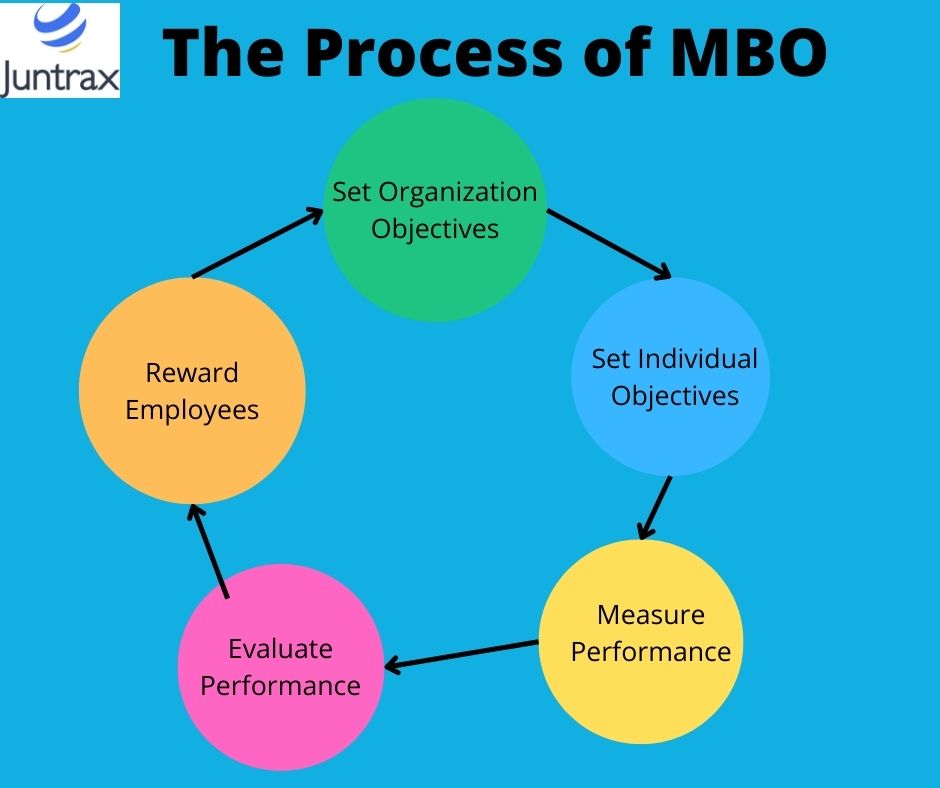
MBO runs as a repeating cycle, typically over a quarter or a year.
- Set organizational objectives. Leadership defines the small number of goals that matter most for the period, grounded in the company’s strategy.
- Cascade objectives to individuals. Managers and employees meet to agree on role-specific objectives that support the company’s goals. Both sides shape the targets, which is what separates MBO from simple target-setting.
- Monitor progress. Managers and employees review progress on a regular cadence, often monthly or quarterly, and adjust where circumstances change.
- Evaluate performance. At the end of the cycle, results are assessed against the objectives set at the start, using measurable outcomes rather than impressions.
- Reward results. Achievement is tied to recognition, bonuses, or development, which reinforces the link between effort and outcome for the next cycle.
The cycle then starts again, with lessons from the last round feeding the next set of objectives. For firms that already run formal reviews, MBO often slots into an existing performance management system rather than replacing it.
Why MBO Fits Project-Driven Service Firms
Most explanations of MBO use generic examples from sales floors and call centres. Project-driven service firms run differently. Their main asset is people, and their economics turn on how much of each person’s available time is spent on billable, well-delivered client work. That makes MBO a natural fit, because the objectives that matter most are already measurable.
The pressure is real. Billable utilization across professional services firms fell to 68.9% in 2024, below the 75% threshold generally considered healthy for profitability, according to SPI Research’s 2025 Professional Services Maturity Benchmark. A few points of utilization, multiplied across a team, move the firm’s margin. MBO gives leaders a structured way to set utilization, delivery, and margin objectives at the level of the individual, then track them through the cycle.
For a services firm, useful MBO objectives tend to cluster around a handful of numbers: billable utilization, project margin, realization rate, on-time milestone delivery, and time-to-fill for staffing roles. These are not abstract. They come straight from timesheets, project records, and billing data, which means progress can be reviewed with facts instead of guesses.
MBO Objectives by Role in a Professional Services Firm
The table below shows how a single company priority can cascade into role-level objectives, and where the data to measure each one comes from.
| Role | Example MBO Objective | How It Is Measured | Where the Data Lives |
| Managing Director or Founder | Lift firm-wide project margin to 35% for the year | Blended margin across active projects | Project and finance records |
| Project Manager | Deliver 90% of project milestones on or before schedule | Milestones met versus planned | Project plans and timesheets |
| Consultant or Engineer | Reach 75% billable utilization across the quarter | Billable hours divided by available hours | Approved timesheets |
| Finance Head | Cut average invoice cycle from 21 to 10 days | Days from milestone to invoice issued | Billing and receivables data |
| HR Head | Reduce average time-to-fill from 30 to 20 days | Days from requisition to accepted offer | Recruitment records |
Building the table this way exposes a practical problem. The objectives depend on data that often sits in separate tools, which is why measurement, not goal-setting, is where many MBO programs stall.
MBO Examples for Services Firms
The following examples show MBO applied across the kinds of firms that run on billable project work.
IT and Software Consulting
An IT consulting practice sets a company objective to raise billable utilization from 68% to 75% over two quarters. That cascades into team objectives to cut bench time between client engagements, and individual objectives for consultants to log and submit timesheets within 24 hours so utilization is visible in near real time.
Engineering Consultancy (EPC, MEP, Structural)
An engineering consultancy sets an objective to keep the project margin above 35% on fixed-price work. Project managers take on objectives to flag scope changes before they erode the budget, while delivery leads own milestone objectives tied to client-approved schedules. Capacity is the constraint here, so many firms pair MBO with structured capacity planning to keep targets realistic.
Legal Firm
A legal firm sets an objective to improve its realization rate, the share of worked hours that is billed and collected. Fee earners take on objectives to capture time daily rather than reconstructing it at month-end, since late time capture is a common source of lost revenue.
Staffing and Recruiting
A staffing firm sets an objective to reduce the average time-to-fill from 30 days to 20 days. Recruiters own individual objectives for candidate response time and submission quality, both of which feed the firm-wide fill rate.
Marketing and Branding Agency
An agency sets an objective to keep over-servicing below 10% of retainer hours. Account leads take on objectives to review logged hours against retainer scope each week, so the firm protects margin without surprising the client at renewal.
Benefits of MBO
When MBO is run well, the benefits are consistent across firm types.
- Alignment. Every objective traces back to a company priority, which reduces wasted effort and keeps teams pulling in the same direction.
- Accountability. Because objectives are specific and measurable, ownership is clear, and progress is hard to dispute.
- Motivation. People who help set their own targets tend to commit to them more strongly than to targets imposed from above.
- Fair evaluation. Reviews rest on agreed, measurable outcomes, which removes much of the subjectivity from appraisals.
- Better communication. The regular review cadence creates a built-in rhythm for managers and employees to discuss progress and obstacles.
The Limits and Risks of MBO
MBO has well-documented weaknesses, and ignoring them is how programs fail.
The most important critique comes from quality expert W. Edwards Deming, who warned that numerical targets push people to hit the number by whatever means available, sometimes at the cost of quality. In a services firm, a utilization target chased without judgment can encourage padded timesheets or low-value billable work that damages client trust. The fix is to balance quantitative objectives with qualitative ones, such as client satisfaction and delivery quality.
Other limits are worth planning around:
- Rigidity. Objectives fixed at the start of a cycle can become stale when client priorities or project scope shift mid-quarter. Build in a review point to adjust them.
- Short-term focus. A heavy emphasis on near-term targets can crowd out longer investments like capability building or client relationships.
- Administrative load. Setting, tracking, and reviewing objectives for every person takes time, and the effort is wasted if the data has to be assembled by hand each cycle.
- Dependence on communication. The method relies on honest, regular conversation between managers and employees. Where that breaks down, objectives drift out of alignment.
MBO vs OKR vs Balanced Scorecard vs SMART Goals
MBO is one of several goal-setting frameworks, and the differences matter when choosing an approach.
| Attribute | Management by Objectives (MBO) | Objectives and Key Results (OKR) | Balanced Scorecard (BSC) | SMART Goals |
| Primary focus | Individual performance against agreed objectives | Ambitious team alignment and stretch | Organizational strategy across multiple lenses | Clarity of a single goal |
| Goal-setting style | Collaborative, manager and employee | Often bottom-up, frequently revised | Structured around four perspectives | A test for writing any goal |
| Measurement | Outcomes versus objectives | Quantifiable key results | Financial, customer, process, learning | Specific, measurable criteria |
| Adaptability | Moderate, set per cycle | High, usually quarterly | Moderate | Varies by use |
| Typical cycle | Annual or quarterly | Quarterly | Varies | Varies |
OKRs tend to suit fast-changing teams that want stretch goals, while MBO suits firms that want each person’s targets tied cleanly to outcomes and rewards. The Balanced Scorecard works at the strategic level across the whole organization. SMART is not a competing system at all; it is a way to write the objectives that any of the others rely on.
Best Practices for Making MBO Work
A few habits separate MBO programs that stick from those that quietly fade.
- Tie every objective to a company goal. If an objective does not support a stated priority, question whether it belongs.
- Keep the number of objectives small. A handful of meaningful objectives per person beats a long list nobody can act on.
- Write objectives to the SMART test. Specific, measurable, achievable, relevant, and time-bound objectives are easier to track and fairer to review.
- Review on a regular cadence. Monthly or quarterly check-ins keep objectives current and catch problems early.
- Balance numbers with quality. Pair output targets with measures of client satisfaction and delivery standards so the numbers are not gamed.
Running MBO on One System
The hardest part of MBO in a services firm is not setting objectives. It is measuring them. Utilization sits in timesheets, margin sits in project and finance records, and review history sits in the appraisal process. When those live in separate tools, every cycle starts with someone stitching spreadsheets together, and the data is often out of date by the time it is reviewed.
This is where an integrated platform helps. Juntrax brings projects, time tracking, and performance management into one system, so utilization, project, and delivery objectives can be tracked from the same data they come from. The PSA module covers project and time data, while the HRMS supports goal-setting, reviews, and rewards. Firms working through how they allocate people across projects often start with a clear resource management system and layer MBO objectives on top.
Frequently Asked Questions
What Are the Three Types of Objectives in MBO?
MBO objectives fall into three levels. Strategic objectives are long-term goals tied to the company’s vision, usually spanning several years. Tactical objectives are shorter-term goals owned by departments or teams that support the strategy. Operational objectives are day-to-day goals specific to a role or team. Each level should feed the one above it.
What Are the Five Steps of the MBO Process?
The cycle has five steps: set organizational objectives, cascade them into agreed individual objectives, monitor progress on a regular cadence, evaluate performance against the objectives at the end of the cycle, and reward results. The cycle then repeats, with lessons feeding the next round.
Who Developed Management by Objectives?
Peter Drucker introduced the concept in his 1954 book The Practice of Management. It was later developed by figures such as George Odiorne, John Humble, and Douglas McGregor, and adopted by companies including Hewlett-Packard.
Is MBO the Same as SMART Goals?
No. MBO is a management method for setting and reviewing objectives collaboratively. SMART is a separate test for writing clear goals, set out by George T. Doran in 1981. They are often used together because SMART helps write the objectives MBO depends on, but they have different origins.
What Is the Difference Between MBO and OKR?
Both align individual work with company goals. MBO ties each person’s objectives to outcomes and rewards, usually on an annual or quarterly cycle. OKRs are often more ambitious and revised more frequently, with stretch objectives broken into measurable key results. OKRs suit fast-changing teams, while MBO suits firms that want clear, reward-linked accountability.
How Do Professional Services Firms Use MBO?
Services firms tend to set MBO objectives around billable utilization, project margin, realization rate, on-time delivery, and time-to-fill. These come directly from timesheets, project records, and billing data, which makes them straightforward to measure when those systems are connected.